Honda
HONDA
WHAT'S IN STORE FOR '84
Honda has more of everything. The fastest is faster, the quickest is quicker, the biggest is bigger.
Performance has never had a bad name, but a look at the 1984 Honda street bikes gives performance a much better name. A quick review of history, or at least last year, brings to mind all those new Honda engines. There were V-Twins in new directions, and tidy inline Fours with low maintenance features, and of course there was the Interceptor. There were also a couple holes, however small, in the Honda lineup.
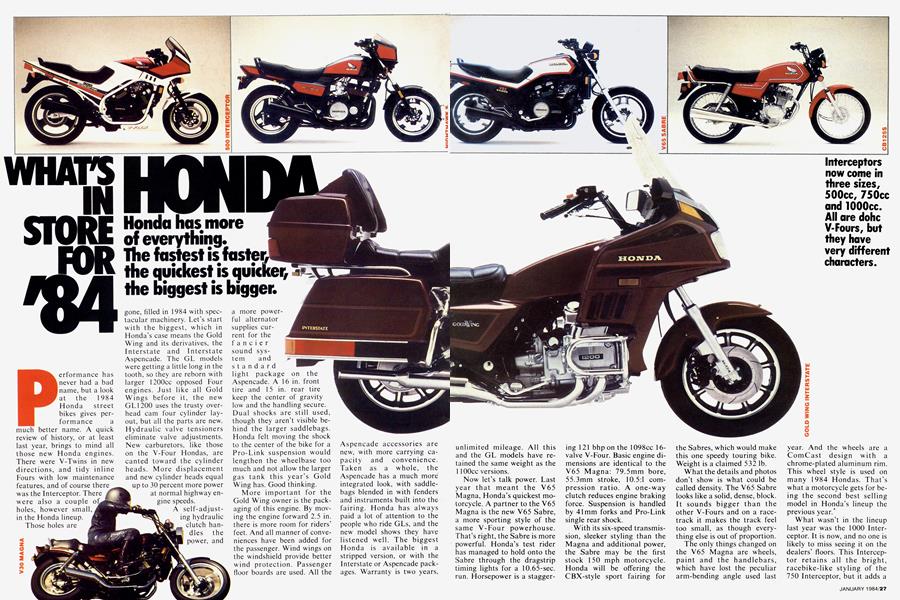
Those holes are gone, filled in 1984 with spectacular machinery. Let's start with the biggest, which in Honda’s case means the Gold Wing and its derivatives, the Interstate and Interstate Aspencade. The GL models were getting a little long in the tooth, so they are reborn with larger 1200cc opposed Four engines. Just like all Gold Wings before it, the new GL1200 uses the trusty overhead cam four cylinder layout, but all the parts are new. Hydraulic valve tensioners eliminate valve adjustments. New carburetors, like those on the V-Four Hondas, are canted toward the cylinder heads. More displacement and new cylinder heads equal up to 30 percent more power at normal highway engine speeds.
A self-adjusting hydraulic clutch handles the power, and a more powerful alternator supplies current for the fancier sound system and standard light package on the Aspencade. A 16 in. front tire and 15 in. rear tire keep the center of gravity low and the handling secure. Dual shocks are still used, though they aren't visible behind the larger saddlebags. Honda felt moving the shock to the center of the bike for a Pro-Link suspension would lengthen the wheelbase too much and not allow the larger gas tank this year’s Gold Wing has. Good thinking.
More important for the Gold Wing owner is the packaging of this engine. By moving the engine forward 2.5 in. there is more room for riders’ feet. And all manner of conveniences have been added for the passenger. Wind wings on the windshield provide better wind protection. Passenger floor boards are used. All the Aspencade accessories are new, with more carrying capacity and convenience. Taken as a whole, the Aspencade has a much more integrated look, with saddlebags blended in with fenders and instruments built into the fairing. Honda has always paid a lot of attention to the people who ride GLs, and the new model shows they have listened well. The biggest Honda is available in a stripped version, or with the Interstate or Aspencade packages. Warranty is two years, unlimited mileage. All this and the GL models have retained the same weight as the 1 lOOcc versions.
Interceptors now come in three sizes, 500cc, 750cc and 1OOOcc. All are dohc V-Fours, but they have very different characters.
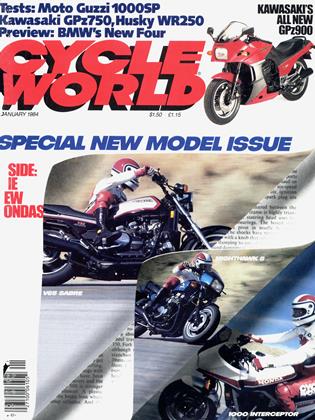
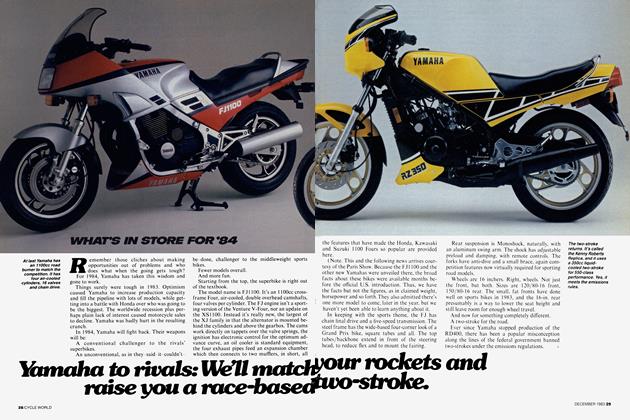
Now let’s talk power. Last year that meant the V65 Magna, Honda’s quickest motorcycle. A partner to the V65 Magna is the new V65 Sabre, a more sporting style of the same V-Four powerhouse. That’s right, the Sabre is more powerful. Honda’s test rider has managed to hold onto the Sabre through the dragstrip timing lights for a 10.65-sec. run. Horsepower is a staggering 121 bhp on the 1098cc 16valve V-Four. Basic engine dimensions are identical to the V65 Magna: 79.5mm bore, 55.3mm stroke, 10.5:1 compression ratio. A one-way clutch reduces engine braking force. Suspension is handled by 41mm forks and Pro-Link single rear shock.
With its six-speed transmission, sleeker styling than the Magna and additional power, the Sabre may be the first stock 150 mph motorcycle. Honda will be offering the CBX-style sport fairing for the Sabres, which would make this one speedy touring bike. Weight is a claimed 532 lb.
What the details and photos don’t show is what could be called density. The V65 Sabre looks like a solid, dense, block. It sounds bigger than the other V-Fours and on a racetrack it makes the track feel too small, as though everything else is out of proportion.
The only things changed on the V65 Magna are wheels, paint and the handlebars, which have lost the peculiar arm-bending angle used last year. And the wheels are a ComCast design with a chrome-plated aluminum rim. This wheel style is used on many 1984 Hondas. That’s what a motorcycle gets for being the second best selling model in Honda’s lineup the previous year.’
What wasn’t in the lineup last year was the 1000 Interceptor. It is now, and no one is likely to miss seeing it on the dealers' floors. This Interceptor retains all the bright, racebike-like styling of the 750 Interceptor, but it adds a 998cc V-Four engine with 113 bhp. Honda says 10sec. quarter-mile times will be easy with this bike.
Radial four-valve heads have been added to the all-new XR250 and XR200. There's a new dual-purpose mount in the Honda stable, the XL350.
It looks just like the smaller Interceptor, but the engine sits lower in the new frame, and the ower radiator has been replaced by a fairingmounted aluminum radiator. The fairing is larger, for more protection, and the handlebars are higher and adjustable. It gets a 17-in. rear tire to go with the 16 - in. front tire.
Up front there’s a new-style fork brace and new double piston brake calipers on the 41mm forks, along with a new style of anti-dive with easier adjustment. Damping adjustments are quickly set by twisting knobs on the top of the fork legs, and with a new remote damping adjustment found on the Pro-Link single rear shock.
Engine dimensions are 77mm bore and 53.6mm stroke. Compression ratio is 10.5:1. Four 36mm CV carburetors are used. Final drive is an O-ring sealed chain and the transmission has five speeds.
A brief ride on the 1000 Interceptor was revealing. It has much more of a big-bike feel than the smaller 750 Interceptor, even though it only weighs about 20 lb. more, according to Honda.
Another Interceptor has no feeling of bulk or large size. That’s the 500 Interceptor, the smallest of the three. This is the jewel of the family. The 500 has the same sleek styling of the bigger Interceptors. It has a V-Four 16-valve engine with liquid cooling and it has chain final drive. The frame is square section steel tubing and the tires are 16-in. front and 18-in. rear. Engine redline is 12,500 rpm. Six transmission speeds keep it on the boil. The short 44mm stroke (bore is 60mm) keeps piston speeds down at high rpm.
What the numbers don’t convey is the wonderful feeling of light weight and responsiveness that the 500 Interceptor imparts. Without ever being difficult to ride, it somehow feels as though it belongs on a racetrack. It’s lively and fun and very, very fast. Honda says the 500 Interceptor can walk all over any 550cc Suzuki or Kawasaki.
A different styled version of the same bike is the V30 Magna. It’s the only Magna with chain final drive, and it has the rest of Magna styling with 500cc Interceptor mechanicals. Horsepower is down to 64, from the Interceptor’s 68, due to different exhaust tuning. Magna styling means dual shocks and small 3.6-gal. gas tank, along with the chromed aluminum wheels, 18-in. front and 16-in. rear.
Interceptors aren’t the only fast Hondas. There’s a new Nighthawk in k84, very different from any Nighthawk Honda has made. This is the Nighthawk S, a 700cc inline Four, with shaft drive, 16 valves and 80 horsepower packed in a 470-lb. package. The front tire is a 16in. and sois the rear. Last year’s 650 Nighthawk was such a success that the larger bike is based on it. But it’s not just a big piston version of the same machine. All the parts are larger,, expecially the clutch, but the layout is the same, with the alternator behind the cylinders for a narrow engine, and the hydraulic valve adjusters eliminating that maintenance chore. The Nighthawk is a wet sump engine, but part of. that sump is the frame. Tubes connect the engine to the frame, and the oil cooler has small couplings running directly to the frame, eliminating any external oil lines to the oil cooler. Neat.
This Nighthawk is a sportylooking machine, with two* tone paint, flatter seat and straighter handlebars than previous Nighthawks. It has triple disc brakes, a 59-in. wheelbase and dual shocks. Gas tank size is 4.2-gal. There’s even a small quarterfairing. More than just the styling identifies this as a sports bike. A quick ride demonstrates the powerful, responsive engine and the quick, nimble handling. It is an easy bike to ride fast on a racetrack, with the shaft drive effects well controlled.
The 650 Nighthawk is back, with new paint and a more powerful alternator.
Just as the big Nighthawk is a 700cc bike, so are the Magna and Sabre and Shadow. These were 750cc machines last year, but to avoid paying extra import duties, engine sizes were reduced below the 700cc limit. The Sabre is the most improved model of the three, with a new seat, new instruments and new exhaust. A shorter 45.4mm stroke takes care of reducing engine size on the V-Four models, and a smaller 76.5mm bore is used on the Shadow.
The Shadow 500, and its more sporting sibling, the VT500 Ascot are continued with new colors and a vacuum petcock on the Ascot. The small V-Twin engine stays the same.
Honda’s street bike lineup includes only one other motorcycle, the CB125. Last year, you may recall, the 125 was out of the lineup. This year everything else small is omitted and the 125 is back, still basic transportation in a a cleanbut-sporting package.
Obviously lots of Hondas are missing this year. There is no Turbo. There are no Hawks. The CX650 models are gone, and so are the old CB750 and 1100 models. The Twin Star small Twins have disappeared, along with the single-cylinder Ascot, the Passport and the MB5.
This is realism. Small bikes have sat unbought in the warehouses, while dealers have faced model lineups of 50 machines. All those models have made parts supplies difficult to manage, too. This is a trend followed by all the big manufacturers this year. Leftover small bikes, with discounted prices, are still available. Instead of adding to the surplus, the bikes offered by Honda are the models that have sold well, plus some models people have asked for.
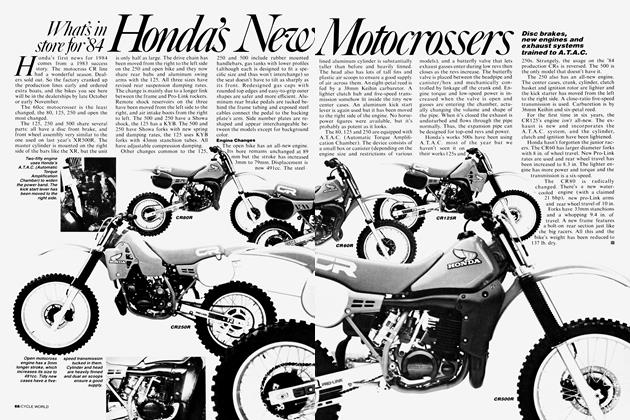
Honda’s motocrossers you read about in the November Cycle World, but the other off-road models and dual purpose models have their own share of novelty.
There’s a completely new XR200R and XR250R. Both have a scaled-downXR500R appearance, right down to their Radial Four Valve Combustion (RFVC) engine. Both engines are the same except for the bore, which measures 75.0mm on the 250 and 67.0mm on the 200. Stroke for both is 56.5mm. The new engine replaces Honda’s dated XR200 engine, which started life as a 100, and the old XR250’s engine that was actually a smaller bore 500.
The new 200/250 engine is designed after Honda’s latest 350 and 500 RFVC engines: four valves are radially placed in the head and activated by a long cam and eight rocker arms. Dual piston-valve carburetors, 20mm on the 200, 24mm on the 250, supply gas, and dual exhaust ports expel what’s left. A wet sump is used on this small RFVC engine. A six-speed transmission, CDI electronic ignition and centrally positioned spark plug are features of the new unit.
Chassis are also shared between the 200 and 250. The frame is highly triangulated and the steering head uses tapered roller bearings. The boxed steel swing arms pivot in needle bearings. Rear suspension is Honda’s Pro-Link system. The shocks have remote oil reservoirs with a knob that adjusts compression damping to any of 16 positions. Rebound damping is adjusted at the bottom of the shock and four settings are furnished. Both models have 10 in. of fork travel although the forks differ in stanchion tube size; the 250 has 38mm tubes, the 200 uses 36mm stanchions.
Seventeen inch rear wheels are shared, as are the rear hub and straight-pull spokes. Twenty-one inch front wheels are standard but front brakes vary; the 200 has a singleleading shoe drum brake, the 250 has a dual-piston hydraulic disc.
Enduro niceties include a resettable odometer combined with a speedometer, quickchange wheels, 35w headlight, 2.6 gal. gas tank, small taillight, big plastic fenders, aluminum skid plate, hand guards, tool bag and spark arrester silencers.
Both have a short 53.5 in. wheelbase. Weight has been kept under control; the 200 has a claimed dry weight of 220 lb., the 250 229 lb.
Honda’s XR500 and 350 remain mostly the same for ’84. The 350 now has a disc front brake. The 350 and 500 get hand guards, better waterproofing, stronger chain guides and tool bags with beefier bottoms. The holes have been eliminated from the shift levers and the silencer bracket on the 500 is stronger and welded to the silencer. A plastic sleeve strengthens the brake hose where it leaves the master cylinder. And the 500 has new damping in the forks. That’s it for them.
The rest of the XR line, the play bike models, 80, 100 and 200, have new decals.
The XL line gets a shot in the arm for ’84. There’s a new XL250R and XL350R based on the XRs. They have all the proper street-legal parts like turn signals (mounted on flexible stalks), larger taillight, quieter silencer, dual-purpose tires, and steel gas tanks. They have Pro-Link rear suspensions (no remote shock reservoir) with 7.5 in. of wheel travel on the 250, 8.1 in. on the 350. Fork travel is 8.7 in. on both models although they have forks with different stanchion tube sizes—35mm for the 200, 39mm on the 350. The 350 has a disc up front, the 250 uses a drum brake. Additionally, the 350 has a 55w halogen headlight while the 250 makes do with a 35w light. Quick-change wheels, aluminum skid plates and a claimed dry weight of 271 lb. (350) and 254 lb. (250) promise these bikes are more dualpurpose than ever before.
The rest of the XL line, 80, 100, 125, 200 and 600, get new decals.