U.S. World Trophy Team Second In Isde; Honda's Youngsters Steal Mx Des Nations And Trophee Des Nations Again
U.S. World Trophy Team Second In Isde; Honda's Youngsters Steal Mx Des Nations And Trophee Des Nations Again
U.S. World Trophy Team Second In ISDE; Honda’s Youngsters Steal MX Des Nations and Trophee Des Nations Again
RACEWATCH
POLITICS STOPS U.S. BID TO WIN ISDE
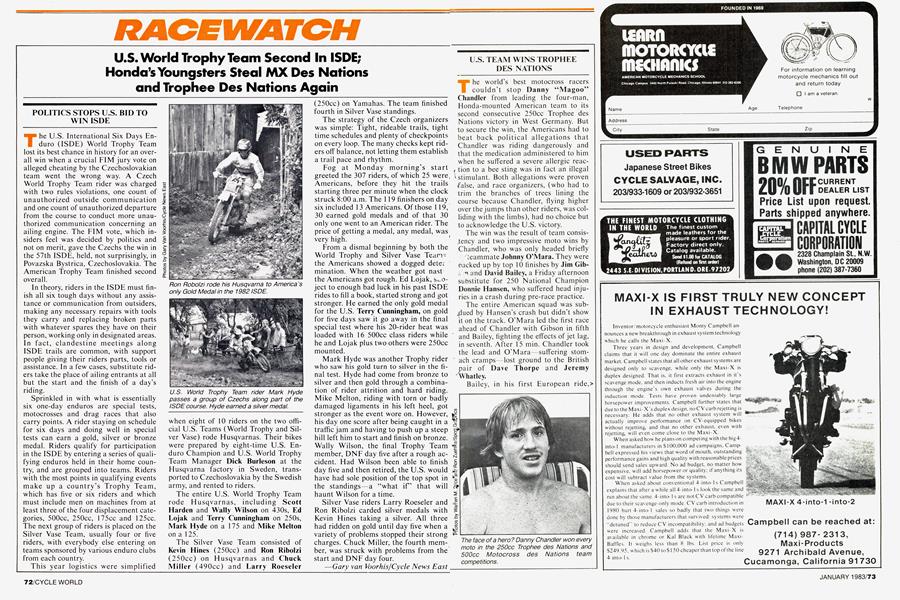
The U.S. International Six Days Enduro (ISDE) World Trophy Team lost its best chance in history for an overall win when a crucial FIM jury vote on alleged cheating by the Czechoslovakian team went the wrong way. A Czech World Trophy Team rider was charged with two rules violations, one count of unauthorized outside communication and one count of unauthorized departure from the course to conduct more unauthorized communication concerning an ailing engine. The FIM vote, which insiders feel was decided by politics and not on merit, gave the Czechs the win in the 57th ISDE, held, not surprisingly, in Povazska Bystrica, Czechoslovakia. The American Trophy Team finished second overall.
In theory, riders in the ISDE must finish all six tough days without any assistance or communication from outsiders, making any necessary repairs with tools they carry and replacing broken parts with whatever spares they have on their person, working only in designated areas.
In fact, clandestine meetings along ISDE trails are common, with support people giving their riders parts, tools or assistance. In a few cases, substitute riders take the place of ailing entrants at all but the start and the finish of a day’s riding.
Sprinkled in with what is essentially six one-day enduros are special tests, motocrosses and drag races that also carry points. A rider staying on schedule for six days and doing well in special tests can earn a gold, silver or bronze medal. Riders qualify for participation in the ISDE by entering a series of qualifying enduros held in their home country, and are grouped into teams. Riders with the most points in qualifying events make up a country’s Trophy Team, which has five or six riders and which must include men on machines from at least three of the four displacement categories, 500cc, 250cc, 175cc and 125cc. The next group of riders is placed on the Silver Vase Team, usually four or five riders, with everybody else entering on teams sponsored by various enduro clubs from each country.
This year logistics were simplified when eight of 10 riders on the two official U.S. Teams (World Trophy and Silver Vase) rode Husqvarnas. Their bikes were prepared by eight-time U.S. Enduro Champion and U.S. World Trophy Team Manager Dick Burleson at the Husqvarna factory in Sweden, transported to Czechoslovakia by the Swedish army, and rented to riders.
The entire U.S. World Trophy Team rode Husqvarnas, including Scott Harden and Wally Wilson on 430s, Ed Lojak and Terry Cunningham on 250s, Mark Hyde on a 175 and Mike Melton on a 125.
The Silver Vase Team consisted of Kevin Hines (250cc) and Ron Ribolzi (250cc) on Husqvarnas and Chuck Miller (490cc) and Larry Roeseler (250cc) on Yamahas. The team finished fourth in Silver Vase standings.
The strategy of the Czech organizers, was simple: Tight, rideable trails, tight time schedules and plenty of checkpoints on every loop. The many checks kept riders off balance, not letting them establish a trail pace and rhythm.
Fog at Monday morning’s start greeted the 307 riders, of which 25 were, Americans, before they hit the trails starting three per minute when the clock struck 8:00 a.m. The 119 finishers on day six included 13 Americans. Of those 119, 30 earned gold medals and of that 30 only one went to an American rider. The price of getting a medal, any medal, was very high.
From a dismal beginning by both the World Trophy and Silver Vase Team1: the Americans showed a dogged dete; mination. When the weather got nast the Americans got rough. Ed Lojak, Sc.oject to enough bad luck in his past ISDE rides to fill a book, started strong and got stronger. He earned the only gold medal for the U.S. Terry Cunningham, on gold for five days saw it go away in the final special test where his 20-rider heat was loaded with 16 500cc class riders while he and Lojak plus two others were 250cc mounted.
Mark Hyde was another Trophy rider who saw his gold turn to silver in the final test. Hyde had come from bronze to silver and then gold through a combination of rider attrition and hard riding. Mike Melton, riding with torn or badly damaged ligaments in his left heel, got stronger as the event wore on. However, his day one score after being caught in a traffic jam and having to push up a steep hill left him to start and finish on bronze. Wally Wilson, the final Trophy Team member, DNF day five after a rough accident. Had Wilson been able to finish day five and then retired, the U.S. would have had sole position of the top spot in the standings—a “what if’ that will haunt Wilson for a time.
Silver Vase riders Larry Roeseler and Ron Ribolzi carded silver medals with Kevin Hines taking a silver. All three had ridden on gold until day five when a variety of problems stopped their strong charges. Chuck Miller, the fourth member, was struck with problems from the start and DNF day four.
—Gary van Voorhis/Cycle News East
U.S. TEAM WINS TROPHEE DES NATIONS
The world’s best motocross racers couldn’t stop Danny “Magoo” Chandler from leading the four-man, Honda-mounted American team to its second consecutive 250cc Trophée des Nations victory in West Germany. But to secure the win, the Americans had to beat back political allegations that Chandler was riding dangerously and that the medication administered to him when he suffered a severe allergic reaction to a bee sting was in fact an illegal 'Stimulant. Both allegations were proven false, and race organizers, (who had to trim the branches of trees lining the course because Chandler, flying higher over the jumps than other riders, was colliding with the limbs), had no choice but to acknowledge the U.S. victory.
The win was the result of team consistency and two impressive moto wins by Chandler, who was only headed briefly Teammate Johnny O’Mara. They were oacked up by top 10 finishes by Jim Gibsi and David Bailey, a Friday afternoon substitute for 250 National Champion Donnie Hansen, who suffered head injuries in a crash during pre-race practice.
The entire American squad was sub.dued by Hansen’s crash but didn’t show it on the track. O’Mara led the first race ahead of Chandler with Gibson in fifth and Bailey, fighting the effects of jet lag, in seventh. After 15 min. Chandler took the lead and O’Mara—suffering stomach cramps—lost ground to the British pair of Dave Thorpe and Jeremy Whatley.
Bailey, in his first European ride,> fought through to sixth ahead of Andre Vromans, Rolf Dieffenbach, George Jobe
and eventual 10th place finisher Jim Gibson.
With British champion Graham Noyce out after a crash the Belgium team posed the only threat to the Americans. And even that threat disappeared when O’Mara led the second moto from Chandler and Belgium rider Jobe crashed in the first turn. Chandler soon took the lead and Andre Vromans relegated O’Mara to third. Bailey was in a secure fifth and Gibson was eighth, ensuring overall victory for America.
AMERICANS DOMINATE MOTOCROSS DES NATIONS
anny Chandler made history in «^Switzerland when he won both motos of the Motocross des Nations team event for 500cc machines. Added
to his previous week’s victory in Germany, Magoo became the first rider ever to win four consecutive motos in the two team events. He also set another record of sorts, having won every International race he’s entered this year.
Things were not going as well for the rest of the Honda-mounted American^ team with 125cc Swiss GP winne^ Johnny O’Mara suffering from an infected hand. Fellow Honda rider David Bailey had a bad first moto start from the forward falling gate as did Jim Gibson. But while Chandler fought off first England’s Dave Thorpe and then Bel-* gium’s Andre Vromans, Bailey worked through to finish a strong fourth with* Gibson crossing the line ninth.
Chandler got his now customary14 holeshot in the second moto with Bailey in fourth and Gibson in fifth.
Things started to go wrong for the Americans when Gibson’s rear tire went flat. He battled on but lost ground and^ O’Mara moved up tp keep American hopes high. The Honda team was even«* more anxious when/Andre Vromans briefly pushed past Chandler for the lead. But Chandler was in command and^ when the pit crew told him to taker Vromans he did and so too did Baileys The two youngsters raced to victory and into the history books with the seconds year of American domination in the World Team events. S