Cagiva 200 Enduro
CAGIVA 200 ENDURO
Good Looks, Good Power and Needs Some Understanding. It Is, Of Course, Italian.
CYCLE WORLD TEST
■ Cagiva isn’t one of those everyday household names like Yamaha, Honda or Coca-Cola. Instead, Cagiva is an Italian manufacturer with a strong position in the home market and with hopes of becoming strong in tne U.S.
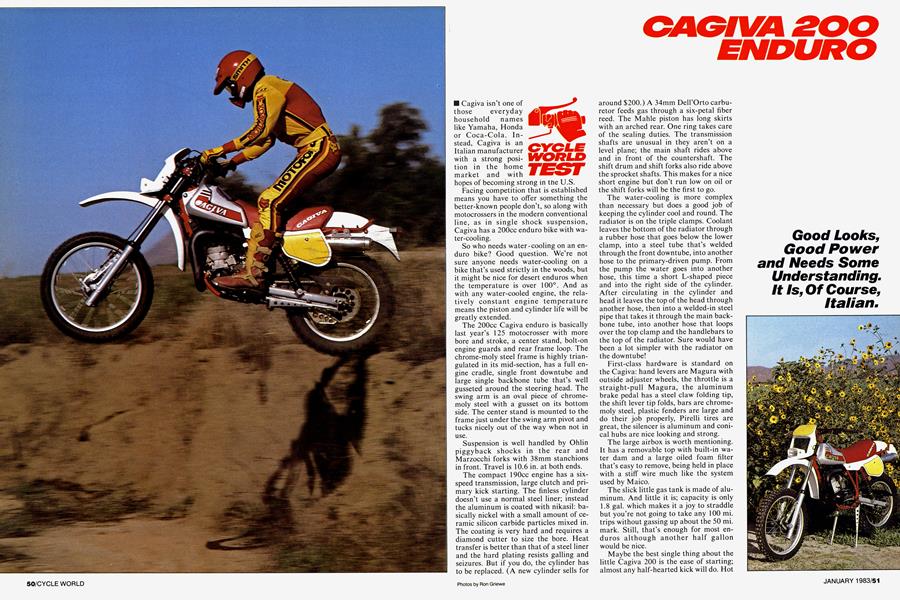
Facing competition that is established means you have to offer something the better-known people don’t, so along with motocrossers in the modern conventional line, as in single shock suspension, Cagiva has a 200cc enduro bike with water-cooling.
So who needs water-cooling on an enduro bike? Good question. We’re not sure anyone needs water-cooling on a bike that’s used strictly in the woods, but it might be nice for desert enduros when the temperature is over 100°. And as with any water-cooled engine, the relatively constant engine temperature means the piston and cylinder life will be greatly extended.
The 200cc Cagiva enduro is basically last year’s 125 motocrosser with more bore and stroke, a center stand, bolt-on engine guards and rear frame loop. The chrome-moly steel frame is highly triangulated in its mid-section, has a full engine cradle, single front downtube and large single backbone tube that’s well gusseted around the steering head. The swing arm is an oval piece of chromemoly steel with a gusset on its bottom side. The center stand is mounted to the frame just under the swing arm pivot and tucks nicely out of the way when not in use.
Suspension is well handled by Ohlin piggyback shocks in the rear and Marzocchi forks with 38mm stanchions in front. Travel is 10.6 in. at both ends.
The compact 190cc engine has a sixspeed transmission, large clutch and primary kick starting. The finless cylinder doesn’t use a normal steel liner; instead the aluminum is coated with nikasil: basically nickel with a small amount of ceramic silicon carbide particles mixed in. The coating is very hard and requires a diamond cutter to size the bore. Heat transfer is better than that of a steel liner and the hard plating resists galling and seizures. But if you do, the cylinder has to be replaced. (A new cylinder sells for around $200.) A 34mm Dell’Orto carburetor feeds gas through a six-petal fiber reed. The Mahle piston has long skirts with an arched rear. One ring takes care of the sealing duties. The transmission shafts are unusual in they aren’t on a level plane; the main shaft rides above and in front of the countershaft. The shift drum and shift forks also ride above the sprocket shafts. This makes for a nice short engine but don’t run low on oil or the shift forks will be the first to go.
The water-cooling is more complex than necessary but does a good job of keeping the cylinder cool and round. The radiator is on the triple clamps. Coolant leaves the bottom of the radiator through a rubber hose that goes below the lower clamp, into a steel tube that’s welded through the front downtube, into another hose to the primary-driven pump. From the pump the water goes into another hose, this time a short L-shaped piece and into the right side of the cylinder. After circulating in the cylinder and head it leaves the top of the head through another hose, then into a welded-in steel pipe that takes it through the main backbone tube, into another hose that loops over the top clamp and the handlebars to the top of the radiator. Sure would have been a lot simpler with the radiator on the downtube!
First-class hardware is standard on the Cagiva: hand levers are Magura with outside adjuster wheels, the throttle is a straight-pull Magura, the aluminum brake pedal has a steel claw folding tip, the shift lever tip folds, bars are chromemoly steel, plastic fenders are large and do their job properly, Pirelli tires are great, the silencer is aluminum and conical hubs are nice looking and strong.
The large airbox is worth mentioning. It has a removable top with built-in water dam and a large oiled foam filter that’s easy to remove, being held in place with a stiff wire much like the system used by Maico.
The slick little gas tank is made of aluminum. And little it is; capacity is only 1.8 gal. which makes it a joy to straddle but you’re not going to take any 100 mi. trips without gassing up about the 50 mi. mark. Still, that’s enough for most enduros although another half gallon would be nice.
Maybe the best single thing about the little Cagiva 200 is the ease of starting; almost any half-hearted kick will do. Hot or cold, one little jab will get it purring. A short warm-up is required just as with any water-cooled engine. It’s necessary to let the parts warm as water-cooled engines run tighter tolerances than aircooled engines.
Letting the clutch out usually surprises first-time riders; the final gearing is way too tall and any slight incline requires slipping the clutch. Once the bike is moving, the transmission with its extra-long shift lever moves through the gears like magic; no clunk, no lurch, no hanging up. Smooth as butter, as they say. Internal ratios are closely spaced and there’s no lag or jumps between them. Using 5th and 6th is out of the question if you’re in any kind of mountainous terrain. And steep twisty gnarly trails, you know, the kind that drop into a gully, make a tight turn, and then go straight up, are out of the question. The gearing is simply too tall. Slipping the clutch in 1st overheats the clutch quickly and most of the lever travel goes up in slack. And you’re still at the bottom; it’s like trying to get up with the gearbox in third. We called Cagiva and they had another front sprocket to our office in two days. Down two teeth in front made the bike much better. Low gear is actually low now. And 5th and 6th are usable on fire roads. Top speed naturally suffers, but it’s still about the same as an IT 175 or PEI75. The gear ratios are straight from the 125 motocrosser, thus they are ultra close. It’s not a big problem but it’s noticed if the bike is ridden in a broad range of terrain. If not, secondary gearing changes will work fine. Used in a combination of desert and mountains, the rider will find 1st not quite low enough and sixth not quite high enough.
The engine has motocross-like porting as well. No low end power, although the bike will putt along at a crawl thanks to the reed induction. Not a lot of power is made until the lower part of the midrange. Then things happen quickly.
This bike was used in several locations. The Colorado 500 lasted for five days, covering nearly 600 mi. The bike was brand new and was used as delivered except for leaner jetting, done with extra jets the bike came with. In fact, the bike didn’t even have the final gearing changed until after the Colorado 500. It performed flawlessly except for one rocky hill where low wasn’t low enough. Riders of open Huskys and XR500s were constantly amazed that the little 200 could stay with them in the straights and on the uphills! The organizers showed concern when our managing editor showed up with such a small displacement machine. (Open bikes are recommended for the ride.) Other participants, most of whom had ridden the event before, showed equal skepticism. How would the little bike get over the 13,000 foot peaks, with loss of power being what it is at high elevations? Day after day the 200 Cagiva amazed all who tried to outrun it. The bike did finish in the back-up truck once during the event: it ran out of gas about 75 mi. into a long section— about a mile before a 500 Husky with a 4 gal. tank ran out!
Testing closer to home further proved the bike extremely reliable. We changed the final gearing and rejetted the carb, going two sizes over stock on the main jet, a 195 in place of the stock 185. The larger main jet increased rpm at top and got rid of a small ping when the engine was run hard in sand. The lower gearing detuned the flat spot (lack of low end) at the beginning of the powerband, making the bike much easier to ride. The power comes on much earlier with the modified gearing although no one will confuse this engine for anything but what it is, a motocrosser. Good riders will have no trouble keeping it on the pipe but it probably wouldn’t be a very good beginner bike due to the quickness with which it gets on the pipe. The rider needs to shift quite often and be ready to downshift any time the throttle is turned off.
Picking up the front wheel to clear ditches is easy, an unusual trait for small enduro bikes. The high power and the lack of weight on the front wheel make it easy to lift or wheelie. Big full-lock slides on fire roads, even wet fire roads, are also easy, and fun. The bike is a natural slider and always has enough power to hang out the rear wheel. It’s also a good hillclimber, within reason. In the right gear the Cagiva will top steeper grades than the displacement would lead one to expect, although if the steep hill is steep enough and long enough, or if there’s a step or a ledge that makes the rider slow doen, revs drop below the powerband and when there are no more downshifts possible, hopping off and running alongside is the only way to the top.
Riding location is pretty much restricted to the low portion of the seat just aft of the tank. Seat padding does extend up onto the tank itself, but the angle is too severe and the rider has to haul himself up and work to stay there; not good for concentration. Shifting to the back of the seat is a little easier but the rider still has to work at it. Fortunately, where the seat makes you sit is right for most. The only problem is when the going gets really tight and the rider needs to get a little farther forward to try and quicken the rather slow handling, he can’t due to the seat. We would modify the seat if we were going to ride the bike all of the time. Cut the tongue off and the rider could slide up onto the tank in tight corners. The slow but stable handling is a result of a 30° head angle. Most dirt bikes have steeper rakes. The nice thing about the mild rake is the bike’s manners in a deep sandwash; straight without a hint of head shake.
The vulnerable-looking water lines that go from the radiator to the pump didn’t get snagged or damaged during our extended test period but all our riders worried about them. If we were going to run one of these in the southern swamps or eastern brush we’d build a guard around the feed hose. Another problem that didn’t happen concerned the exposed center cases; the six-day guards only protect the engine’s side cases, the center is open. The bike was used in rocky terrain several times without mishap but more frame tubes or a skid plate would offer insurance.
A couple of things on the Cagiva are an annoyance: front brake pull is very heavy and using the brake is tiring. The shift lever shaft has coarse splines and the lever is long, so moving the lever one spline means the tip has traveled more than 2 in. And the bike gets wide when the rider moves back on the seat. The rear of the tank, which is what you usually straddle from the seat’s best spot, is only 7 in. wide. Aft of that, though, because the dual shocks are outboard of the frame, the bike widens to 13.5 in., and it’s quickly noticed, especially by riders accustomed to skinny single-shock models.
The shift lever problem was solved by removing the lever and persuading it into a new bend via a.hammer. Brake effort was reduced by unhooking the return spring on the backing plate lever.
Adjusting the chain’s tension is another small but bothersome job. Most modern bikes have a close countershaft sprocket/swing arm pivot relationship, which means chain tension doesn’t vary much when the rear wheel moves up and down. The Cagiva’s relationship isn’t so good. It’s almost 4 in. between these pivot points and the chain tension changes a lot. The chain has to be adjusted so there’s lots of slack in it while the bike is on the center stand. Otherwise it’s too tight when the wheel moves.
The brakes are just fair at best. Our easier riders thought they were fine, our harder riders got into trouble when going fast. Compared to the competition, the Cagiva brakes aren’t strong enough at high speeds. And they require more power from the rider than necessary, meaning it’s more tiring to ride the bike. They don’t like water either; they go away in water crossings, the rear returning quicker than the front.
Initially the suspension was stiff and harsh but it relaxed some after the first 500 mi. Then we drained the fork oil and replaced the lOw with 5w. The oil change made the forks much better. The Ohlins were adjusted also; the springs had sacked a little, requiring moving the spring clip to one position more preload to get ride height back to normal. Compression damping is a little too stiff for maximum comfort as delivered but the shocks are rebuildable and adjustable so changing them shouldn’t be much of a chore for a dealer who’s familiar with Ohlins.
CAGIVA 200 ENDURO
SPECIFICATIONS
$2295
We were critical of the new kid on the block until we rode it for a few hundred miles. A broken rubber headlight/ numberplate strap was the only problem. The bike proved fun and extremely reliable. And it drew a bigger crowd than any recent test bike. Everyone noticed and asked questions, and those who participated in rides were always surprised at the bike’s power and speed. We have to claim the 200 Cagiva worth looking at if you’re in the market for a 175/200 enduro bike. But, that may be hard to do. When asked about the dealer network the importer could only say, “We are working on it.” Interested buyers and dealers should contact Cagiva, John Ingham, Director, North America, Inc., PO Box 18830, Shreveport, Louisiana 71138. Phone (318) 688-5288. &