20 Years At Trackside
20 YEARS AT TRACKSIDE
20 CYCLE WORLD
Joe Scalzo
Joe Scalzo has been a fan, a racer, a rider, a reporter and photographer for as long as Cycle World has been here. So for our 20th Anniversary we asked Joe to re call life at the track. Not history, we said, all the results and points standing and so forth are already in the record books. Tell us, we asked, what it's been like out there.
The editors said no history and that's fine with me. Motorcycle racing is to me the Grand National Championship, now known as the Winston Pro series, and I can't write a history of it. What follows is rambling, discursive ahd I hope informative. But it isn't history. Ideally, history is objective. Being flatly objective about the racing that's been my pleasure. privilege and passion to observe was, I learned to my surprise, beyond me.
Perhaps the most radical change racing ever experienced occured in 1969. Prior to that date Harley-Davidson’s flathead engines, which had dominated for eons, had been permitted 750cc’s while the importted, read English, ohv engines had been restricted to 500 cc. Then the AMA decreed that all engines would be allowed equal displacement, with no regard for valve location or design. And lightweight, stiff, frames and brakes—after decades of brakeless dirt racing!—and suspension were permitted for all marques.
Harley held on for one more season but in 1970 and ’71 the British bikes were ready. In an orgy of spending and racing that helped bankrupt BSA and nearly took out Triumph as well, the English won the top six places in the series in ’70 and the top four the next year. But by 1972 they were out of money and almost out of racing and Harley-Davidson’s alloy XR750 was ready and winning . . . and of course is still winning, while new rivals, this time Yamaha and Honda, pour out money and pull in riders and tuners in hopes of defeating the most venerable (and successful) engine on the track.
Oddly, the three unusual and fertile minds whose loud lobbying for change can be charged with responsibility for much of what happened in 1969 are today almost forgotten. Albert Gunter the agitator, is dead; Neil Keen the philosopher, is selling samurai swords. Only Dick Mann the stoic is still in racing.
Mann happens to be the basic and vital personality of the era. In 1963 he became the first, the symbolic, non-factory-sponsored, non-Harley-Davidson seasonal champion. Eight years later, in 1971, he became at 36 the oldest champion. Few were as obsessed with racing and motorcycles, were as popular, or accomplished as much. Mann was, in fact, the first Number 1 to achieve the “grand slam’’ and score National victories in all five competition forms: mile track, half-mile, short track, TT steeplechase and road racing.
While racing he was never deliberately reckless and his riding style was rated among the smoothest of all Number Ones. Off his motorcycles Mann never showed emotion, either joy or sorrow. As an underdog privateer he was totally self-sufficient (painting his own motorcycles, changing and mounting his own tires, figuring out gear ratios, making his valves, grinding his own cams, heat-treating his inadequate tires on the roof of a garage), innately versatile (winning 24 Nationals on BSAs, Matchlesses, Ossas, Yamahas and Hondas, but never Harley-Davidsons), and an original thinker and natural doubter. He doubted that dirt track racing was safer without brakes, even though it was supposed to be, and saw only nonsense in rules keeping frames, forks, and other vital components stock (and therefore ill-handling). His quarter-century-long career didn’t last long enough for him to take advantage of all of today’s changes, but Mann’s imprint is indelible. Dirt track racing has become a booming mini-industry of companies selling the disc brakes, custom frames and swing arms that Mann in 1962 despaired of ever seeing. Six years ago Dick O’Brien, Harley’s venerable racing chief, who admired and fought Mann, claimed that the availability of racing parts meant a privateer could build a machine equal to that of O’Brien’s factory racers. In the Eighties privateer XR750s became not just equal but demonstrably faster than the factory versions.
During a revealing, rather sad conversation I had with him some years back Mann seemed to regret the changes. He thought perhaps it has become too easy to join the vaunted Grand National tour; that the wider, stickier tires and powerful brakes have done away with artistic broadsliding; that the ovals have become one-track grooves rather than the revered cushions, and that the Harley-Davidsons are so overpowered few are putting all their horses on the ground. All the young riders seem indistinguishable, colorless. In Mann’s era, and I suppose my era as well, the majority of the regulars on the national circuit were more dedicated than skilled and were daft enough to be or have been soldiers, ferriers, reformed or practicing beatniks and artists, violinists, farmers, even singers.
Mann and I exchanged anecdotes about his remarkable friend Dick Dorresteyn, gangling and ungraceful except when he was doing a TT, where he was perfection, and who poignantly died in bed of a leaky heart; of the mad Californian and 40-inch Triumph racers Eddie Mulder, logically nicknamed Squirrel, and Skip Van Leeuwen, whose nickname Van Looney spoke for itself; the wonderful malcontent Neil Keen, famed for his unfailing ability to observe the idiosyncrasies of others while missing his own.
Bart Markel was Mann’s great rival in the 60s and was still producing anecdotes in 1979. When Jay Springsteen and Kenny Roberts pressed too close to his record of 28 national wins Markel, aged 44, made a dramatic, foolish and totally characteristic comeback attempt. At Syracuse, after posting a snail’s pace qualifying lap, he was hit and knocked down during his heat race—and afterward had the good grace to remark that after a career full of knocking other riders down he probably deserved it.
The best story involves Mann himself. During a long-ago Daytona 200 the BSA team had all the bikes on the line for qualifying but Mann, the team’s star, was missing. Ralph White, a substitute rider, was disguised as Mann and sent out to qualify the bike. Mann finally appeared. Where had he been? Out splashing around in the swamps, having a delightful time participating in an amateur event called the Alligator Enduro.
So where are the Jay Springsteen anecdotes, the Mike Kidd tall tales, the pranks of Steve Eklund and Scotty Parker?
About all the colorless, faceless prodigy racers of today can do is put on the fiercest, the closest, the most compelling races in the history of the Grand National Tour.
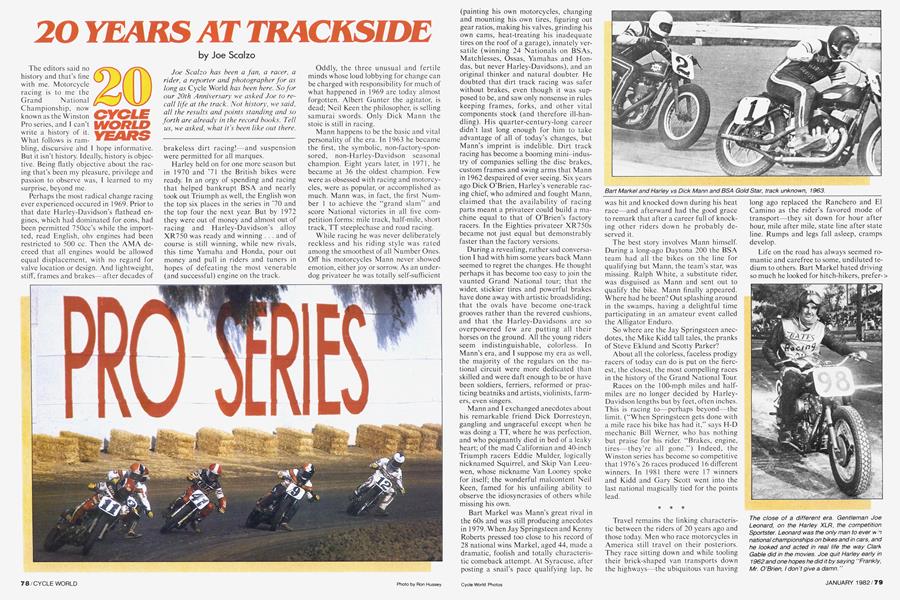
Races on the 100-mph miles and halfmiles are no longer decided by HarleyDavidson lengths but by feet, often inches. This is racing to—perhaps beyond—the limit. (“When Springsteen gets done with a mile race his bike has had it,’’ says H-D mechanic Bill Werner, who has nothing but praise for his rider. “Brakes, engine, tires—they’re all gone.”) Indeed, the Winston series has become so competitive that 1976’s 26 races produced 16 different winners. In 1981 there were 17 winners and Kidd and Gary Scott went into the last national magically tied for the points lead.
* * *
Travel remains the linking characteristic between the riders of 20 years ago and those today. Men who race motorcycles in America still travel on their posteriors. They race sitting down and while tooling their brick-shaped van transports down the highways—the ubiquitous van having long ago replaced the Ranchero and El Camino as the rider’s favored mode of transport—they sit down for hour after hour, mile after mile, state line after state line. Rumps and legs fall asleep, cramps develop.
Life on the road has always seemed romantic and carefree to some, undiluted tedium to others. Bart Markel hated driving so much he looked for hitch-hikers, preferably sailors because they tended to be leadfoots, to drive while he slept. An antipathy for travel is reliably reported to have wasted one of the great natural dirt track talents, Ronnie Rail, who won the Heidelberg and Columbus Nationals as a Harley-Davidson independent in 1963. Rail lived on a small farm in Ohio, in the days when Ohio was the state of the hard tryers (today Michigan, with its active cast of Sprinsteen, Goss, Parker, Brow, and Boody, and inactive cast of Keener and Beauchamp, gets the nod). Leaving his farm to hit the road made Rail so homesick, he finally quite racing. Ironically, he could have flown rather than driven, since he had his own plane, an old banger he frequently landed in the cornfields.
Missing today are certain rider types who used to be essential. The bullying rider who intimidates others with his tactics is no longer around, probably because those who tried it usually got rabbitpunched or out-bluffed or bounced into the wall for their trouble.
Gone too is the celebrity crasher who got lionized rather than castigated for his accidents. For the first half of the seventies David Aldana, a violent and continous crasher, was fondly nicknamed “Rubber Ball” for his recklessness and odd ability to walk away unhurt from spills. It was a poor choice of words. A crashing motorcycle doesn’t bounce like a rubber ball, nor does its rider. Today’s riders—including Aldana, who is faster than ever but much less reckless—take better care of their health.
Health. A general concern for fitness led to rules requiring medical certificates, and some of the riders weren’t as concerned and submitted faked papers. Gene Romero didn’t know what the term meant, so his certificate was signed by a gynecologist. He was caught and his suspension kept him out of races and cost enough points to lose him the No. 1 plate.
We’ve seen riders who raced with broken bones, and tracks so dangerous that on one occasion a group of racers, led by Corky Keener, tried to steal the starter’s flag so the race couldn’t be run. It didn’t work; Rex Beauchamp crashed in the narrow first corner and snapped both collarbones; the starter waved a loaded pistol at Keener and the AMA sent a threatening letter ... to Keener.
What is tragic is that no sanctioning body in the world seems strong enough to meet the awesome responsibility of protecting riders from themselves. Cal Rayborn, judged America’s if not the world’s greatest road racer was in the Antipodes in 1973 and was given the opportunity to race a maladroit bike on an execrable track with no protective haybales and no doctor, or perhaps even an ambulance, present. The results proved fatal.
Americans today are judged the world’s best road racers. Twenty years ago they would have taken all awards for being the worst. In 1962, whenever our fastest national competitors left dirt tracks for paved ones, which they did grudgingly, it was to fit their KR models with weak brakes, marginal tires, handlebars like those on the wheelbarrows on George Roeder’s farm and to leave black skid marks all over the corners. Road races in the Sixties were some of the grandest freefor-alls on record. During 1964 matters become tidier when Mann, on a proper Grand Prix bike, a G50 Matchless, won three straight paved nationals, at Windber. Greenwood and Meadowdale. Mann took the measure of Harley-riding Roeder, Dick Hammer and Ralph White, and of BSA-mounted violinist Jody Nicholas, who beat Roeder on the very last lap of the galvanizing 1963 Laconia road race. Some months later, at the rainy Daytona 200 of 1965, the favorite was English rider and Isle of Man veteran Ron Grant. But he never had a chance against the ungainly Harleys of Roger Reiman and Mert Lawwill which threw up rooster-tails of spray across the rain-streaked gray-black banking in a wholly inappropriate, unexpected, and hilarious one, two rout. Ron Grant subsequently proved himself to be far madder than the maddest Harley rider, notably off of the track, and the flat tire, ruptured gas tank and near double immolation of himself and Dick Hammer in their rental car one midnight on the Daytona beachfront still is talked about wherever crazy people gather.
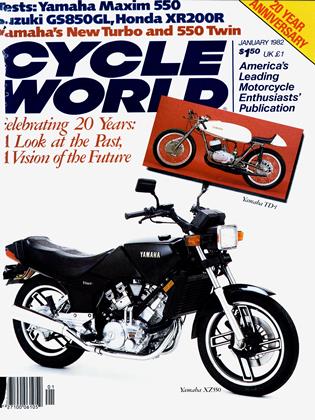
Among the first road race machines to have clip-on handlebars, streamlining and smokey two-stroke engines were the achingly noisy TD-1 model 250 Yamahas. Neil Keen, who was a diabolically fast, and radically unpredictable road racer, scored the marque’s first victory of consequence at Dodge City during the 1963 Labor Day races. Mann won Yamaha its first U.S. National at Nelson Ledges, Ohio, in 1965. In 1966, Yamaha’s U.S. importers sent Gary Nixon to Japan to compete in a race for production bikes which Nixon won. Afterward he asked for a try-out ride on one of Yamaha’s pukka GP bikes. Team captain Phil Read (with Bill Ivy at his elbow) succeeded in squelching the request by insisting to his Japanese masters that Nixon, being American, raced too hard, ignored proper corner lines and behaved as if he could go sailing off the road with impunity.
Four years later Nixon, whose dirt racing seemed to end because of the aftereffects of his Santa Rosa spill, was racing Triumphs in England but not winning. The honor of being the first American road racer to achieve real distinction overseas went to the-ill-fated Rayborn in 1972. He traveled to England and posted three victories and three second places on tracks he’d never seen before against international riders who erroneously believed that they were the world's best. There is humor worth savoring in the fact that Rayborn did his superb work not aboard anything that was exotic but on one of Dick O’Brien’s old iron-barrel XR models . . . and the road racing purists winced. Many of the Europeans who saw Rayborn that day never got over him or the shock, a year later, of his shameful demise.
It still was a long wait for the first American world road championship. And there was disillusionment. Pat Hennen, who was a protege of Ron Grant, and destined to be disabled by a 1978 crash on the Isle of Man, became, in 1976, at Imatra, Finland, the first American to capture a world championship road race. The organizers lacked a recording of the Star Spangled Banner, so it was Hennen’s reward, or fate, to afterward sit through the wellmeaning but cacophonous attempts at our national anthem by the Japanese folk singer/racer Takazumi Katayama. Nixon, tenacious and unlucky as ever, survived a brutal arm-fracturing crash in Japan on the very prototype Suzuki square Four that his British friend Barry Sheene subsequently raced to the 1975 world’s championship. In 1976, Nixon seemed to win the Formula 750 world title on a Kawasaki. But when the American Motorcyclists Association refused to vigorously back him, he lost the title to international politics and to a third-rate Spaniard named Polumbo. Myopic little Steve Baker became the first American to win a world championship in the 750 class of 1977, but in a strange, unprecedented ending for a world champion Baker got fired by his Yamaha employers. His replacement for 1978 became Kenny Roberts, who at the time was in the doghouse with Yamaha’s U.S. distributors for wasting $100,000 of their money in his dismally unsuccessful chase of the dirt track Harley-Davidsons. Roberts, in effect, was exiled to Europe, where he began three years of unbroken American dominance of world road racing. He also, in his outspoken, failed, attempts to upgrade penurious starting money and safety conditions on the Grand Prix tour, had continental race promoters temporarily scared to death.
One of the last to poor-mouth Americans as road racers was Nixon's old fan Phil Read. During the Daytona 200 of 1976 Read found himself the teammate of Gene Romero on the Don Vesco team and boldly suggested to Vesco that he, Read, be given the team’s first-string bike. He was, after all, a world champion. Romero listened in on the conversation, then calmly declared that that title, plus fifty cents, might be enough to buy Read a cup of coffee in Daytona’s over-priced infield cafeteria. Read wound up with the second, not the first-string, team bike.
A recklessly opinionated British reporter got his comeupance in an even more direct manner. At Brands I-latch during the mid-Seventies, the reporter told Roberts he was overrated, David Aldana that he was nothing but a crasher, and Baker's mechanic Bob Work that he was untalented. Roberts proceeded to pour wine into the reporter's lap, and Al dana to remove his glasses (saying that because he couldn't talk right he didn't deserve to see, either) so that Work might blacken one of his eyes. His flattering sto ries about Americans made interesting reading afterward.
* * *
As to the name of the most influential rider to come out of the 20 years, nobody but a dolt would dare name anybody but Kenny Roberts. Not that others aren't of interest: Dick Mann winning his second Number 1 at the age of 36, against an entirely different cast of riders from those he’d whipped eight years earlier; or Markel with his 28 national victories or Springsteen with his three Number Ones, and all the national victories, including the most stressful of them all, the 1976 Ascot National when he overcame broken fingers, double vision and telltale stomach problems.
Nevertheless Roberts, with his pair of Grand National crowns, and “grand slam’’ in a single season would be the pick even without his European and world successes. Everyone must have his own pet Kenny Roberts observations. My own is that when Kenny isn’t racing he must be the most disorganized, and perhaps-accident-prone, person who ever lived. In Europe he is famous for losing passports and carrying the wrong currency. He is prone to hayfever and regularly stricken with sunburn. He forgets messages, loses telephone numbers, bungles street addresses. At a 1977 press conference, the autographed press packages Yamaha passed around all bore what looked like a different autograph but wasn’t; Roberts always signs his name differently and has had trouble being issued travelers checks for that reason. And his mishaps. One day in 1973 when it was 112° at one of his California ranches he accidently shot himself in the leg (Springsteen, another gun freak, once shot himself through the ankle); and this sort of carelessness seems to run in the family since Roberts’ father once managed to wound himself hunting and Roberts’ older brother, a security guard, has managed to shoot himself in the kneecap with a .38. As a young boy Kenny had his front tooth brutally amputated during a dirt clod fight; and as a grown man he has had highway wrecks, one ofif the road and upside-down into an I mola canal in a car also containing Barry Sheene and Gene Romero. Even while doing something so routine as putting a new edge on a dirt tire with a razor blade Roberts is apt to slip and inadvertently slash himself and lose more blood that way than dragging his knees and toes road racing.
And yet, not counting Japan in 1979, his first and only serious big crash, Roberts’ record for non-injury racing is unequalled.
* * *
Ask any of our Grand National champions what memories they have of certain motorcycles and it is sure that the locking transmissions of the 750 Triumphs which hurled both of them to the ground scores of times will be mentioned by Gene Romero and Gary Nixon; that all the thrown chains and breaking batteries of his 1975 and ’76 Yàmahas will animate Kenny Roberts; that any XR HarleyDavidson titlist will groan about sparkless magnetos; and that Bart Markel, Roger Reiman and Mert Lawwill will recall the lefthand side air cleaner of the Model KR, which even during the most innocent slideout always managed to be wrenched free. The apparently natural tendency of a rider to recall the most malevolent, instead of the best, characteristic of an old machine is revealing. But two motorcycles, the XR750 Harley-Davidson dirt tracker ( 1972) and the TZ750 Yamaha road racer (1974) co-rate as the most vivid of the 1962-1980 epoch.
Weighing almost a quarter of a ton with the rider in place, an XR—or a pack of them—digging in and firing off a mile track corner has become one of racing’s great sights. Dick O’Brien originally built them to replace his beloved, antiquated KRs, and to crush the BSA and Triumph marques who lobbied for rules that made the KRs obsolete, and to endure, as they have, and the British have not.
Yamaha’s furious pursuit of the XR750 during 1975, ’76, and ’77 was unsuccessful but always entertaining because it was Kenny Roberts who was doing the pursuing. Not even Roberts quite unlocked the key to anchoring the twitchy Yamaha horsepower to dirt, however, and his top heavy vertical Twin was famous for whipping around in the corners and actually getting its front wheel off the ground. Meanwhile, on the straightaways, as at Du Quoin in 1977, the unwieldy bike once spun its rear wheel for the length of the backstretch while Roberts was running 15th among 17 Harley-Davidsons and about to slip to 16th. He and Yamaha did get the better of the Harleys at the Indianapolis mile of 1975 with a shrieking beast of a Yamaha TZ four-cylinder whose power was so uncontrollable Roberts himself subsequently and successfully urged its banishment from racing; it was simply too difficult to ride. And the XR Harleys continued winning.
As for Yamaha’s four-cylinder, twostroke, road racing TZ750, it may have been the first bike ever to win its first race, the 1974 Daytona 200. The descendant of the TD-1 and the popular Yamaha 350, designed to annihilate the challenging Suzukis and Kawasakis, it was quickly made available to privateers everywhere, as the XR750 was. With 100 horsepower or more available, the TZ was by its nature skittish, and the term “getting sideways’’ became inescapable road racing venacular. And the rider animation it took to control one! Roberts, his right, then left, buttock hanging ofif the saddle while overhanging the track, kissing his knee to the pavement while cornering, invented an entirely unique pavement style. At 340 lb. the TZs were not light, nor were they supposed to be, for they were capable of exceeding 180 mph on the high banks of Daytona and the g forces would have snapped anything lightweight in two. The TZs only woke up at 100; anything else was creeping. In 1974 Gene Romero rode one around the Daytona banking for an hour, completing 62 laps at a spectacular average of 150 mph. Afterward Yamaha offered him a free piano.
Maybe the speeds have helped create the gap between road and dirt track racers. In the beginning road racers were considered effete and the dirt riders were motorcycling’s brakeless daredevils. Now the milers still make their machines perform tricks as they float on dusty ovals whose surfaces change from lap to lap, while the road racers are aiming at the same line through a narrow corner at the same perilous speed every lap, never daring to doubt that the slick tires won’t skid out from under, never thinking about the consequences of getting tossed over the bars at 180 mph.
* * *
The motives that compel today’s riders to compete on the Grand National tour are as elusive and hard to define as they were 20 years ago. Racers always have raced for the excitement, the occasional money, the barnstorming of the country. I believe a lot of them race to gain the approval and impress the only people they really care about: each other.
Race promoters underpay them, sponsors are fickle, the AMA is incompetent, and the press is not to be trusted. The popular press, for the most part, continues to ignore the racing. Being a motorcycle racing fan still means, as it did 20 years ago, getting up Monday morning following a National, turning to the back pages of the newspaper sports section, and usually finding race results, if they are there at all, in the meanest agate type. Riders appreciate the fans, hero-worship in their eyes, who visit the pits for autographs and whatever after a race. But although they are enthusiastic, the fans really have no better understanding of racing than the fans of football or other sports. Certain things only can be seen on the track, while racing. And so for as long as they race the 99 National numbers are their own greatest fans, seeing one another in moments of greatness, fear, ruthlessness. Only the other riders know, truly know, who is worth admiring and who is not. It always seemed to me that Jay Springsteen reached maturity after the 1976 Columbus National, where he beat Roberts even though Roberts smashed an elbow into his face during the dueling. Partly for psychological reasons and partly because that is the way he is, Roberts rarely if ever has positive words for any rival. Yet after that national he was overhead saying that Springsteen was the most rugged of the lot. It touched Springsteen, and undoubtedly provided him with the exact psyching up that Roberts would have preferred to avoid.
* * *
Money has become everyone’s concern and a contradiction. Twenty years ago we accepted racing as a poor man’s pastime and we did it to be part of the experience. It’s no secret now that despite the cigarette money shoring up the prize fund most riders lose money. In Europe (where, we were falsely led to believe, all the riders got rich) there is at least starting money. As close as we come, I’m told, is that the reigning No. 1 gets $200 per race. Winning pays from $3000 at the average dirt track to $14,000 at Daytona’s 200. And the non-factory rider has to pay for food, lodging, ruinously expensive gas for his van—after 20 years nothing in racing is more prized than a valid gasoline credit card.
The myth of making your fortune in racing began, I think in 1974, when Roberts’ manager Jim Doyle boasted that the contract Kenny had just signed with Yamaha was the richest ever given a racer. (False, by the way. Yvon Duhamel got even more from Kawasaki, to Kenny’s chagrin.) Meanwhile factory contracts seem to promise more than they deliver and two days before the last race of the 1981 season the privateers hanging around the LA race shops were helping each other build engines and pooling five bucks to get a retreaded tire for the van.
Curious, the charisma of the factory team. They do bring salaries and fringe benefits to some riders. They are alleged to bring glamor and prestige to the racing but the expensive factory equipment has often been outclassed by that of the starving, faithful privateers. Yamaha, Kawasaki, Suzuki and Honda, and before them Triumph and BSA, have bullied the AMA into changing the rules for their benefit while being willing to drop out of racing at the drop of a sale. Harley-Davidson has been in it for the full 20 years— seconded by Yamaha with production road race bikes for all—and as a curious reward H-D has been the villain everybody tries to beat.