Honda's 1981 Surprises
HONDA'S 1981 SURPRISES
Pro-Link Suspension Makes the CBX,GL500,XRs and Watercooled CRs as Exciting as the CR450 and CB900F.
Deciphering Honda’s priorities is easy. At 5:30 a.m. on the morning of the 1981 show, the press was yanked from their beds and packed into a bus. Breakfast, 6:30 a.m., was the Japanese hotel’s version of a western picnic lunch, gobbled on the bus. Lunch, on the same bus, was another picnic lunch. Dinner, on the bus headed back to the hotel, was—yes—a third picnic lunch.
For between-meal business, we were turned loose on the high speed oval and the handling circuit with the revised CBX, the just-released-for-America CB900F and the elegant GL500. Then it was off to the motocross track and some fast laps on the incredible CR450, the water-cooled CR250 and CR125, mixed with jumps and slides on the serious XR200R, XR250R and monster XR500.
For dessert, back to the banked oval. Whisk, off came the dust cover. Under one condition—don’t rev the engine beyond 18—you read it right, 18 thou—we rode the Grand Prix NR500.
No frills, lots of thrills. At Honda the go is the show.
Honda is an engineering company. The top men are the technical men and they care most about the machines. They figured we were the same, so they skipped the banquet and the speeches, rolled out the bikes and the designers. We wouldn’t have it any other way.
There are several themes for Honda’s 1981 line. First must be suspension. Single rear shock absorbers are the coming thing, at Honda as well as elsewhere, i.e. Yamaha, Suzuki, Kawasaki, even BMW, and all the really new Hondas, from CBX to XR200R, have the Pro-Link system.
The idea isn’t new. At least three English makers used it back in the Thirties, and of course Yamaha re-invented the monoshock for motocross seven or eight years ago.
Honda’s version came out of the R and D think-tank known in house as NR, which is known on the outside mostly for the NR500. But the project team is supposed to take requests and make them into working ideas; Honda’s motocross team wanted a single rear shock, so the NR team came up with one.
Pro-Link appeared on the works motocrossers and (modified) on the NR500, and for 1981 it’s on the CBX, the GL500, the CR125, 250 and 450 and the XR500R, 250R and 200R.
Why Pro-Link? The designers say the single large shock can do more damping with less weight. Next, the vertical shock just aft of the engine puts the weight closer to the center of gravity, concentrates the mass, which makes the bike more responsive to input and thus easier to control. As sort of a bonus, the central shock means there’s room for saddlebags on the road bikes and less obtrusive exhaust pipes on the dirt bikes. Most of all the Pro-Link provides highly progressive spring and damping rates.
Nor is that all. Models still using twin shocks for 1981 have another step forward, with adjustable damping and in some cases air/oil aiding the springs. There are more air-assist forks, and even in the smaller models, as in the 400 Hawk, the stamped upper clamp is replaced by a proper cast clamp with genuine pinch bolts. Inside the forks are slick metal bushings top and bottom, for less stiction and reduced wear. The days of mass-produced pogo sticks are behind us.
Styling comes next. We’re going to be hearing a lot in the near future about “European” styling. It’s a popular term, not quite accurate. The 1981 Hondas (and Yamahas, Kawasakis and Suzukis) don’t look Swiss or French or German. They look Italian, in the best tradition of Italian design, where engines, typewriters, shoes, etc., always seem to look better than the same stuff from other countries.
Yamaha scored great success with the Specials, which were based on English tanks and American modifications, so all the makers came out with similar models until they were normal, which calls for a different kind of newness.
For 1981, the newness is race-based, sports and touring oriented, with the various models tailored to specific uses.
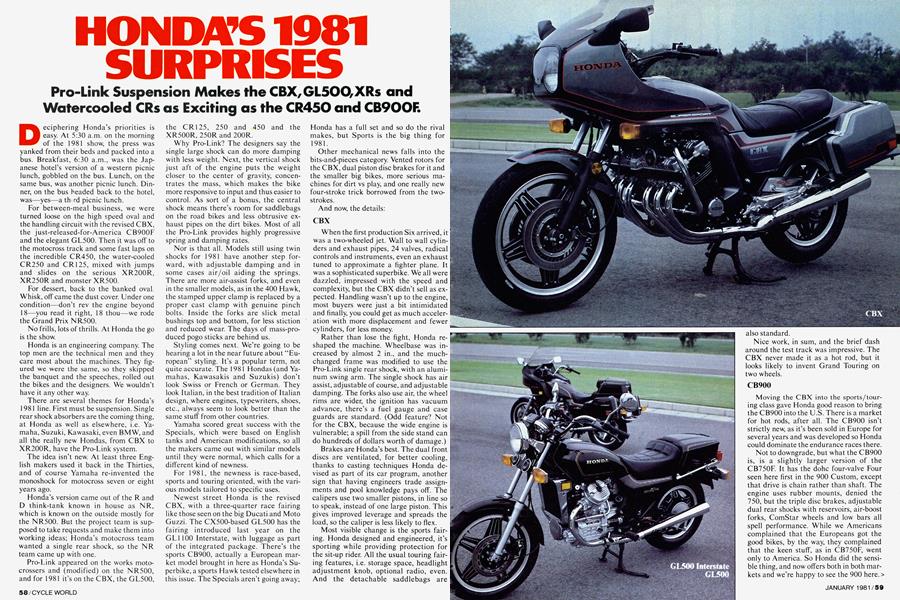
Newest street Honda is the revised CBX, with a three-quarter race fairing like those seen on the big Ducati and Moto Guzzi. The CX500-based GL500 has the fairing introduced last year on the GL1100 Interstate, with luggage as part of the integrated package. There’s the sports CB900, actually a European market model brought in here as Honda’s Superbike, a sports Hawk tested elsewhere in this issue. The Specials aren’t going away; Honda has a full set and so do the rival makes, but Sports is the big thing for 1981.
Other mechanical news falls into the bits-and-pieces category. Vented rotors for the CBX, dual piston disc brakes for it and the smaller big bikes, more serious machines for dirt vs play, and one really new four-stroke trick borrowed from the twostrokes.
And now, the details:
CBX
When the first production Six arrived, it was a two-wheeled jet. Wall to wall cylinders and exhaust pipes, 24 valves, radical controls and instruments, even an exhaust tuned to approximate a fighter plane. It was a sophisticated superbike. We all were dazzled, impressed with the speed and complexity, but the CBX didn’t sell as expected. Handling wasn’t up to the engine, most buyers were just a bit intimidated and finally, you could get as much acceleration with more displacement and fewer cylinders, for less money.
Rather than lose the fight, Honda reshaped the machine. Wheelbase was increased by almost 2 in., and the muchchanged frame was modified to use the Pro-Link single rear shock, with an aluminum swing arm. The single shock has air assist, adjustable of course, and adjustable damping. The forks also use air, the wheel rims are wider, the ignition has vacuum advance, there’s a fuel gauge and case guards are standard. (Odd feature? Not for the CBX, because the wide engine is vulnerable; a spill from the side stand can do hundreds of dollars worth of damage.)
Brakes are Honda’s best. The dual front discs are ventilated, for better cooling, thanks to casting techniques Honda devised as part of its car program, another sign that having engineers trade assignments and pool knowledge pays off. The calipers use two smaller pistons, in line so to speak, instead of one large piston. This gives improved leverage and spreads the load, so the caliper is less likely to flex.
Most visible change is the sports fairing. Honda designed and engineered, it’s sporting while providing protection for the sit-up rider. All the usual touring fairing features, i.e. storage space, headlight adjustment knob, optional radio, even. And the detachable saddlebags are also standard.
Nice work, in sum, and the brief dash around the test track was impressive. The CBX never made it as a hot rod, but it looks likely to invent Grand Touring on two wheels.
CB900
Moving the CBX into the sports/touring class gave Honda good reason to bring the CB900 into the U.S. There is a market for hot rods, after all. The CB900 isn’t strictly new, as it’s been sold in Europe for several years and was developed so Honda could dominate the endurance races there.
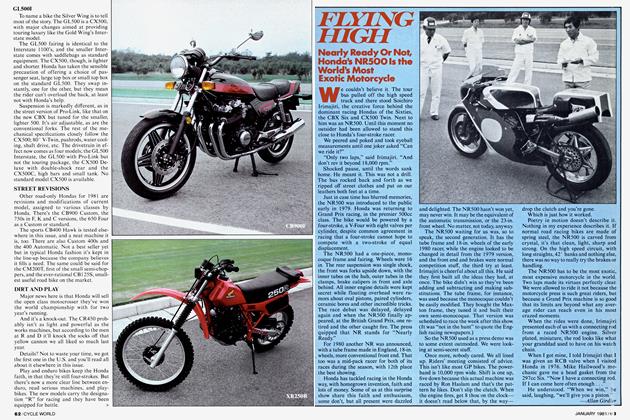
Not to downgrade, but what the CB900 is, is a slightly larger version of the CB750F. It has the dohc four-valve Four seen here first in the 900 Custom, except that drive is chain rather than shaft. The engine uses rubber mounts, denied the 750, but the triple disc brakes, adjustable dual rear shocks with reservoirs, air-boost forks, ComStar wheels and low bars all spell performance. While we Americans complained that the Europeans got the good bikes, by the way, they complained that the keen stuff, as in CB750F, went only to America. So Honda did the sensible thing, and now offers both in both markets and we’re happy to see the 900 here.>
GL500I
To name a bike the Silver Wing is to tell most of the story. The GL500 is a CX500, with major changes aimed at providing touring luxury like the Gold Wing’s Interstate model.
The GL500 fairing is identical to the Interstate 1100’s, and the smaller Interstate comes with saddlebags as standard equipment. The CX500, though, is lighter and shorter. Honda has taken the sensible precaution of offering a choice of passenger seat, large top box or small top box on the standard GL500. They swap instantly, one for the other, but they mean the rider can’t overload the back, at least not with Honda’s help.
Suspension is markedly different, as in the street version of Pro-Link, like that on the new CBX but tuned for the smaller, lighter 500. It’s air adjustable, as are the conventional forks. The rest of the mechanical specifications closely follow the CX500; 80° V-Twin, pushrods, water cooling, shaft drive, etc. The drivetrain in effect now comes as four models; the GL500 Interstate, the GL500 with Pro-Link but not the touring package, the CX500 Deluxe with double-shock rear and the CX500C, high bars and small tank. No standard model CX500 is available.
STREET REVISIONS
Other road-only Hondas for 1981 are revisions and modifications of current model, assigned to various classes by Honda. There’s the CB900 Custom, the 750s in F, K and C versions, the 650 Four as a Custom or standard.
The sports CB400 Hawk is tested elsewhere in this issue, and a neat machine it is, too. There are also Custom 400s and the 400 Automatic. Not a best seller yet but in typical Honda fashion it’s kept in the line-up because the company believes it fills a need. The same could be said for the CM200T, first of the small semi-choppers, and the ever-rational CB125S, smallest useful road bike on the market.
DIRT AND PLAY
Major news here is that Honda will sell the open class motocrosser they’ve won the world championship with for two year’s running.
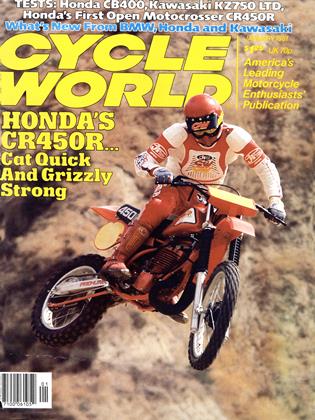
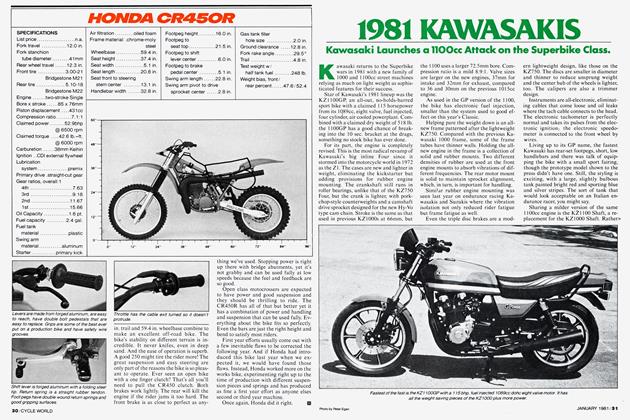
And it’s a knock-out. The CR450 probably isn’t as light and powerful as the works machines, but according to the men at R and D it’ll knock the socks off that yellow cannon we all liked so much last year.
Details? Not to waste your time, we got the first one in the U.S. and you’ll read all about it elsewhere in this issue.
Play and enduro bikes keep the Honda faith, in that they’re still four-strokes. But there’s now a more clear line between enduro, read serious machines, and playbikes. The new models carry the designation “R” for racing and they have been equipped for battle. >
XR500R
The top three XR models get Pro-Link suspension, more wheel travel and, for the 500R, some surprises.
A reed valve. Right, just like we’ve seen on two-strokes for years. Odd, how we can all understand that putting the one-way reed valve between the carburetor and the ports can widen the power band and control blow-back with radical two-stroke ports, but not until now has anybody thought to put a reed valve between the carb and the valves of a big four-stroke Single. Of course, we all say when somebody else thinks of the obvious.
It works. Full conclusions await a full test, but all who rode the XR500 came away with respect. The reed valve keeps the top end power where it always was, that is, ‘way up there, but now the 500 pulls well all the time.
The XR500R (and 250R and 200R) are obviously new at a glance. The frames are changed to accommodate the Pro-Link, side panels are larger and more elegant, the seats are longer, with the increase in the front and the plastic fuel tanks look like motocrossers, which is how all enduro bikes look nowadays. Double leading shoe front brakes are used on the 250 and 500XRs and the big motocrossers.
One change not much mentioned in the factory fact sheet is the front tire. The R models now have conventional 21-in. fronts. The 23, for which Honda had so much hope they worked out new tread designs to suit, has been dropped from the pure dirt Singles. Not a complete flop and the engineers have kept the 23s on the XL line, but it goes to show not all change is accepted as progress.
The benefit from this willingness to try new things shows up at the back. The XRs have 17-in. rear wheels. It’s fair to say that if the designers weren’t willing to try things that may not work, they’d never risk trying things that do work.
XR250R AND 200R
The XR250R is even more like the 500 than before, except of course that it’s got the smaller version of the same basic engine. Same suspension design, same double leading shoe front brake. The 250’s extra touch is a sixth speed for the transmission, and a slightly revised pair of primary exhaust pipes for more mid-range power.
The XR200R is also Pro-Link, but it already had six speeds and a 21-in. front tire, so those are the same as they were.
Honda seems to still be working on the middle of the market for dirt as well as street. Just as there are more versions of the 500 V-Twin, so is there an XR200R with Pro-Link and racing equipment and the XR200 plain, with conventional double shocks and a smaller price tag. The other four-stroke playbikes, the XR100, XR80 and kid-play ZR50, are mostly unchanged this year.
CR250R
We guessed right. CW got a ride on the works CR250 in the November issue and sure enough, what we saw then is what we get for 1981, a water-cooled 250.
Plus some things we didn’t see. The CR250 has a Keihin carb that can be tuned and jetted as easily as the rival Mikuni. Double leading shoe front brake. Monster 41mm Kayaba forks. Look for this one in front of the pack.
The 250 may have lost a little in the change from RC to CR, well, make that gained, as the claimed dry weight of the production bike is 230 lb. vs 216 lb. for the RC we rode with half a tank of fuel, but the CR also gets the front brake from the CR450.
In fact, the 250 and 450 have exactly the same frame and even the same suspension, allowing for different spring and damper weights.
Notice the flipped-up front number plate? It’s 12 by 12 in. to comply with ’81 AMA rules and the number can be read from the scoring tower, we’re told. It also gives clean air for the radiators on the water pumper models. It’s on the 450 because it’s cheaper to make twice as many of the same part as to have two different parts with half the production run. Practical, these Honda guys.
CR125R
A little brother in everything except detail, the CR125 is liquid cooled, has ProLink rear suspension and so forth. It’s an inch shorter, has an inch more ground clearance and an inch lower seat, half an inch less wheel travel than the 250, a smaller rear tire and is listed at a dry weight of 207 lb. Straightahead 125 motocross stuff, in other words. Honda and Yamaha have announced their water pumpers, Suzuki will do the same any day now and Kawasaki is staying with air, but all four makes will offer major changes for 1981.
THE OTHERS
By Honda’s account there are 11 new red bikes for 1981. Which means the other models in the complete line-up, total 50odd counting no-peds and the like, are carried over from 1980.
No real problem here. The XL500S, XL250S, XL185S and XL100S are changed only in minor ways. The XL 100 has been downsized an inch or so here and there, mostly for younger riders who’ve outgrown, say, the XR80 and don’t yet have the legs for an XL 125. The XR80 and CR80 are only a year or so old, so they hold steady . . . noting here that the CR80 has received some needed attention to the rear suspension, the bike’s major flaw last year. And although it’s not strictly a motorcycle, the ATC is fun in the dirt, so be it known that the power mad can get one with the CR250 two-stroke engine and suspension.