Yamaha Yz250g
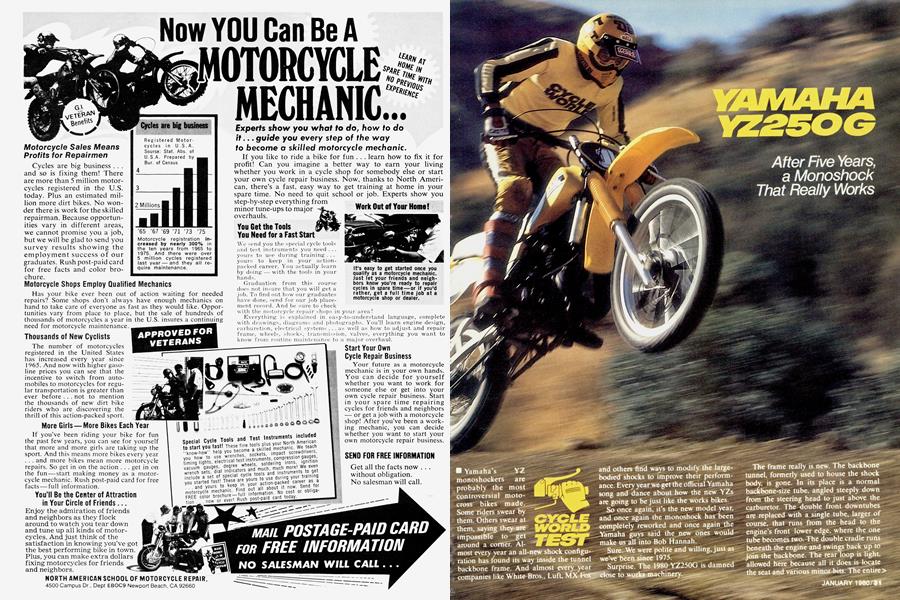
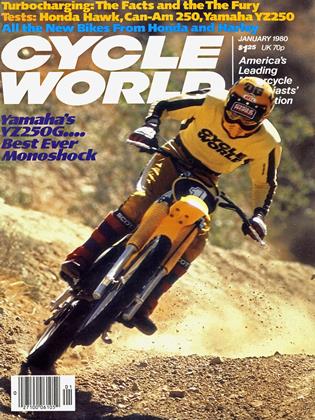
YAMAHA YZ250G
CYCLE WORLD TEST
After Five Years, a Monoshock That Really Works
Yamaha’s YZ monoshockers are probably the most controversial motocross bikes made.
Some riders swear by them. Others swear at them, saying they are impossible to get around a corner. Al-
most every year an all-new shock configuration has found its way inside the tunnel backbone frame. And almost every year companies like White Bros., Luft, MX Fox and others find ways to modify the largebodied shocks to improve their performance. Every year we get the official Yamaha song and dance about how the new YZs arc going to be just like the works bikes.
So once again, it’s the new model year, and once again the monoshock has been completely reworked and once again the Yamaha guys said the new ones would make us all into Bob Hannah.
Sure. We were polite and willing, just as we’ve been since 1975.
Surprise. The 1980 YZ250G is damned Close to works machinery.
The frame really is new. The backbone tunnel, formerly used to house the shock body, is gone. In its place is a normal backbone-size tube, angled steeply down from the steering head to just above the carburetor. The double front downtubes are replaced with a single tube, larger of course, that runs from the head to the engine’s front lower edge, where the one tube becomes two. The double cradle runs beneath the engine and swings back up to join the backbone. The rear loop is light, allowed here because all it does is locate the seat and various minor bits. The entire > frame is nicely braced and gusseted, a welcome contrast to the ugly multi-layer beef built into the older YZ frames.
The frame naturally gets—actually was designed for—the new monoshock. The body itself is shorter than before, and meets the backbone’s main tube just above the engine. The tube is tilted down so that the mounting junction is lower, in turn moving the shock’s weight down, lowering the center of gravity. (One of the old-style monoshock problems was the high center of gravity, a flaw the factory obviously had in mind when they made these changes.
The body itself is lighter, because it’s shorter. It holds as much oil as before because there's a giant reservoir to make up for the loss of volume inside the main body. Body and reservoir are aluminum, another weight saver.
The shock has been reversed, with the body in front and the spring in back. The reservoir is mounted in lightweight brackets and the nitrogen pressure is easily adjusted with the reservoir-mounted valve. The reversed shock placement also allows spring preload to be changed without removing the shock body from the frame, a required procedure on past YZs. The preload nuts are easily reached without removing any part of the bike. If you feel crowded adjusting it, removing the seat will allow adjustment while standing up. In the past, rebound damping has been adjustable by inserting a screwdriver through the frame and turning a star wheel. The G model’s damping can be changed by turning a large knob at the rear of the shock, just aft of the spring preload (under the rear fender). Rebound damping adjustments are a 5-sec. affair. The shock shaft is well protected by a plastic sleeve and a plastic splash pan. Between the two, nothing should be able to damage the shaft or seal."
Yamaha has used reed valve induction for several years. The ’80 retains the reed system with improvements. The reed stops are lightened and let the stainless steel reeds open 3mm farther ( 12mm compared to 9mm in 79). Yamaha insists on using steel reeds, shirking the claim of fiber reed superiority in favor of the long life stainless steel gives. Some people worry about steel reeds breaking and destroying an engine but we have never seen it happen. And the steel reeds don’t need constant replacement.
A 38mm Mikuni carburetor still feeds the 246cc engine. It has a pull-type choke lever with a plastic knob that works fine. Internally the jetting has changed consid-> erably. The main jet size has dropped from a number 400 to a 370, needle jet from a P-8 to a smaller Q-0. pilot jet from a 50 to a larger 60. The needle stays the same +^6fl6 but is adjusted to a different clip position. These changes in the carburetion were necessary because of an all-new pipe and different ignition timing.
The new pipe has a huge mid-section. It exits the right side of the cylinder (not the center as before), and winds across in front of the frame, where the first cone starts. It has strong, well placed mounting brackets and three springs holding the headpipe to the cylinder. Although larger, it doesn’t burn the rider like last year.
A fat silencer is mounted on the rear of the pipe to quiet the bark some, but it isn't rebuildable. The YZ should have a rebuildable silencer. Enough riding areas and even race tracks are already closed because of noise. If the YZ unit was repackage. maybe a few riders would repack it; not many w ill buy a complete silencer to reduce the noise . . . unless forced to do so.
The G has an almost completely new engine. The center cases are smaller than ever, looking like they belong on a 125. The transmission has six speeds, spaced properly for motocross racing. First is rather tall, just about right for hole shots from the starting line. Shifting is much improved thanks to a shift drum that rotates in bearings and new shift linkage. The pin detent (which holds a selected gear and helps stop overshifting) has been replaced with a spring-loaded arm and roller. These changes contribute to better shifting. Pri-, mary kick starting is still used and primary drive is via narrow helical-cut gears. The primary drive gear is one tooth smaller, the clutch basket gear three teeth smaller, but the end ratio is close to being the same.^ The reduction in size is another weightsaving change.
Countershaft sprocket placement was a major consideration when the new cases -were designed. The countershaft is at the rear of the engine and the swing arm pivot-* has been placed as close to it as possible, the distance between the swing arm pivot" and countershaft centers measuring a measly 2.7 in. Forget about thrown ’ chains—it won't happen. Swing arm movement hardly changes the chain tension.
Bore and stroke are the same as in 1979 and a two ring piston is still used. The cylinder is aluminum with a cast-in steel liner, meaning the owner can rebore it when it wears out or a mishap occurs. Four” overbore pistons are available from Yamaha and some American companies make another couple of sizes larger. The, connecting rod and crankshaft are basically unchanged.
Even the shock spring is trick. It is made from tapered diameter wire. The center section is the heaviest, the ends smaller. The overall diameter of the spring also changes in proportion to the wire diameter. The end result is a progressive spring with little change in the spacing between windings. This type of progression requires less spring (meaning it is lighter) and the spring can be shorter in overall length while furnishing the same travel as alonger, normally-wound progressive spring.
This new shock has been fitted to a much improved, rectangular cross-section aluminum swing arm that is well braced and strong. It pivots on needle bearings and has a hollow swing arm bolt that also acts as a rear engine bolt. The single bolt eliminates the problem of broken rear engine bolts and eliminates a couple of brackets and hardware.
The superb rear suspension is complemented by equally good front forks. Travel is 1 1.8 in., matching the rear end travel and quality. Oil seal drag is nearly nonexistent. Still, the seals are oil tight and good fork boots ensure they will stay that way for a long time. Travel has increased more than an inch from last year but stanchion tube engagement hasn't suffered; new lower legs supply the same engagement as before. Air caps are provided but Yamaha suggests trving the forks with no air. Stronger springs are standard and most riders w ill find them right w ithout air. The return to heavier springs and no air pressure is an attempt to eliminate the problem with the forks pumping up from heat. Normal air/oil/spring forks usually gain several pounds pressure by the end of a 40min. moto. Eliminating the starting air pressure makes the percentage buildup less, and the rider gets more constant fork action through long motos. As before, the damping can be altered by changing the volume and weight of fork oil.
YZs have had good double pinch bolt triple trees for several years. For 1980 the top one has had rubber mounted pedestals added. The rubber mounting eliminates vibration and shock; meaning the rider tires less during long races.
Yamaha YZs have had basically the same conical hubs for several years. The front hub for ’80 remains the same but the rear is completely new. The rear is much smaller and lighter than before, and uses the same brake lining as the YZ125. The old hub had a brake diameter of 6.3 in., the new hub measures 5.12 in. across. The lining length and width also change. The larger brake used slightly narrower but 1.0 in. longer lining. The smaller rear hub looks nice but braking power is reduced and it chatters when applied hard on bumpy downhills. Although the front hub is the same, the brake cam leverage has been changed. The front brake will stand the YZ on its nose with two fingers. Because the front brake does most of the stopping on a motorcycle, a potent front brake and softer rear makes sense.
The new G has yet another new airbox. This one is a good design that boasts a cone-shaped, dual stage foam filter. Gone is the nearly worthless fuzzy foam unit of years past. The dual filter has an outer filter that wraps around the inner and seats against the front of the airbox for complete sealing. The attachment is also new. Two studs attach to the front part of the air filter cage and protrude through the front of the filter box where wing nuts snug the cage and filter tightly against the airbox.
Most plastic parts on the G are new. Fenders are wide, long and effective. The cast-in strengthening ribs are gone in favor of thicker, smoothly-finished units. The front fender has a flared front section that looks right and works right, keeping mud and water out of the rider’s face. The fuel tank is shaped like last year’s tank but it’s not interchangeable. It holds 2.0 gal. of premix, has a reasonably-sized filler hole and decals that don’t fall off in the first 10 min. of riding. Decals are a minor thing to complain or boast about but a new machine looks old quickly when they fall off. Past YZs we have tested had bare tanks within a few minutes, but the G’s decals are still on the tank and they look like new.
Yamaha says most owners won’t need aftermarket modifications if they will read the owner’s manual and take the time to dial in the supplied suspension units—and they are right.
The aluminum shock has 24 rebound damping adjustments a twist of the finger away, spring preload that takes just a little longer to set, and the nitrogen pressure can be altered by tapping into the bottom of the remote reservoir. If these adjustments don’t produce the intended results or you are very light or heavy, a stiffer and softer spring are available from Yamaha.
The forks offer the same broad range of adjustment: vary the air pressure, the oil volume, oil weight, replace the fork springs with stiffer or softer springs, or change the handling quickness of the bike by raising or lowering the fork stanchion tubes in the triple trees.
Taking an hour or so to dial the suspension to the rider and track could make the difference between first and second in a race. And don’t forget to play with tire pressures while you’re at it. The Bridgestone tires on the YZ worked much better on hard ground after we dropped the air pressure from 12 psi to 10 psi.
Once dialed-in, the YZ handled like no previous monoshock. The top-heavy feel is completely gone, and it has lost the old tendency to highside in corners. The bike can be pitched into a berm, slid full-lock, or the corner can be motored through. The rider chooses and the bike complies. Handling through corners is neutral. It goes > where pointed, flex isn’t felt and rider confidence is excellent. Balance is also perfect. The front wheel stays on the ground in the corners and during full throttle acceleration but explodes into the air with a bump from the rider’s wrists. Once in the air, balance and control are good. The bike doesn’t try to loop or fall over sideways, it just stays where the rider wants it.
The G feels light and agile, probably because it is light. Yamaha claims the machine weighs 214 lb. dry. Our calibrated scales showed 220 lb. with a half tank of gas, 214 lb. dry. The light weight makes the 250 as agile as a 125. A full grown rider won’t be cramped on the bike as the control placement and general dimensions are full size 250, but the thrill of pitching a light 125 w'ill be present when aboard the 250G.
Handling in whooped straights has always been great on monoshocks and the ’80 model lives up to the deserved reputation. It will go through high speed whoops fast enough to scare about anyone. It never gets sideways or tries to side hop. Older model monoshocks had a nasty habit of kicking the rear wheel if the throttle was chopped over a rolling hill or a square shaped object was encountered. Every year the kick has become less severe, and it has been completely eliminated on the G model. The rear wheel behaves like a good conventional shock set-up. Bottoming the rear wheel’s 11.8 in. of travel is possible, as it should be, but the damping is very progressive and the rider’s spine doesn’t bottom with the suspension.
Engine power is plentiful but sudden. The engine comes on the pipe low in the rpm scale but the sudden surge may take a little getting used to. Once the rider adapts, the sudden burst of power can be used to exit corners in a rapid manner, but off-camber situations call for caution or the rear wheel will pass the front.
The G has a clutch pull much like a Maico—stiff. Although hard to pull, it engages smoothly and progressively.
The tall first gear will allow' starting in low at many tracks. The abundant power and the new shift linkage will also put the YZ into the first turn at the head of the pack much of the time. Shifting is smooth and positive and can be done rapidly. It can’t be shifted full-throttle no clutch. Maico style, but it is close. Turning the throttle off slightly or touching the clutch lever with one finger will let the shift lever engage the next gear.
Our only complaint with the G is a rear brake that chatters slightly when used hard on downhill bumps. And it isn’t bad enough to slow anyone dow n. Otherwise it is hard to fault the newest 250 motocross racer from Yamaha. And racer is w hat it is: as a play bike the quickness of the powerband will be hard to control for all but experts. But on the racetrack it is competitive both in suspension and power, and is up to the task of winning.
YAMAHA YZ25OG
SPECIFICATIONS
FEATURES