Can Am 250 Qualifier III
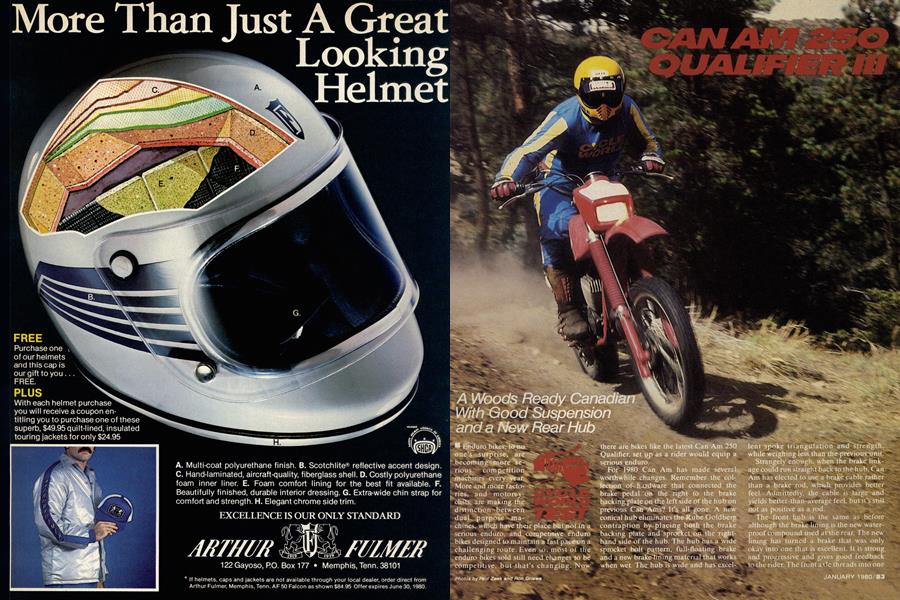
CAN AM 250 QUALIFIER III
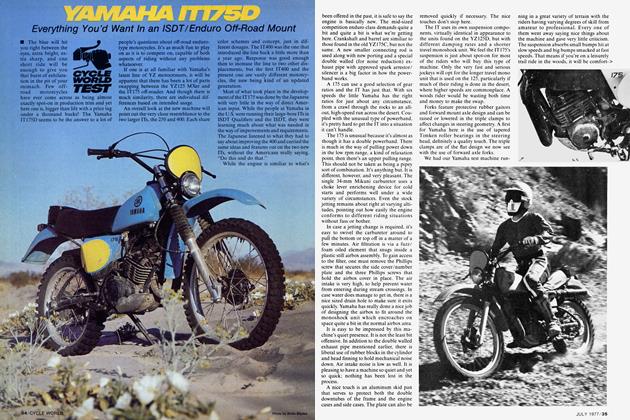
A Woods Ready Canadian With Good Suspension and a New Rear Hub
CYCLE WORLD TEST
Enduro bikes, to no one’s surprise, are becoming more serious competition machines every year. More and more facto-
ries, and motorcyclists, are making the distinction between dual purpose ma-
chines, which have their place but not in a serious enduro, and competitive enduro bikes designed to maintain a fast paceon a challenging route. Even so, most of the enduro bikes sold still need changes to be Competitive, but that’s changing. Now
there are bikes like the latest Can Am 250 Qualifier, set up as a rider would equip a serious enduro.
For 1980 Can Am has made several worthwhile changes. Remember the collection of hardware that connected the
brake pedal on the right to the brake backing plate on the left side of the hub on previous Can Ams? It’s all gone. A new conical hub eliminates the Rube Goldberg contraption by placing both the brake backing plate and sprocket op the righthand side of the hub. The hub has a wide sprocket bolt pattern, full-floating brake and a new brake lining material that works when wet. The hub is wide and has excel-
lent spoke triangulation ami 'Strength, while weighing less than the previous unit.
Strangely enough, when the brake linkage could run straight back to the hub. Can Am has elected to use a brake cable rather than a brake rod, which provides better
feel. Admittedly, the cable is large and yields better-than-average feel, but it*$ stiR not as positive as a rod.
The front hub is the same as before although the brake lining is the new waterproof compound used at the rear. The new lining has turned a brake that was only okay into one that is excellent. It is strong and progressive and gives good feedback to the rider. The front axle threads into one side of the forks, eliminating one nut and making removal quick and easy. After loosening the pinch bolts the rider can simply kick the pull bar to loosen it, turn counterclockwise and pull the axle out.
Although the suspension looks unchanged from last year, it is much better. The 35mm Marzocchis are smooth and compliant. They never jar or punish the rider; all of the harshness we have complained about for years is gone. They respond to the slightest irregularity, have progressive damping, and seldom bottom. They also contain excellent seals. Seal friction is slight and they don’t leak. Forget Marzocchi’s reputation, the newest ones are as good as anything made.
Rear suspension is a pair of gas charged Girling shocks and a curved chrome-moly swing arm.
Girlings, yuck, we grumbled during our initial garage inspection. It is hard not to pre-judge anything when the mere presence of an item makes your kidneys hurt. It really makes you feel silly when the product ends up working. Once broken in, the double spring Girlings worked great in the mountains and were acceptable for desert and cross-country use. Woods riders won’t need to change them until they wear out; they aren’t rebuildable. Most cross-country users will find they aren’t perfect but useable. For high speed cross-country riding, the compression damping is a little too heavy. Not to the point of stacking or pumping down, just too stiff for maximum comfort.
Outwardly the Rotax engine looks as it has for several years. The 250 motocrosser engine changed to a longer stroke configuration last year while the Qualifier stayed the same. For 1980 the Qualifier also gets what Can Am refers to as the long-stroke engine. With a bore of 72mm and stroke of 61mm, it really isn’t a long stroke engine, just longer than the 74 x 57.5mm borestroke it replaces. A two ring piston is used and uncorrected compression ratio is 12.5:1. Cylinder finning is more than generous and overheating is possible but not likely. A perfectly spaced six-speed transmission, wet clutch with primary kick starting and Bosch electronic ignition combine to make a smooth power plant.
And power is one thing Can Ams are famous for. They consistantly out produce their competition while being quieter. The newest Qualifier is as quiet as many street machines and, naturally, is forest legal. Too bad all bike manufacturers don’t produce quiet machines. The quiet spark arrester/silencer is also repackable, meaning an owner can keep it polite with a minimum of effort.
Many things on the Can Am have been made adjustable: The forks have been fitted with air caps that are connected by a balance tube, the pegs can be adjusted fore and aft, brake pedal height is easily changed, and the throttle is a nifty piece of trickery that can be a quick or slow throttle by pulling a plug and inserting the cable into a large or small spool. The swap takes less than a minute and doesn’t require complete disassembly of the throttle.
Control levers are top-of-the-line on the Qualifier. The shift lever has a spring loaded folding tip and the hand levers are dog-leg Maguras. The rear brake pedal doesn’t fold but can be easily bent back by hand if it does snag on a rock or tree root.
The chrome-moly frame is almost the same as before with a couple of minor changes. It has been strengthened at the steering head and the large top tube no longer serves as a tank for two-stroke oil. The oil injection has been dropped in favor of premixing. Otherwise the heavy-duty double downtube frame is unchanged.
Past Can Ams had a steering head that was adjustable to suit any condition. For 1980 the adjustable steering feature has> been dropped. The adjustable head cost more to produce and few owners took advantage of it—a 30° rake is standard now. Nice thing is, if a buver of an '80 model really wants to adjust the rake to a different angle, the older offset bearing races will fit and almost any angle is possible with the combination of races available.
Another part that has been eliminated is the center stand. Most Americans don't like them because a hard, level spot has to be found before they will hold the bike upright long enough to pull a wheel. Most enduro riders prefer laying the bike on its side for wheel removal, thus eliminating the possibility of it falling off the stand and bending the bars or levers. A curved side stand has taken its place and it works fine.
Good claw-top footpegs are mounted high enough to keep the rider’s toes from being smashed under the engine when the suspension is compressed and the pegs have strong return springs.
The air cleaner is another item that won't have to be thrown away. It is a K&N cloth filter, wrapped with an oiled foam Uni filter. It sits in an airbox at the top of the frame, under the seat. Cleaning requires removal of the seat (two bolts), but one of the advantages of a K&N filter is the long time between cleaning intervals. K&Ns aren't the best in water, hence the addition of the foam cover. Most cleanings will only amount to sliding the foam cover off. cleaning and oiling the foam and sliding it back over the K&N unit.
Starting a 250 Qualifier is a simple onekick affair. The kick lever is placed on the left side of the bike but doesn’t seem clumsy. It completely clears the foot peg and the lever turns the engine over several times with one prod. It may be one of the easiest bikes made to kick over, and it feels like it could be done barefooted.
Our test machine had a regular speedo/ odometer but later bikes will be equipped only with an odometer similar to the unit used on Suzuki PEs.
Stock gearing is good for a speedo indicated 75 in sixth, while supplying a lowgear that will climb about anything. Spac-> ing between gears is perfect and the gearbox ratios and engine power complement each other.
250 CAN AM QUALIFIER III
SPECIFICATIONS
DIMENSIONS
FEATURES
The 32mm Bing carburetor runs cleanly at all elevations but doesn’t yield very good mileage. We tested the bike in the Mojave desert and in pine covered forests that ranged to 8500-ft. elevation, without changing the jetting. Fuel mileage proved a problem at all test sites. The plastic 2.6 gal. tank went empty at 63 miles in the desert and ran out of fuel at 52 miles in the mountains. Of course, rider ability and rating will have much to do with the miles covered; an easy rider will cover more miles. Our desert testing was done by a desert expert, the mountain testing by an A enduro rider. Both riders were on the main jet most of the time, and the short distances covered reflect hard riding. Still, a larger tank would be nice.
Comfort and control are great. The seating position and general control layout are excellent. About the only complaint is a seat that has a small hump in the front, right were a fast rider will want to sit. This hump is intentional though. After the foam breaks in, the extra thickness prevents a hole or low spot and everything feels right. This proves a bonus; the seat will be usable for a long time.
Handling is hard to fault on the 250 Qualifier. It goes exactly where the rider points it, doesn’t knife or skate the front wheel. Brakes are strong and predictable, shifting is positive, pow'er is smooth, controllable and plentiful, fenders keep water and mud ofif the rider and the suspension is fine for most riders as delivered. Control is exceptionally good in sand washes and loose rocky areas. We can’t think of any modern bike with leading axle forks that comes close to matching the stability of the Can Am in rocks or sand. We have come to expect head wobble in deep sand when aboard a bike with leading axle forks—the 250 Qualifier changed all that. It is arrow straight down the deepest sand washes, and its stability through loose rocks is unbelievable.
The 1980 Can Am 250cc Qualifier doesn't need modification in any form to be race ready. It is a complete, well thought out, serious woods bike. And the buyer won’t have to be an A rider to be able to enjoy its virtues. Beginner to expert will find the Qualifier competitive, yet easy to ride.
If all this sounds like we liked the 250 Qualifier III, it's because we did.