Honda Cbx
HONDA CBX
For Those Who Won't Settle for Less Than TOO MUCH
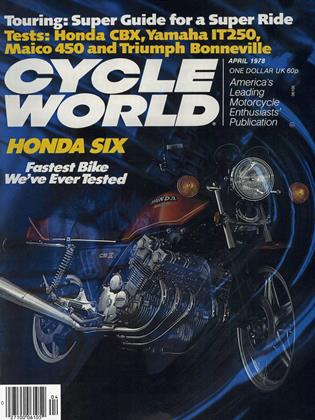
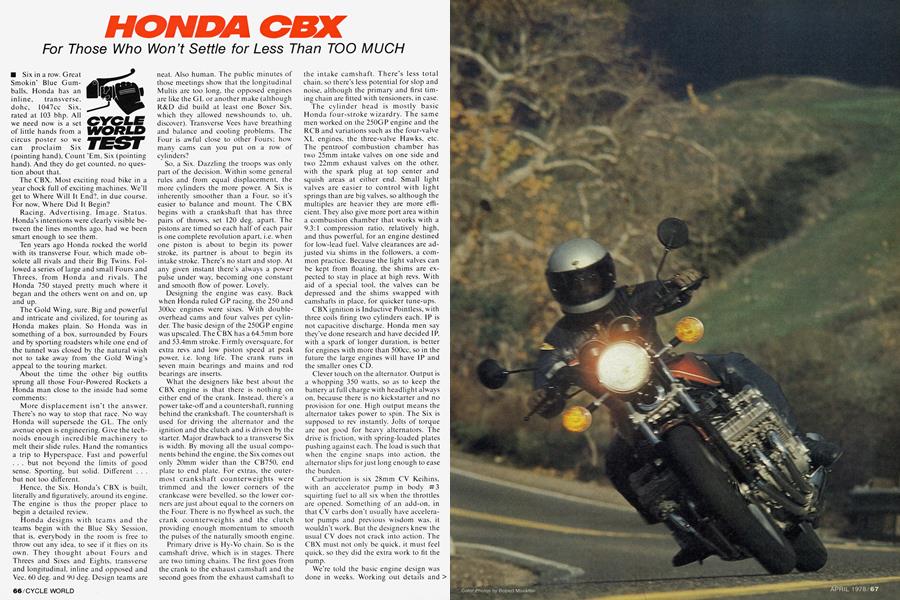
Six in a row. Great Smokin' Blue Gumballs, Honda has an inline, transverse, dohc, 1047cc Six, rated at 103 bhp. All we need now is a set of little hands from a circus poster so we can proclaim Six (pointing hand). Count 'Em, Six (pointing hand). And they do get counted, no question about that.
The CBX. Most exciting road bike in a year chock full of exciting machines. We'll get to Where Will It End?, in due course. For now. Where Did It Begin?
Racing. Advertising. Image. Status. Honda's intentions were clearly visible between the lines months ago, had we been smart enough to see them.
Ten years ago Honda rocked the world with its transverse Four, which made obsolete all rivals and their Big Twins. Followed a series of large and small Fours and Threes, from Honda and rivals. The Honda 750 stayed pretty much where it began and the others went on and on. up and up.
The Gold Wing. sure. Big and powerful and intricate and civilized, for touring as Honda makes plain. So Honda was in something of a box, surrounded by Fours and by sporting roadsters while one end of the tunnel was closed by the natural wish not to take away from the Gold Wing's appeal to the touring market.
About the time the other big outfits sprung all those Four-Powered Rockets a Honda man close to the inside had some comments:
More displacement isn't the answer. There's no way to stop that race. No way Honda will supersede the GL. The only avenue open is engineering. Give the technoids enough incredible machinery to melt their slide rules. Hand the romantics a trip to Hyperspace. Fast and powerful . . . but not beyond the limits of good sense. Sporting, but solid. Different . . . but not too different.
Hence, the Six. Honda's CBX is built, literally and figuratively, around its engine. The engine is thus the proper place to begin a detailed review.
Honda designs with teams and the teams begin with the Blue Sky Session, that is, everybody in the room is free to throw out any idea, to see if it flies on its own. They thought about Fours and Threes and Sixes and Eights, transverse and longitudinal, inline and opposed and Vee, 60 deg. and 90 deg. Design teams are neat. Also human. The public minutes of those meetings show that the longitudinal Multis are too long, the opposed engines are like the GL or another make (although R&D did build at least one Boxer Six. which they allowed newshounds to, uh, discover). Transverse Vees have breathing and balance and cooling problems. The Four is awful close to other Fours; how many cams can you put on a row of cylinders?
So, a Six. Dazzling the troops was only part of the decision. Within some general rules and from equal displacement, the more cylinders the more power. A Six is inherently smoother than a Four, so it's easier to balance and mount. The CBX begins with a crankshaft that has three pairs of throws, set 120 deg. apart. The pistons are timed so each half of each pair is one complete revolution apart, i.e. when one piston is about to begin its power stroke, its partner is about to begin its intake stroke. There's no start and stop. At any given instant there's always a power pulse under way, becoming one constant and smooth flow of power. Lovely.
Designing the engine was easy. Back when Honda ruled GP racing, the 250 and 300cc engines were sixes. With doubleoverhead cams and four valves per cylinder. The basic design of the 250GP engine was upscaled. The CBX has a 64.5mm bore and 53.4mm stroke. Firmly oversquare, for extra revs and low piston speed at peak power, i.e. long life. The crank runs in seven main bearings and mains and rod bearings are inserts.
What the designers like best about the CBX engine is that there is nothing on either end of the crank. Instead, there's a power take-off and a countershaft, running behind the crankshaft. The countershaft is used for driving the alternator and the ignition and the clutch and is driven by the starter. Major drawback to a transverse Six is width. By moving all the usual components behind the engine, the Six comes out only 20mm wider than the CB750, end plate to end plate. For extras, the outermost crankshaft counterweights were trimmed and the lower corners of the crankcase were bevelled, so the lower corners are just about equal to the corners on the Four. There is no flywheel as such, the crank counterweights and the clutch providing enough momentum to smooth the pulses of the naturally smooth engine.
Primary drive is Hy-Vo chain. So is the camshaft drive, which is in stages. There are two timing chains. The first goes from the crank to the exhaust camshaft and the second goes from the exhaust camshaft to the intake camshaft. There's less total chain, so there's less potential for slop and noise, although the primary and first timing chain are fitted with tensioners, in case.
The cylinder head is mostly basic Honda four-stroke wizardry. The same men worked on the 250GP engine and the RCB and variations such as the four-valve XL engines, the three-valve Hawks, etc. The pentroof combustion chamber has two 25mm intake valves on one side and two 22mm exhaust valves on the other, with the spark plug at top center and squish areas at either end. Small light valves are easier to control with light springs than are big valves, so although the multiples are heavier they are more efficient. They also give more port area within a combustion chamber that works with a 9.3:1 compression ratio, relatively high, and thus powerful, for an engine destined for low-lead fuel. Valve clearances are adjusted via shims in the followers, a common practice. Because the light valves can be kept from floating, the shims are expected to stay in place at high revs. With aid of a special tool, the valves can be depressed and the shims swapped with camshafts in place, for quicker tune-ups.
CBX ignition is Inductive Pointless, with three coils firing two cylinders each. IP is not capacitive discharge. Honda men say they've done research and have decided IP, with a spark of longer duration, is better for engines with more than 500cc, so in the future the large engines will have IP and the smaller ones CD.
Clever touch on the alternator. Output is a whopping 350 watts, so as to keep the battery at full charge with headlight always on, because there is no kickstarter and no provision for one. High output means the alternator takes power to spin. The Six is supposed to rev instantly. Jolts of torque are not good for heavy alternators. The drive is friction, with spring-loaded plates pushing against each. The load is such that when the engine snaps into action, the alternator slips for just long enough to ease the burden.
Carburetion is six 28mm CV Keihins, with an accelerator pump in body #3 squirting fuel to all six when the throttles are opened. Something of an add-on, in that CV carbs don't usually have accelerator pumps and previous wisdom was, it wouldn't work. But the designers knew the usual CV does not crack into action. The CBX must not only be quick, it must feel quick, so they did the extra work to fit the pump.
We're told the basic engine design was done in weeks. Working out details and > building a motorcycle around the engine took most of the 18 months spent on the project.
The carbs: The Six is no wider than the Four, at the crank. But the Four is a good 6 in. narrower at the top than at the bottom and the sides of the Six are straight up and down. Six carbs coming straight back from the intake ports splay the rider's knees. No good. The intake port flanges are aimed inboard. This Vee keeps the airbox no wider than the fuel tank. It also gives unequal length to the intake tracts. Most of the resulting imbalance of pulses and thus mixture has been taken care of by fitting unequal length tubes inside the airbox. But the engineers also say the outboard cylinders don't breathe as well as the inside ones do.
The exhaust. Not strictly a width problem but surely a matter of numbers. Getting just the right sporting note and efficiency and legal noise level meant the header pipes had to be precisely cut and placed, running into just-so collectors, one for each side of three. The exhaust system set up a screen between the engine and cooling air. Rather than muddle the exhaust or increase engine size and complexity and weight with a larger sump, an oil cooler was added, just aft of the stanchion tubes. Looks like a sports option but it isn't.
Now comes the hard part: getting the engine into a normal motorcycle. The Six is unavoidably tall as well as wide. As we'll see shortly, keeping the engine as low as possible was critical. The cylinders therefore were tilted forward to 33 deg., compared with 15 deg. on the CB750.
Now the engine is long. A long wheelbase was out. Not sporting and agile. Wheel-to-engine clearance was possible only if there were no front downtubes.
Demanding work. There have been many motorcycles with no front downtube. Those GP bikes with smaller Sixes had frames like that. There was a time in the early Sixties when the "7" Framebackbone for top, center post for the legwas common. The late Vincent Twins went so far as to bolt the oil tank to the cylinder heads and the steering head to the oil tank. And a couple modern motocrossers have no downtube or engine cradle, to gain ground clearance.
The CBX goes beyond this. The frame not only has to handle force from the wheels, it must carry a 240-lb. engine as well. And resist 100 blip. The CBX has three backbones. One larger, central tube runs from the top of the steering head straight back to the rearward loop that ends beneath the rear fender. The other tubes run from the bottom of the steering head outward and back to aft of the tank, where they sweep down to the swing arm pivot. There are braces between the center and the outboard tubes.
Now. The larger this triangle, the stiffer the frame. And the more trouble fitting the engine and the fuel tank. The triangle stiffens in all dimensions. Because it can't do this as well as the standard cradle frame, the CBX engine is a supplemental frame member, firmly bolted to the cylinder head and to the rear of the engine. (The mounting pattern forms a diamond, which is how the factory refers to the frame design.)
About the fuel tank. A deliberate balance had to be found between size of triangle and shape of tank. The CBX has the widest and most shallow 5-gal. tank ever fitted to a motorcycle. The tank straddles the triangular backbone and the fuel rides high and outside.
For a payoff, the CBX wheelbase is 58.9 in., only 0.2 in. more than a CB750 and 2.0 in. shorter than the GL. Best, the CBX frame is stiff. It does its job.
Brakes are a good display of picking from the parts counter. The dual front > discs are mixed CB750 and GL. Linkage is revised, in that there's more travel for a given brake pressure. With an expert hand, the brakes can be controlled to exactly whatever force the rider wishes. They could also be locked by a clumsy hand, but Honda doesn't intend the CBX for newcomers. The rear disc is a new caliper and a CB750 rotor. Does the job.
HONDA CBX
Showa straight-leg fork Fork travel 6.3 in. Engagement 5.8 in. Spring rate 50/58 lb./in. Compression damping force 8 lb. Rebound damping force 35 lb. Static seal friction 18 lb. Forks on this pre-production CBX are basically 750F2 units, with slight modification. A progressive spring is fitted, instead of the F2's 47-lb. coils. Static seal friction is high, resulting in a loss of compliance and a stiffer than necessary ride. Contrary to latest practices, no slider bearings were employed in these smallish (35mm) diameter legs. Production units will be much the same, but will be fitted with teflon-impregnated slider bearings.
Showa FVQ shock Shock travel 3.7 in. Wheel travel 4.3 in. Spring rate 120 lb./in. Compression damping force 40 lb. Rebound damping force 64 lb.
The CBX rear suspension gives more feedback than necessary. This harshness does not stem from excessive spring rate, but rather from dual-stage compression damping. The dashed line shows a conventional damping curve at half-normal test velocity. Above this relatively low (4.7 in./sec.) speed, there is an abrupt increase in compression damping, which produces a very harsh ride. A shock with half the compression damping and twice as much rebound damping would better suit the majority of CBX purchasers.
Tests performed at Number 1 Products
If there are compromises in the CBX— and of course there are. just as with any product of human hands—they appear in the suspension. Weight was something the design team worked against. The camshafts are hollow, for instance, there are lightening holes in the gears, myriad smaller parts are aluminum or magnesium, which usually isn't used on road bikes.
The front stanchion tubes are only 35mm in diameter. The swing arm tubes are no larger than you'd find on a 250 motocross bike. The steering stem is hollow. The swing arm rides in plastic bushings.
Nothing wrong. It's just that the other Cannons, four cylinders or no, are arriving with adjustable front spring loading, and even externally variable rear shock damping. and air forks and stiffer stanchion tubes and swing arms with needle bearings.
CBX wheels are second-generation ComStar, with aluminum spokes instead of the steel used on the originals.
Tires? Tubeless. No less. Japanese Dunlops on our test CBX. We've also seen tubeless Bridgestones on the CX500. Honda and at least those two tire companies have been working on a good idea whose time should have been before now. Tubeless tires are lighter, run cooler, lose> air pressure more slowly in case of puncture and can be designed to retain some grip and control when flat. We look for more of this, from the other tire makers and on motorcycles from other factories.
Time for sheer entertainment. The rule book doesn't say handlebars must be round and hollow and the CBX bars aren't. Better we call them handbeams, as the CBX has alloy forgings, round at the grip, then I-beam, then round again at the clips. Right. Clip-ons, like at the races. The beams cinch to the top of the stanchion tubes. They can be adjusted fore and aft, although not up and down. Bars of course are the reverse. Quoting from the Honda spokesman, the engineers wished "to emulate an aircraft," specifically the F14 Phantom, so they made the beams instead of bars.
Same for controls and instruments. The beams and grips and clamps and wires are black. The horn button is yellow. Bright yellow. The starter button and kill switch are red as Honda red can be. Tachometer and speedometer sit above a panel containing lights for oil pressure, neutral, high beam and turn signal, with a voltmeter between them. The dials are white numbers with orange, behind glare-proof glass. The intended effect is, again, aircraft. Fighter planes. Speed, power, function.
Function? Well, the controls do work well, for the most part. And just who did say handlebars must be round?
Styling is Honda. Oh yes, the CBX was styled. Some of the tank shape came from the demands of the frame, but the curves are Honda. The 1978 Honda family is just that, from XL250S to Hawk to CX500 to CBX. The CBX tank curls up and down to the scooped seat, which curves up to a second step and then flips, into a spoiler tail. Does it work? Not in terms of downforce, no, but it does catch the eye.
Impact is dependent on position. From the front, the huge, gleaming, finned engine, bristling with cam towers and exhaust pipes, big shoulders bulging beyond the tank, unblocked by frame tubes, dominates the view, stops onlookers in their tracks.
From the sides the CBX appears its actual size, which isn't as big as the engine makes it look. From the side the CBX is clearly different. Other bikers follow the CBX for miles, sure it's something new and splendid but not aware until they're told that it's Honda's Super Six.
The lights are matched to the bike's intended purpose. The headlight is a quartz-halogen, in the DOT-legal H4 spec. The taillight is maybe twice as big as normal. Turn signals are also oversized and the front lights are always on, the better to tell oncoming traffic that this is a motorcycle rather than a one-eyed car.
Puffed, two-step seat and fancy aft section bolt to the frame. The seat base is plastic, another weight saving.
Rider pegs, shift and brake lever pivots, passenger pegs and muffler mounts all attach to aluminum castings bolted to the frame. One reason is weight. Another is that in case the bike gets dropped, the impact can be taken by the pegs and casting, which are easier to repair than is the frame.
Both sets of pegs fold. Both sets are serrated, with rubber inserts. The rider pegs have replaceable bolts at the bottom outside, to touch down before the stands or mufflers do. The bolts, see, can be replaced if worn away. Static leaning angle of the CBX is 39 deg. The CBX is reported by Honda to have more cornering clearance than any other production bike. So much for too wide an engine.
To close the technical description, a brief comparison:
In layman's terms, there is no free lunch. Honda went for power-per-cc, and got it and found that the extra power meant complexity and bulk. Paring off everything practical—there is no fat on the CBX— brought the Six neatly into place on the stepladder; the bigger the engine, the heavier the bike.
Flurry of trumpets, though, on account the actual purpose of this size and power has been achieved.
We have a new champion. Of the world. The CBX's best time at the dragstrip was 11.46 sec., with a speed of 117.95mph through the traps.
Right, we're talking about a victory measured in hundredths of a second. And we're talking about a pastime in which not all owners of these projectiles indulge. And when Grudge Night comes, the winner likely will be he who rides best and tunes with the greatest skill.
And the above paragraph rings hollow. When they hand out the trophies and sign the checks, nothing in the fine print says you didn't win by much. First place is first place.
As useful to all riders is that the CBX is well mannered when all the stops are out. Rev to 7500 when staged, drop the clutch and nail it on green and POW! out of the hole like a rifle bullet, both wheels on the ground. A touch too much power and the rear wheel does begin to walk but that can be controlled, witness the pictures from the testing.
The Super Six is magnificent. A masterpiece. The most sophisticated motorcycle engine ever built for sale. The CBX engine idles smoothly, pulls from all speeds and gets stronger as revs build.
As words of comfort to the other 40 or so motorcycle manufacturers in the world, the CBX is not perfect. (Although our test example was #8 and perhaps still had a few of the inevitable bugs that always appear on a new engine.)
Starting from cold took practice. One tester tried full choke and it took him several minutes. A second man used threequarter choke and two blips of the accelerator pump and it took him several minutes. The third man says the drill is threequarter choke, no blips and don't touch the throttle until the engine is firing.
Nearest thing to a vibration comes at idle, when the firing order displays itself with a tiny rocking couple and the engine can be felt to tremble side-to-side. Our test unit had audible slop in the primary drive, the friction clutch on the alternator squeaked now and then. The CV Keihins are better than most but even so, they did display an occasional surge at cruise.
Clutch action is progressive and the pull is lighter than one would expect, considering the power being held by the plates. Shifting is beyond reproach. Gearing and spacing didn't show up in the test reports because there is so much power on tap at all times that there's never a need to downshift, nor does one feel it's time to shift up as the peak is passed.
The accelerator pump does its work in that the engine responds immediately to the throttle. A mixed review is that the test riders who don't believe there can be too much power thought the CBX lacked the punch of, say, an XS11. Crew members more at home on middleweights had their breath taken away by the CBX as quickly as by the other missiles.
There is a price paid at fuel stops. The test circuit was 38 mpg and during the test period results dropped at times to 27, which isn't good for a car these days. A lOOOcc Harley-Davidson will do 50 mpg. Power is not the same as efficiency.
Beginning as the CBX does as a sports machine, it comes as no surprise that the ride is rough. Especially so on the highway, where the forks have excess stiction and the rear shocks have high damping at the first compression stage, with stiffish springs designed to handle the power at speed. Every bump and ripple comes through.
In exchange for this, CBX handling is not as good as it could be.
Recall how the engineering was done, that is, engine first, then chassis around the engine, then suspension for the chassis. The best came first.
The CBX Six is high and wide and heavy. The tank is high and wide and while a 5.3-gal. fuel load is not unreasonable, it does ride in an awkward place. The center of gravity is high and the mass working at this center is considerable.
Centrifugal force pushes this mass outward on turns with the leverage produced by the distance from the ground to the e.g.
continued on page 78
Gravity pulls the e.g. down, also levered by the distance from e.g. to pivot, the tire contact patch on the ground.
Balance is no problem, as the two above factors cancel each other out. A motorcycle with a low e.g. doesn't handle better. What it does is change positions and attitudes with more agility. The CBX is not agile. It takes rider effort and time and planning to go from one mode to another.
The suspension doesn't completely control the mass and the various forces working on it. Riding at a sporting pace, say 7/ 10s maximum with traction and steering potential in hand for emergencies, the CBX has a mild wallow at both ends. On a fast sweeper with smooth surface, the CBX can be felt working against itself, slowly flexing. Put a few bumps into the road and the CBX begins to wander and pitch.
Mark this. Danger is not the question here. These symptoms appear with the pegs unscraped and the pegs scrape well before the rest of the bike, that is, well before traction is lost or the machine is committed to a line it will not hold. The shock absorbers and forks especially are not so much not good as they are not good enough.
The finest engine ever, the high point of a string of Superbikes, deserves better than adequate.
Brakes are excellent and demanding. Excellent in that stopping distances are better than average and control is unsurpassed . . . with practice. The front brake leverage has been set so that there is long travel and light pull. Modulation is great", as exactly the desired amount of braking can be fed into the discs. There is some drawback here as a hearty grip can lock the front wheel. In this case, the expert is catered to and one can't quarrel with that.
The rear brake tends to chatter when used to the full. This too can be controlled although a better solution (also working on the theme that the best engine deserves the best of everything else) would be a fullfloating brake. Surely top-grade shocks and full-floating brakes aren't that much more expensive than I-beam handlebars.
Controls are rated at maybe 95 out of 100. The I-beams do work, indeed we suspect that setting the angle is at least as useful as setting the height. Throttle effort is light, giving hope that after all these years of griping and fitting CB550 springs to the CB750 engine, we got their attention.
And they get ours. The two-plane seat looks a bit. well, like the Hawk seat and the other new-for-1978 Honda seats, that is to say, not all that good. But it fits just fine. The curve is large enough for the average butt and high enough in back to keep you in place, no easy task when the tach shows 9500 and you reach for another gear. The shape doesn't intrude, as it curves with the normal thigh and leg. (Two years ago we saw Honda R&D guys fitting experimental seats with pressure sensors and transducers and like that, to show where the rider sets his seat. Their work was not in vain.)
Seat-bar-peg-lever ratios pleased everybody, well, one guy did say the pegs seemed a shade high for him but hell, people have different leg-arm-trunk ratios.
The headlight is bright enough to illuminate just how far behind all sealed beam headlights are.
Nearly forgot the fuel tank cap. The actual cap twists to close. Its upper surface has a wide groove and when the cap is fastened, the groove runs fore and aft and a stout bar swings down from a hinge at the rear and locks the cap in place. Another aircrafty feature but again, it works well enough and it is different. The orange and white needles with anti-glare glass are an aircraft touch and they do belong and perform well. The monitor lights are brighter than they need to be.
The turn signal switch is dumb. Dumb. It's a semi-circular knob with knurled sides and a shallow notch in the middle. The notch is too small for the gloved human hand, which means you work it from either side, just like any other switch and that means, why the notch? Further, there is no detectable detent in the center or off position, so you can push too far or not far enough, which turns off the running-light circuit. Humph.
Now, a sprinkling of philosophy.
Where It Will End is right about here. During the last several years we've seen huge changes in huge engines and we've gone as far as we'll go, even allowing for the 1500cc Harley, the BMW Four and a rumored unconventional Multi from a source too close for us to identify at present. Sure, there will be larger and more powerful motors and even more speed. Records were made to be . . . fill it in.
If drag racing is how we pick winners, then drag racing is what we'll parallel. Once it was toppling of records. Now it's bitter contests over fractions.
Meanwhile, the CBX is It.
The CBX is Honda's way of telling the other outfits what they can do with their Fours.
The CBX is too much.
The CBX is outrageous.
The CBX is the Most, of what we don't need. As is well known, what you don't need is what you ean't get enough of.
This isn't 1968. The CBX will not have the impact the 750 had. We're more experienced now and we have more choices. If the Harley and BMW people didn't switch from Two to Four, why should they get sweaty palms for a Six?
Admitting all that, adding that a Six really isn't that much smoother than a Four, and that you can't tell much difference when riding, and that there are other Superbikes with more torque and comfort and better handling, and you come up with a motorcycle that makes its own rules.
The others will argue the merits of their entries for Top Eliminator and they will of course have sound reasons behind them.
Won't matter. A Six! Damn! If you're gonna go too far. might as well go as too far as you can. As of this instant, soon as the sight of that incredible engine and those pipes becomes a shriek through the traps 11 sec. later, CBX Rules.