Suzuki Rm370
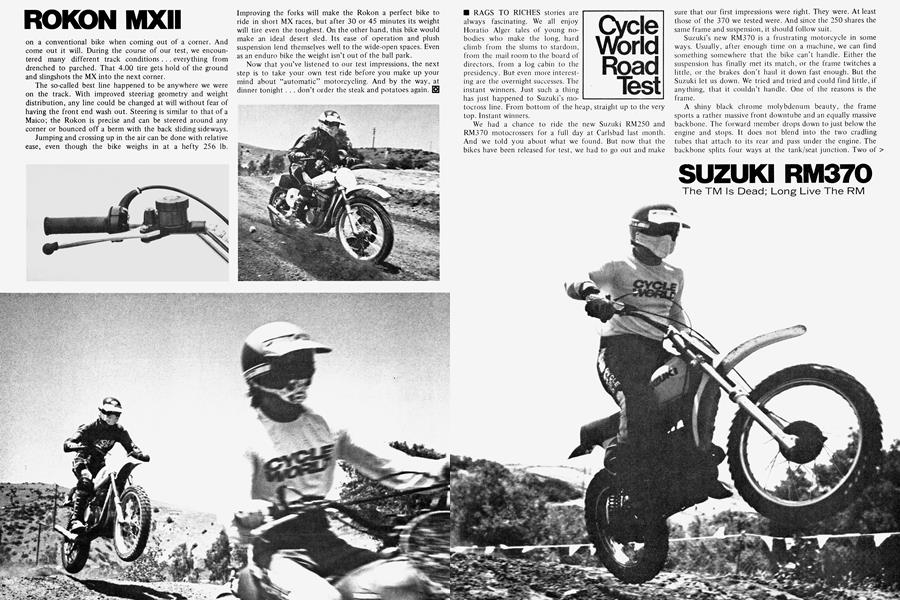
SUZUKI RM370
Cycle World Road Test
The TM Is Dead; Long Live The RM
■ RAGS TO RICHES stories are always fascinating. We all enjoy Horatio Alger tales of young nobodies who make the long, hard climb from the slums to stardom, from the mail room to the board of directors, from a log cabin to the presidency. But even more interesting are the overnight successes. The instant winners. Just such a thing has just happened to Suzuki’s motocross line. From bottom of the heap, straight up to the very top. Instant winners.
We had a chance to ride the new Suzuki RM250 and RM370 motocrossers for a full day at Carlsbad last month. And we told you about what we found. But now that the bikes have been released for test, we had to go out and make sure that our first impressions were right. They were. At least those of the 370 we tested were. And since the 250 shares the same frame and suspension, it should follow suit.
Suzuki’s new RM370 is a frustrating motorcycle in some ways. Usually, after enough time on a machine, we can find something somewhere that the bike can’t handle. Either the suspension has finally met its match, or the frame twitches a little, or the brakes don’t haul it down fast enough. But the Suzuki let us down. We tried and tried and could find little, if anything, that it couldn’t handle. One of the reasons is the frame.
A shiny black chrome molybdenum beauty, the frame sports a rather massive front downtube and an equally massive backbone. The forward member drops down to just below the engine and stops. It does not blend into the two cradling tubes that attach to its rear and pass under the engine. The backbone splits four ways at the tank/seat junction. Two of the smaller diameter tubes slope down to meet the engine cradles at the swinging arm pivot. The other two go straight back to form the mounting base for the seat. At the end of the seat, the frame stops. There is no rear fender loop.
The swinging arm is also chrome moly (as are the handlebars). The rear frame sections on the Suzuki are designed for a lay-down (cantilever) shock arrangement. The standard shocks are Kayaba gas/oil units. We knew from previous exposure to Kayaba gas units that they are unquestionably the finest conventional shocks on the market. The ones on the RM didn’t alter our opinion at all. They work flawlessly. It is a tribute to the design and operating versatility of the shock that neither our 145-lb. staff flyweight nor our 195-lb. spring-sacker had a single complaint about the RM rear end.
The ride is plush. The first few of the available 8.3 in. of travel (by our measurement) are very soft. The final inches are much stiffer. But the transition from the soft to the stiff ride is not discernible. It all flows very smoothly back and forth from one range to the other.
The front forks are very good. They’re not the finest we’ve ever tried, although the finest on any Japanese machine by far. The forks were bottoming out with more regularity than we consider acceptable. Different pre-load spacers are available for the forks. We substituted longer ones and the problem went away. Actually, it would have been better if Suzuki had used a spring that would get progressively stiffer sooner than the stock one does. But since they didn’t, the spacers accomplish just about the same thing.
There was also a tendency for the front end to search when going through sand or soft dirt at speed. When we stiffened the spring rate up, some of this tendency diminished as well. The forks have more than 8.5 in. of travel. In order to achieve this much, it was necessary to go to an offset front axle that allows the fork to be extended below the level of the axle. In conjunction with the offset axle, a pair of straight-across triple clamps are supplied. This provides very Maico-like steering characteristics. And, recalling what the Maicos, 125 Elsinores, MR 175 Hondas and XL125 Hondas all felt like in sand, we can tell you that a little front-end searching is characteristic of all machines that have this type of steering geometry.
Everything on the RM370 is new. Nothing is a carry-over from the near-defunct TM line. Especially the motor. Suzuki calls its new case-reed induction a “Power Reed.” Basically, it consists of a very mild intake port in the normal position, supplemented by a reed valve that breathes from the intake tract directly into the crankcase. The mild port gives the machine its fantastic low-end pulling power. At high rpm, it is a combination of the full-stroke breathing power of the reed, as well as the conventional port, which feeds the RM enough fuel to produce its fierce horsepower. The combination has proven successful on the Suzuki RH-series G.P. machines over the past season-and-a-half of racing. The single reed is stainless steel and Suzuki claims exceptional reed life.
The piston in the RM measures 77mm (stroke is 80mm) and features a more rigid internal X-type bracing. There are also small oil holes drilled into the new piston for more efficient lubrication.
Porting on the RM370 is not as radical as on its quarter-liter counterpart. While the RM250 has six transfer ports, the 370 comes with only four. No noticeable power increase was available with six transfers, so Suzuki opted for the simpler— but just as efficient—four-transfer cylinder. Another unique thing about the 370 is the compression-bypass hole. This is a minute tunnel that runs from the cylinder wall above the> exhaust port to the exhaust port itself. Its purpose is to relieve compression when the engine is being kickstarted and reduce the possibility of kickback. Once the engine is running, the speed of the piston is so great and the hole so small, that its effect virtually disappears.
Straight-cut primary gears take the power from the motor and deliver it to the close-ratio five-speed transmission. The transmission is all-new and shares nothing with the TM400 gearbox. Ratios are designed explicitly for the RM370’s power. As usual, the operation cannot be faulted. The Japanese sure know how to build transmissions. The one thing that we didn’t like, though, was the lack of primary kickstarting. If you want to start the 370, it had better be in neutral. This is made necessary by Suzuki’s desire to save weight. While this machine is truly a G.P. Replica, we feel that enough Novices and Beginners are going to end up on it, because of its appeal, to warrant an in-gear starting convenience. The two pounds saved can hardly be justified for anyone short of a professional racer.
Gassing around on the 370 is really where this bike is at. The floating sensation that the suspension delivers makes it beg to be ridden hard. But it has the grunt and softness of ride to be used as a play bike, although its tiny silencer makes it unacceptable for such applications.
On the race track, the RM will run with anything and away from most. The geometry allows you to steer precisely wherever you want. Changing lines in mid-turn is easy. It’s even easier if you learn to use the power in conjunction with the lithe steering. Coming out of corners, we’d have to rate Maico’s 450 as slightly quicker, because the Maico has more flywheel and gets a greater percentage of its power to the ground. But once the snappy Suzuki hooks up, it really gets moving. Slowing down, the same lack of flywheel on the RM> makes the rear brake’s application particularly critical. The front binder is great, but care must be taken with the rear one so as not to lock up the engine. If you do, then you have to find neutral before you can restart the motor.
At 225 lb. dry, the RM370 is far from the lightest Open class motocrosser. Robust things like the frame, swinging arm and shock absorbers offset such lightweight items as the Dural fork sliders, magnesium outer engine cases and the aluminum gas tank. But the RM feels much lighter than it is, due mostly to unsprung weight that has been kept to a minimum. Here, we encounter our only serious complaint about the Suzuki. The ridgeless Takasago rims are much too soft for serious competition. They are very light, but they bend easily. And the spokes are forever coming loose. We wish that Suzuki had used D.I.D.s instead.
SUZUKI RM370
$1545
SUSPENSION DYNO TEST FRONT FORKS
Description: Suzuki RM370fork with 31 5 oil Fork travel, in.: 8.5 Engagement, in.: 5.5 Spring rate, lb./in.: 20/25 progressive Compression damping force, lb.: 11 Rebound damping force, lb.: 21 Static seal friction, lb.: 4
REMARKS: Front fork action is very good, but does not equal that of the rear. Heavier riders (200 lb.) or those who ride very hard, will need to go to a progressive spring that gets stiffer quicker than the stock unit. The stock spring requires approximately 4 in. of movement before the spring rate becomes progressive. For the majority of riders, however, no changes are necessary. With 5.5 in. of engagement, travel can be extended 1.5 in. but new springs would have to be fitted, since coil binding occurs at 9.5 in. We do not recommend extension for motocross because of the resulting geometry change that would slow down steering response. However, desert riders may take advantage of the extra available travel, picking up additional high-speed stability from the increased rake, albeit at the expense of cornering.
REAR SHOCKS
Description: Kayaba gas/oil shock Shock travel, in.: 4.6 Wheel travel, in.: 8.3 Spring rate, lb./in.: 90/200 progressive Compression damping force, lb.: 52 Rebound damping force, lb.: 134
REMARKS: Rear suspension offers a soft ride with excellent control and cannot be faulted for action. The system is different from the norm, however. Most manufacturers would achieve the soft ride by using a higher initial spring rate and less compression damping. The mechanical advantage of 1.81 to 1 is not excessive. Reliability should be excellent. Tests performed at Number One Products
Also, although we didn’t experience it directly ourselves, some RM250 owners we talked to complained about the rear sprocket nuts coming loose. It seems that as the rear hub gets hot, the nylon on the Nyloc nuts softens and allows the nuts to back off. Double-nutting the sprocket bolts cures this.
The RM370 is truly a fine machine. Suzuki has picked itself up by its own bootstraps and, in one bold move, gone from the bottom to the top. From rags to riches. g>
DYNAMOMETER TEST HORSEPOWER AND TORQUE
PARTS PRICING
REMARKS
ONE RIDE ON SUZUKI’S new RM motocrossers will tell you that the rear suspension works beautifully. But, as with all of our test bikes nowadays, we took it to Number One Products and put one of the shocks on their dyno to find out why it performs. What we found out was really interesting. Suzuki has tackled the problem of balancing compression damping, rebound damping and spring rate in a manner that is certainly new to us.
Suzuki uses two springs on the Kayaba gas/oil shocks. With the springs installed on the shocks, we measured their stiffness. The short, soft spring has 90 lb./in. resistance. The longer, stiffer spring, exactly 200 lb./in. Actually, these were not the true spring rates because the shock itself has 35 lb./in. gas pressure resistance. So the true spring rates are 55 and 165 respectively.
The RM swinging arm has a 1.81:1 mechanical advantage. A Maico G.P. has a 1.80:1 mechanical advantage. Maico, whose rear suspension performance is excellent, although short-lived by modern standards, uses a 110-lb. straight-rate spring on a shock with 30 lb. compression damping. Suzuki uses a 55-lb. spring, 35 lb. gas resistance and 50 lb. compression damping. Overall, what this means is that the compression and rebound speeds per given force are virtually identical. But Suzuki uses the gas pressure as part of the resistance, which yields a much cushier ride than a straight spring. This is why the RM can be comfortably ridden at a slow pace without any of the roughness usually found in stiffly-sprung long-travel rear ends.
As the travel gets up into the last few inches, you would expect the 200-lb./in. resistance to slow the action abruptly. But the mechanical advantage increases during compression as the shock becomes more and more horizontal with the arc of the swinging arm. Therefore, the change to the 200-lb./in. resistance is not as harsh as it first appears. The resistance does succeed in stopping and reversing the inertia of the wheel and swinging arm before bottoming. And it does so very smoothly. There is no adjustment in the shocks for spring tension, but their action suited all who rode the machines.
We’re sure that the engineering work that went into the shocks and this particular application is quite massive and that our attempt to explain their operation is, if anything, highly oversimplified. But let us assure you that they work perfectly. You couldn’t ask for more.