Triumph T160 Trident
Cycle World Road Test
ALL OF YOU staunch British bike supporters can take a deep breath and relax. From all indications, Triumph is alive and well in the company's Birmingham-based facility. Bikes are rolling off the production line in a steady flow.
Keeping tabs on this up-anddown company has been difficult. On the surface its problem consisted of a lack of finances and a rebellion of the labor force. But the ramifications go much deeper than that. Many years ago, when Triumph had the opportunity to continue domination of the U.S. sales market, it projected a typically stuffed-shirt attitude instead of bending to meet the challenge of outside pressure. After all, Triumph was number one, why change?
The question "why change?" was one that the British and the old-school American management should have taken the time to answer. For in the early `60s the first wave of Japanese imports hit the shores of this country. Honda's first order of business was to initiate an advertising campaign aimed at changing the image of the motorcyclist. He was no longer the "Wild One" in greasy jeans, but the businessman down the street who used a two-wheeler for everyday transportation. Or she was the housewife who used a 50 for the weekly shopping chores.
Along with this image change came a new breed of rider, one who wouldn't put up with adding oil at every gas stop or replacing the light bulbs every time the engine was revved high, two "features" for which Triumph and the Lucas electrical system were noted. But Triumph’s attitude was negative. A little oil on the ground never hurt anybody. . .and they never blow out bulbs! Their argument was perhaps true to a certain extent. The type of riding done overseas is less demanding than it is here. Slower speeds are the order. And, at these slower speeds, engine seals aren’t as likely to pass oil (at least not as much), and the demands made on the electrical system are much less harsh than on this side of the ocean. They use their parking lights most of the time.
TRIUMPH T160 TRIDENT
The British Are Coming...Again! And This Time They've Brought Along Electric Starting.
But let’s not forget that Triumph pioneered the superbike field. Yes, it was the first manufacturer to introduce such bikes. The Triumph Trident hit the dealers’ showroom floors in late 1968, before the Honda 750 Four. Although the Trident was reputed to be only a 500 with one more cylinder added, this wasn’t the case, internally, the engine was all new. . .including crank, pistons, valves, etc. But several undeniable facts remained: it still had a push-rod engine with four speeds, there was no electric starter, and it leaked oil like an open faucet.
All the while, the Japanese offered five speeds, electric starters and oil-tight engines. Up until this point the Triumph image and looks were still selling motorcycles, but the stage had already been set for a fade-out. Triumphs had always had a classic look about them, but with the introduction of the Three, that changed. That bike looked like something straight out of a Buck Rogers serial. The styling was terrible: tank, seat, exhaust system, ugh! It was fast, in fact the fastest thing on the road at the time, but it had nothing in the way of aesthetic appeal or sales features. . .except for that extra cylinder. To make a long story short, exit the Triumph as a major power.
So much for the past as we see it. Now for the present. After all the trials that Triumph has endured, it is still around.
A merger with Norton, more money from the government and new management bring with them an all new T160 Triple. But it has the same basic design as the first Three.
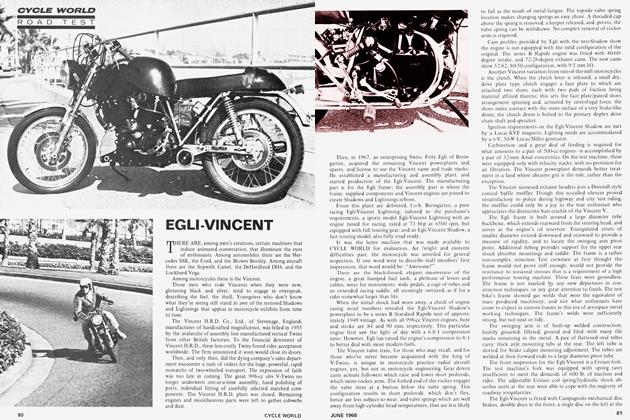
Triumph has now gone full circle. The clean lines of the ’72 Trident shine through, and there are several worthwhile changes. The most obvious lies in the mounting of the engine. From the bike’s inception until last year the engine was positioned upright in the frame. The ’75 T160 has cylinders inclined forward 15 degrees. From the engineering standpoint, this puts more weight on the front wheel, improving handling at speed without affecting it adversely around town. In order to accept the different engine configuration, the frame had to be changed slightly as far as engine mounts are concerned; however, head angle and trail remain the same ideal dimensions as before.
In an effort to cut down on the top-end noise so common with this overhead-valve design, noise suppression plugs have been added in the cylinder and head. It’s hard to tell if there has been an improvement; there is still more valve noise than we like to hear, but that could have something to do with the quieter exhaust system, which is noticeable in more than one way. . .as we’ll explain soon.
Before we stray too far from the engine, let’s point out a few more of its changes and improvements. The 9.5:1 compression ratio remains standard on the Trident, but to retain this combustion pressure a copper head gasket is now used instead of the old asbestos one.
Undeniably the biggest change (not necessarily improvement), is the redesign of the crankcase for the lelthand shift. Whether we like it or not, this was an essential change; standardization of controls is here to stay.
Other areas of the engine remain the same. The rods are H-shaped and highly polished for strength. They run on plain bearings on the crank. With the three-cylinder engine, the crank journals are spaced 120 degrees apart. Oil pressure is in the neighborhood of 70 psi at operating temperatures.
Another positive feature of the inclined cylinders has to do with the induction length of the manifolds. This extra distance between the three 27mm Amal concentric carburetors and the intake port allows the intake length to be tuned for best performance. The air box has been modified somewhat to reduce intake noise, another move to satisfy governmental restrictions on noise levels.
Triumph claims that the T160 checks in at an actual 83 dba. It is our feeling that this figure is accurate. Others have been known to fudge somewhat. Redesigning the exhaust> system has brought about this major step forward in sound reduction. The earlier Threes had the center port exhaust pipe join the two outside pipes several inches below the port. The drawback was the tremendous heat buildup at this point. Now there are two pipes from the center port that join the outside pipes under the gearbox and then extend into annular mufflers on either side of the bike. This reduces any heat buildup and even prevents the pipes from discoloring.
As the performance figures indicate, the "75 Trident is much slower and more sluggish than its predecessors. We feel that the back pressure created by the new mufflers causes both an over-rich condition and poor performance. If the engine weren’t choked up as much as it is and were allowed to breathe, quarter-mile times could be improved by a full second or better.
We also blame the exhaust system for another very annoying problem. . .vibration! The Three should be as smooth as riding one of the desks in our editorial department, but isn’t. The crankshaft on the Trident has always been dynamically balanced, and this year is no different. This allows the maintenance of more precise tolerances to reduce engine vibration, but the T160 still vibrates to an unacceptable degree. Unless the balance factor of the crank is out of the ballpark, there can be only two other reasons for this unbearable vibration—rich carburetion and/or a resonant vibration set up in the exhaust. Leaning the carbs out helped somewhat, but the annoying tingle was still there. In an effort to place the blame for this, we moved our feet from the pegs to the engine. Smooth. Crank balance is right on.
Pegs and handlebars are both rubber-mounted, but to no avail. Up to 3000 turns the bike is smooth. Between 3 100 and 3700 the shake damn near forced our feet off the pegs; there was also a slight tingle in the grips. There’s another smooth spot between 3800 and 4000 rpm. This is most likely the range that most riders will run in, at least at cruising speeds. This condition occurred at an indicated 60 mph. The buzz encores after this point, to disappear once again after 4600 rpm. At 100 mph the Three is again smooth and comfortable to ride, but we don’t recommend that speed unless one has access to a race track, money for bail, or is a fool. All Triumph can say is, “We’re working on it.”
And now for the big news. After eight years of existence, the Trident finally has an electric starter. This is a first for any British bike. It was a mere 1 0 or 12 years late. Actually, we have never had any trouble starting the Triple. But remember that aforementioned image change. People wanted electric starting even if it offered no real advantage; the same goes for the five-speed gearbox. How much more civilized to simply push a button to bring the engine to life. Provided the carbs have been “flooded,” that one push of the button should usually suffice. In cold weather we found choking unnecessary and even ineffective unless the two outside carbs spewed fuel from their Boat bowls. The center carb need not be primed.
With the pre-’75 Tridents two or three stabs at the starter lever were usually needed before the engine would fire. So the only thing that makes the electric starter really advantageous now is the design and shape of the kickstart lever. It sticks out quite a ways from the right case and interferes with the rider’s ankle. For the duration of our test the kickstart lever was removed and we relied on the electric starter. When the starter button is pushed, a gear on the starter motor engages with the clutch, thereby turning the engine over. It’s very similar to an automotive starter.
We’ve saved the best feature for last. Without a doubt—and even with the increase in weight—the Three handles better than most, if not all, bikes on the road today. But then, even the early Triples were known for the fine handling qualities they exhibited. No matter how hard this bike is flicked into a corner, or from side to side, there are no signs of frame flex. It’s rock-steady and confidence-inspiring. With the cylinders inclined forward, the good handling traits are all the more noticeable.
There is no question that the frame was built with two things in mind: safety and comfort on twisty roads. But one area that has been neglected is ground clearance. Without too much effort, either footpeg can be grounded in a turn; ditto the centerstand on the left. The pegs should be folding and the stand should be redesigned for greater clearance.
The 4.10-19 Dunlop tires fitted to both ends of the Trident add their own degree of stability to the bike. They wear well and offer considerable traction in dry and wet conditions. These are some of the best tires we’ve ridden on, short of a racing tread.
While still on the subject of handling, it must be mentioned that the swinging arm has been lengthened and the forks shortened. The net effect is a slightly lower CG and improved high-speed stability in a straight line or corner. Also, with the longer swinging arm, the shock angle is changed, which makes for a little more action at the wheel and a smoother ride in general. The Girling shocks are three-way adjustable, offering a good ride in the soft position for a solo rider weighing in at around 150 pounds. We opted for a little stiffer setting (the middle position) to gain extra ground clearance. The firmer ride didn’t bother us.
Another new feature on the Triumph this year is the hydraulic disc fitted to the rear wheel. In many ways it is superior to the shoe brake used before. The action and feel are more positive and there is no fade evident even with hard usage. Caliper units at both ends are identical, so are the discs.
Overall, when compared to that of the ’72 model, on-theroad performance of the new Trident is disappointing. The seating position is satisfactory, we can even get used to the rubber-mounted bars, but the seat is too firm and wide for our liking. After many miles of riding, our testers found their posteriors getting numb. Although the seat is in dire need of softening, we could learn to live with the width. Ground-toseat distance is only 32 in., so it is possible to plant both feet on the ground.
Unless the bike is operated in the rpm ranges we mentioned before, vibration would wear on us quickly, requiring frequent rest stops to, if you’ll pardon the expression, shake the tingle. For a 750, power and performance are in line; with the economy kit installed, fuel consumption is average. Riding at night is easy, thanks to the beam thrown out by the headlight. Its illumination is second only to that of the halogen light on the BMW.
As we’ve already said, the most impressive thing the Trident has going for it is the handling. It’s nothing short of fantastic. All indications point to the engine’s being the same bulletproof unit found in previous Triples, but we are somewhat dismayed with its performance, or rather lack thereof. Thank the D.O.T. for that. Vibration is something that Triumph will surely have to correct. . .and soon. Once this is done, the T160 will fall in line as one of the best 750s available today.
TRIUMPH
T160 TRIDENT
$2870