The E-Z Rider Trailer
THE E-Z RIDER TRAILER
It Carries A Big Payload, With Little Adverse Effect On Handling.
TOURING BY MOTORCYCLE has to be one of the greatest things going, but packing, because of the limited space available, has always been a bummer. Sure, once the gear is stowed, solo riders can get by, but add one feminine pillion passenger and her accompanying luggage and practically all but Harley 74s turn into tail-heavy, overcrowded disasters.
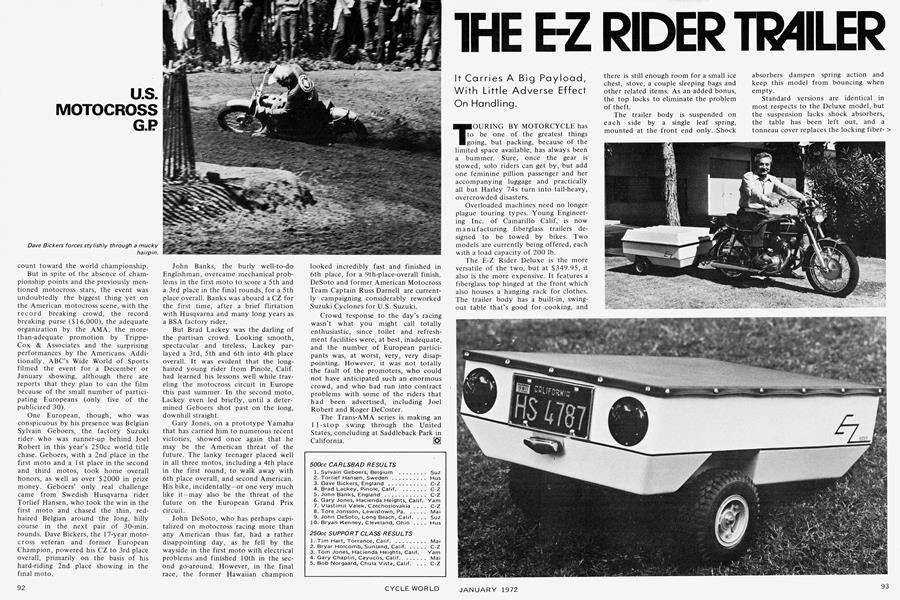
Overloaded machines need no longer plague touring types. Young Engineering Inc. of Camarillo Calif, is now manufacturing fiberglass trailers designed to be towed by bikes. Two models are currently being offered, each with a load capacity of 200 lb.
The E-Z Rider Deluxe is the more versatile of the two, but at $349.95, it also is the more expensive. It features a fiberglass top hinged at the front which also houses a hanging rack for clothes. The trailer body has a built-in, swingout table that’s good for cooking, and there is still enough room for a small ice chest, stove, a couple sleeping bags and other related items. As an added bonus, the top locks to eliminate the problem of theft.
The trailer body is suspended on each side by a single leaf spring, mounted at the front end only. Shock absorbers dampen spring action and keep this model from bouncing when empty.
Standard versions are identical in most respects to the Deluxe model, but the suspension lacks shock absorbers, the table has been left out, and a tonneau cover replaces the locking fiber> glass top. At 78 lb. empty, it is easier to pull than the heavier 92-lb. Deluxe, but it bounces when empty or carrying a light load.
Both share common dimensions. The main body of each is 3 ft. 7 in. long, 2 ft. 5 in. wide and 13 in. deep. The fiberglass top on the Deluxe model adds another 5 in. to its depth. Each must be licensed and fitted with taillights. These are wired into the running and brake lights, but not the turn signals on the motorcycle.
Naturally, the ability to carry increased loads is the main reason for towing a trailer, but carrying more gear without objectionable handling is the real beauty of the system. With the exception of additional drag, mostly noticeable pulling away from stoplights, and a slight oscillation in the 35-40 mph range, it is practically impossible to tell that the trailer is there—under normal driving conditions.
As for travel on mountain roads, unless you’re going fast enough to ground the centerstand or footpegs on curves, either trailer, when loaded, tracks perfectly. If sane speeds are exceeded, either will oscillate, but not violently enough to cause the rider to lose control.
Neither E-Z Rider affects handling of the tow bike to any great degree, as long as legal speeds are maintained. There are, however, certain circumstances that warrant caution. In a panic stop, for instance, it is possible to jack-knife the trailer. And on downhill turns, with a camber change midway through, the bike will again oscillate —in this case enough to cause concern.
Because of the trailer’s need to remain flat on both wheels, yet allow the motorcycle to bank over for turns, hitch design is unusual. The tongue of the trailer is fitted with a universal joint which has a notched disc welded onto it. To make a coupling, the disc is inserted into a motorcycle-mounted section of 1-in. box tubing and is held there by two locking pins. The pins engage only the notch and allow the disc to rotate freely until tabs contact stops. This prevents a trailer from flipping all the way over in case of a mishap.
The motorcycle section of the hitch consists of a U-section, held in place on each side by the lower rear shock bolts.
A triangulating tube bolted to the left upper shock mount governs hitch height. Even though this unit is completely out of the way, most riders will probably take the time to remove it between trips, as it is rather ugly, and looks out of place without the trailer.
Now for the big question. How does riding a motorcycle/trailer combination compare to touring on a heavily loaded bike? For light loads, and a solo rider, the motorcycle/saddlebag arrangement is still better, primarily because bikes pulling trailers are restricted to 55 mph in Calif., and suffer similar speed restrictions in most states.
For two-up touring, say with an 80to 100-lb. load, trailers are a good way to go. More space on the bike and greater carrying capacity are the obvious reasons for this, but there is another, that of weight distribution on the motorcycle. An 80-lb. load, when carried in the heavier Deluxe trailer, results in a tongue weight of only 23 lb. This 20-odd-lb. tongue weight affects the handling characteristics of medium displacement machines far less than an 80-lb. load carried conventionally above and slightly behind the rear axle.
Greater carrying capacity with less weight on the motorcycle, coupled with the all-weather protection offered by either model, make the E-Z Rider well worth considering.