The 265-Mph Record Thief!
The 265-mph Record Thief!
They Called Him "Calvin Lee Palpitating Pussycat Rayborn" And He Was Backed By The Villainous Harley Gang...
JUST HOW DO you go about stealing a record? If you are a member of the notorious Harley-Davidson gang, you don’t waste much time.
Your plan is brash, spontaneous. You don’t much care whether your hottest road racing property goes bouncing across the salt in a series of loops and end-overs. As long as he comes to rest alive, uninjured and ready to go again, that’s fine.
Only 1 1 days before departing the Los Angeles area for Bonneville where they hoped to break Don Vesco’s motorcycle land speed record, HarleyDavidson racing chief Dick O’Brien and streamliner owner Dennis Manning began preparation.
AMF, parent company of the Harley-Davidson Motor Co., finally decided that they should try for the record. The go-ahead was given. All Dick and Dennis had to do was get the streamliner ready. Since it already had its shakedown cruise during Speed Week at Bonneville in August, the job would be easy, right? Wrong!
After two frustrating weeks on the salt, rider Cal Rayborn pushed Don Vesco’s recently set record of 251 up to
255 mph, and then climaxed the effort with a stunning two-way average speed of 265.492 mph!
During the 1 1 days, Dick not only had to coordinate revamping the streamliner from its Bonneville runs, but had to get a crew together for the assault. From Milwaukee came Clyde Denzer, Dick’s assistant in the racing department at Harley-Davidson, along with John Pohland.
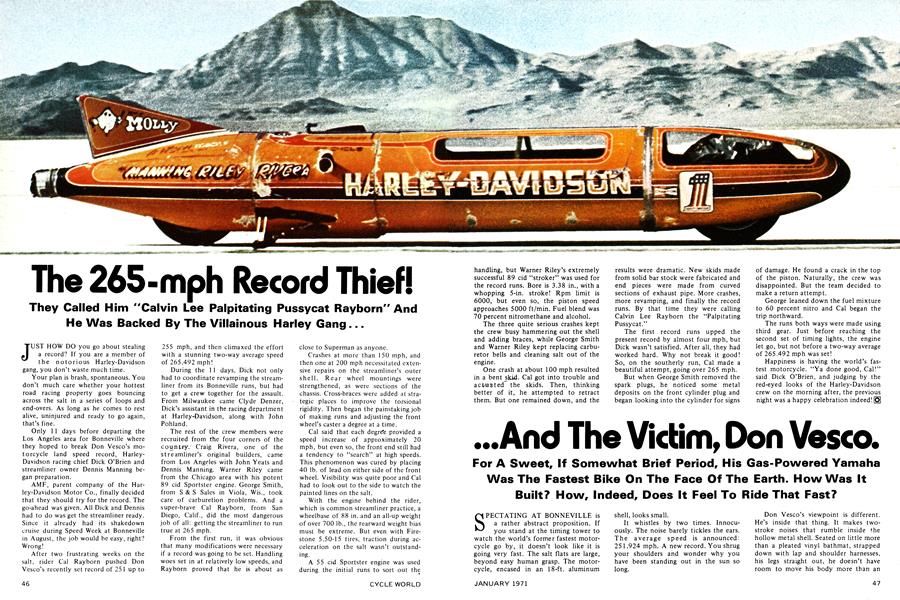
The rest of the crew members were recruited from the four corners of the country. Craig Rivera, one of the streamliner’s original builders, came from Los Angeles with John Yeats and Dennis Manning. Warner Riley came from the Chicago area with his potent 89 cid Sportster engine. George Smith, from S & S Sales in Viola, Wis., took care of carburetion problems. And a super-brave Cal Rayborn, from San Diego, Calif., did the most dangerous job of all: getting the streamliner to run true at 265 mph.
From the first run, it was obvious that many modifications were necessary if a record was going to be set. Handling woes set in at relatively low speeds, and Rayborn proved that he is about as
close to Superman as anyone.
Crashes at more than 150 mph, and then one at 200 mph necessitated extensive repairs on the streamliner’s outer shell. Rear wheel mountings were strengthened, as were sections of the chassis. Cross-braces were added at strategic places to improve the torsional rigidity. Then began the painstaking job of making runs and adjusting the front wheel’s caster a degree at a time.
Cal said that each degree provided a speed increase of approximately 20 mph, but even so, the front end still had a tendency to “search” at high speeds. This phenomenon was cured by placing 40 lb. of lead on either side of the front wheel. Visibility was quite poor and Cal had to look out to the side to watch the painted lines on the salt.
With the engine behind the rider, which is common streamliner practice, a wheelbase of 88 in. and an all-up weight of over 700 lb., the rearward weight bias must be extreme. But even with Firestone 5.50-15 tires, traction during acceleration on the salt wasn’t outstanding.
A 55 cid Sportster engine was used during the initial runs to sort out the
handling, but Warner Riley’s extremely successful 89 cid “stroker” was used for the record runs. Bore is 3.38 in., with a whopping 5-in. stroke! Rpm limit is 6000, but even so, the piston speed approaches 5000 ft/min. Fuel blend was 70 percent nitromethane and alcohol.
The three quite serious crashes kept the crew busy hammering out the shell and adding braces, while George Smith and Warner Riley kept replacing carburetor bells and cleaning salt out of the engine.
One crash at about 100 mph resulted in a bent skid. Cal got into trouble and actuated the skids. Then, thinking better of it, he attempted to retract them. But one remained down, and the
results were dramatic. New skids made from solid bar stock were fabricated and end pieces were made from curved sections of exhaust pipe. More crashes, more revamping, and finally the record runs. By that time they were calling Calvin Lee Rayborn the “Palpitating Pussycat.”
The first record runs upped the present record by almost four mph, but Dick wasn’t satisfied. After all, they had worked hard. Why not break it good! So, on the southerly run, Cal made a beautiful attempt, going over 265 mph.
But when George Smith removed the spark plugs, he noticed some metal deposits on the front cylinder plug and began looking into the cylinder for signs
of damage. He found a crack in the top of the piston. Naturally, the crew was disappointed. But the team decided to make a return attempt.
George leaned down the fuel mixture to 60 percent nitro and Cal began the trip northward.
The runs both ways were made using third gear. Just before reaching the second set of timing lights, the engine let go, but not before a two-way average of 265.492 mph was set!
Happiness is having the world’s fastest motorcycle. “Ya done good, Cal!” said Dick O’Brien, and judging by the red-eyed looks of the Harley-Davidson crew on the morning after, the previous night was a happy celebration indeed! [5]