Report From Italy
REPORT FROM ITALY
CARLO PERELLI
IMOLA GOLD SHELL
A few days after they were beaten in the Italian GP, Benelli issued a statement announcing their withdrawal from racing for the remainder of the 1970 season. But Benelli also stated that they would make a strong comeback (with Hailwood?) next year.
This decision not only brought despair to Paso fans and race organizers, but took much of the salt out of the “Golden Shell” meeting.
Anyway, the most ardent race goers consoled themselves at the fast Imola autodrome by watching the rapid progress of Angelo Bergamonti on the MV Three. Many of the best privateers also put on good shows.
The 250 class was the first of only three classes run on the international program. Fastest qualifier Kent Andersson led comfortably most of the way on his works Yamaha. On the last lap, his gearbox packed up and he freewheeled to the checkered flag. The Swedish champion had built up such an advantage, he still came home first-15 in. in front of Ginger Molloy on another works Yamaha.
The two hottest challengers were Visenzi and Grassetti, both on private Yamahas. Visenzi’s machine began misfiring and he lost contact with Molloy. He finished 3rd. Grassetti spilled and retired unhurt after gas from a dislodged fuel tank cap soaked his tires while he braked for a turn.
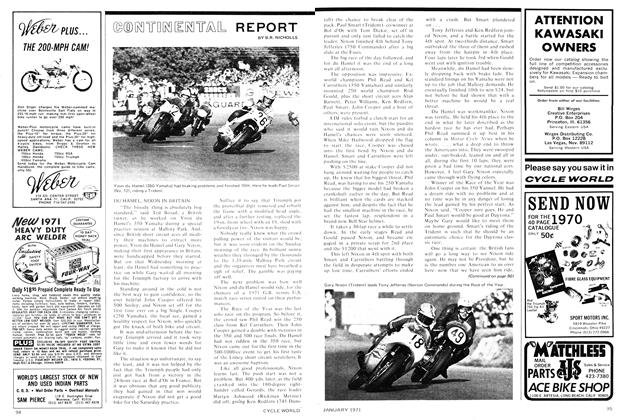
Bqrgamonti was sensational in the 350 practice, circulating faster than Agostini. And during the race, the two MV riders stayed together in front, frequently exchanging positions. Then, while lapping some slower riders, Ago’s experience paid off, and Berga was left somewhat behind. Finally the world champion set flying and beat the famous Paso-1969 lap record.
Andersson and Findlay kept up a fine duel for 3rd place until the Australian retired with a broken crankshaft.
In the 500, neither Ago nor Berga enjoyed a dashing start, but they soon took control of the situation. The race ended much like the 350. The two MV riders exchanged positions, then Ago took the lead while passing in traffic. Again Ago set the fastest lap and won by 3 in.
Five men and three different models scrapped vigorously for 3rd position. They were Bertarelli (Kawasaki), Molloy (Kawasaki), Zubani (Kawasaki), Gallina (Paton), and Pagani (Linto). Pagani, winner of last year’s Imola event,
showed his capability, but was sidelined by ignition troubles.
Bertarelli briefly pulled away from the group, but his rear wheel collapsed, puncturing the tube. Gallina lost some ground because of a “flattening” battery which limited maximum rpm from 10,500 to 9000. Then on the finishing line Molloy just pipped Zubani.
Another close finish came when Dennehy (Drixton-Honda) edged Mandracci (Paton) for 6th place. Findaly was again unlucky, and crashed his Suzuki-engined special.
The program was concluded by one of those production machine races, which are quickly catching on in Italy. The Laverda team withdrew as a protest against non-standard brakes fitted to another machine, but there was some good racing.
Giuliano Ermanno, fastest in practice, was the winner on a Norton 750. He was followed by Vinci (Triumph Trident) with the controversial Fontana brakes. Vinci had to work hard to hold off the vivacious challenge by Bruno Spaggiari (450 Ducati). And Spaggiari got the satisfaction of getting close to the big Honda Four, Norton Commando, and the BSA Three, straddled by good riders like Parlotti.
SCRAMBLERS FROM DUCATI
To attract the younger riders (and later direct them toward the “desmo” and sohe scramblers), Ducati has just introduced two new off-road models. The 50-cc version will not be exported to the U.S., but the 100-cc model should arrive shortly.
The scramblers feature sturdy frames and four-speed gearboxes. The twostroke engines are rated at five bhp and eight bhp respectively, measured at the rear wheel.
These new mounts from Bologna have met with considerable success, and are known for their good riding qualities. The 50, revving up to 8000 rpm and fed by an 18-mm carburetor, must be kept on the boil. The 100 redlines at 7000 rpm and sports a 24-mm carburetor. The latter also enjoys about the same weight as its little brother-approximately 148 lb.
A TOP RIDER WHO BEGAN BADLY
Who is Angelo Bergamonti? Why was he selected by the Count to prove that his machines can win world titles without super §tars like Ago?
(Continued on page 80)
Continued from page 78
Well, Angelo Bergamonti’s career began in 195 7, right in the worst period for the sport in Italy. That was the year in which Gilera, Mondial and Moto Guzzi jointly announced their withdrawal from GP racing, racing they had excelled in for over a decade.
And it didn’t look like a promising career at all. In three starts with the Morini 175, he crashed three times!
Furthermore, he was not brilliant in the two following seasons. He always rode the then popular “pushrods” from Bologna, the same mount that another newcomer (Giacomo Agostini) raced successfully from the beginning.
“Berga” said he was a great rider, but he mostly finished on the retired list. To top it all off, in 1960 he started hunting a girl named Rosa (now his wife), and seemed to forget motorcycles. At this point, nobody would bet a penny on his career as a GP racer.
On the contrary, he began riding again, and this time in a brilliant way. Berga was still “hot” in 1964, but more controlled. He placed well in several meetings on a 175 Morini, and finished 2nd in the junior hillclimb championship.
He even did better in 1965, winning both the circuit and the hillclimb championships in the junior category. This earned him passage into the category of top riders for the next season.
Again his escalation continued. Sponsored by Giuseppe Pattoni, he rode the 250, 350, and 460 Patons so well that at the end of the season, he was invited to test and ride the 250 Benelli Four in one event. But the Pesaro firm, looking for a substitute for the great Provini, who stopped racing after a serious Isle I of Man accident, chose Renzo Pasolini
instead. Destiny was already directing Berga toward MV.
But three years and two nasty crashes had to pass before the great jump. The year 1967 was full of glory for Bergamonti. He won the 250 senior championship with the fabulous exProvini and Agostini Morini Single (beating Paso on the Benelli). He won the 500 title as well, with a Paton, outscoring Agostini who missed two rounds.
Then tragedy struck. Berga, trying to avoid a fallen rider, crashed heavily with the 250 Morini on the Madrid circuit. His helmet cracked and for many days he was close to death. Finally, his strong physique won and in 1968 he got back on the racetrack. Luckily, he was perfectly fit, with an unchanged spirit.
During his absence, the task of winning had become more difficult. In the 250, Paso appeared with an improved Benelli, and Berga couldn’t avoid some narrow defeats. At this point, Morini retired from racing, putting an end to a brilliant 10-year career for their Single.
Toward the end of the season, Berga had his second serious crash. In a minor Yugoslavian meeting, riding an outdated 125 Mondial, he pushed too hard trying to keep up with the leaders and hit a stone wall. He retired with various fractures in his legs.
Again, he had all winter to recover and to “charge” himself psychologically. And, at the opening of the next season, he was the obvious choice of Aermacchi to replace their No. 1 jockey, Gilberto Milani. Milani was still recovering from a crash in the Yugoslavian GP the year before.
Berga took the fast pushrods from Varese to fine placings in the Italian GP, and in other world championship meetings. He placed 2nd in both the Yugoslavian GP and the Dutch TT with the 420-cc model. And these performances attracted Count Agusta’s attention— which was soon transformed into a one-year contract!
Small, smiling, and self-confident, “Augiulin” has some features in common with Paso and Ago. Like Paso, he is a home man. He shys away from publicity and social life. He is married, has two small children, and doesn’t like to live in towns. Instead, he lives in a house by Lake Varese. But, unlike Pasolini, his riding style is neat and effortless, resembling Ago’s.
Bcrga says, “With the MV Three, I still have some indecision in braking and when lapping riders, because it is so much faster than my previous mounts. Yet in a few meetings, with a lot of training in between, I think I can overcome this disadvantage. Then, I am confident I will be at Ago’s level!”
(Continued on page 82)
Continued from page 81 )
In addition, Berga is a fine mechanic. He used to build and sell successful conversion kits to take the 175 Morini to 250cc. Once he competed with a home-tuned 125 Morini pushrod, and on the tricky Italian courses, frequently beat sophisticated GP machines—like the Honda dohc Twin.
Now Berga is engaged as a tester at the MV factory, and his favorite task is to get around on the four-cylinder 750 S.' “It really does 130 mph,” he says.
And he has quickly learned the Gallarate factory’s style regarding GP racing machines. Try to get some information from him about the new Fours or Sixes, and with a smile he’ll invariably reply, “I don’t know that, please ask the Count.”
MOTOCROSS DES NATIONS
The Motocross des Nations, held for the first time in Italy, attracted 30.000 fans to the Maggiora circuit. No less than 50 top riders from 10 countries competed (except Robert, suffering from a complicated toothache).
In the 500 class, riders had to compete in two 45-minute heats, with fivemember national teams. Places were calculated on the performances of the three best team riders.
In the first leg, a chaotic mass pile-up occurred in the first bend, and a young Czech, Jiri Stodulka (420 Jawa), turned in an amazing performance. He led at times, fighting bravely with such stars as Jonsson (400 Maico), Aberg (400 Husqvarna), and Teuwissen (400 Husqvarna). And all three really had to work to get ahead of him.
In the second heat, Stodulka did even better. He kept in front, aided by another first-lap pile-up involving Jonsson, Aberg, DeCoster, Geboers, Nicoll, and Robertson. Allan (380 Greeves) finished 2nd, followed by Kring (400 Husqvarna), Wolsink (400 Husqvarna), Johansson (400 Husqvarna), and Geboers (370 Suzuki).
Sweden came out on top in the team standings, followed by Belgium, Czechoslovakia, Britain and Holland. Italy, Russia, Switzerland, France and Denmark finished together.
S I 6,500 OFFERED CONTENDER
The supremacy of foreign mounts in the Motocross des Nations was obvious: an executive of the Italian Federation offered SI 6,500 on the spot to the national factory or artisanal enterprise producing a reasonably successful 250or 5 00-class machine in the near future.
Italian mounts have completely disappeared from the top scrambles scene for nearly 10 years. Let’s hope this offer will tempCsomeone ... [O]