Forty Year of Sidecars
FORTY YEAR OF SIDECARS
Could There Ever Be Something As Much Fun As Defying The Laws Of Physics On A Three-Wheeler?
GENE BIZALLION
I HAVE NEVER been able to determine why the sidecar faded from the motorcycle scene, or exactly when. Come to think of it, they didn't fade away; all of a sudden—BOOM— they were gone. Some say the increase in automobile ownership made sidecars unnecessary for family transportation, and the motorcycle became more a sporting vehicle. I don't buy this; if it were so, why didn't the depression create a boom in these outfits for economical operation? I know that my combination of an Indian sidecar on a 1930 Harley allowed us to make many a trip that we could not have afforded by car. A permanent top installed on the sidecar with button-on side curtains made it possible for me to take my wife and two boys on a number of trips from Phoenix, Ariz., to the West Coast and back in comfort—and for less than five dollars for the round trip.
Many riders now say the sidecar must have been a nuisance anyhow, and probably took the pleasure out of motorcycle riding. With this I heartily disagree for I had, and still have, a lot of fun with sidecars.
My first experience with a sidecar may not sound like fun, and maybe it wasn’t then; but it didn’t discourage me. My first motorcycle, a 1918 Excelsior which I acquired in 1923, was equipped with a sidecar simply because I was afraid to try to hold up a solo job. The hack was a Rogers, and the method of attachment to the machine was not the best. The fittings were ball and clamp, and very small, about the size of marbles—aggies. Furthermore, those on my outfit were worn down nearly flat, a condition which I discovered the hard way. While cruising down Broad Street in Newark, N.J., the front fitting pulled loose and dropped to the ground.
For what seemed an interminable time there was grinding, screeching and gyrating. And when pandemonium had subsided I was in the gutter, pinned between motorcycle and sidecar. This little incident occurred during the second day of the two-week practice period for my driver’s license. And as the law specified, I had a licensed driver in the sidecar. I feel sure the statutory time limit will protect me now when I admit that was the last day I could get anyone in the hack; for as reckless and foolhardy as motorcyclists were supposed to be, no one volunteered. The rest of the two weeks I practiced alone.
The written examination was a breeze. So with confidence and exuberance oozing from every pore, I arrived at the driver test station. Actually, it was not quite that simple, for I had to induce another rider to follow on his own machine to within a block of the test ajea. Then he rode around the corner in the sidecar so I could arrive with a licensed driver. Even this obvious
lack of confidence in my capability did not dampen the fact that it was Spring, I had my first motorcycle, had passed the paper work and now, to earn my license, simply needed to demonstrate my superb driving technique.
An inspector was just climbing into the sidecar when I burst out, happily, “Climb in, hang onto your hat and...”
Evidently that tore it, for he pushed himself back as if the hack was half full of rattlesnakes.
“Listen, you,” he said. “Drive down to the corner—by yourself—shift all gears, make your signals, and if you make it back, we’ll talk license.”
Talk about the “longest mile.” That block was the longest, most nervewracking ride I have ever taken. The inspector stood on the curb with his arms folded in a sinister fashion, and my friend stood alongside him with his arms folded. I stalled making my turn, making so many hand signals I must have looked like an octopus. But when I got back, the officer without a word wrote out my temporary driving slip and waved me on my way. How about that! A licensed motorcycle rider.
Really, at the time, that “down to the corner and back” was about the extent of my driving ability, but from the mechanics and riders around the Harley shop I began to learn the handling of a sidehack. First they showed me the proper angle to lean the bike out by adjusting the rigid bar, which is the bar connecting the frame of the machine from under the saddle to the sidecar chassis. The correct angle (about three degrees) causes the motorcycle to steer to the left enough to counteract the pull of the sidecar to the right. I learned that the outfit is steered not entirely by the handlebars, but also by use of brake and throttle. By braking before entering a right-hand turn, then accelerating through the turn, the drag of the sidecar helps pull to the right; then, in a left turn, the use of the brake through the turn lets the over-run of the hack push to the left.
Because I had never ridden solo, I had no great difficulty learning to handle a sidecar; but if you want to see some startling didos, get some rider who has ridden only solo for a number of years, and let him start out on a sidehack. Usually he will pull out from the curb, then try to straighten up to the right with a bank to the right. It doesn’t bank. Finally, he remembers to steer to the right and the machine leans to the left, contrary to all his experience. To recover, he instinctively makes a sharp left, across the street into the neighbor’s petunia bed.
One Saturday a group gathered at our garage, and two of us volunteered to go for some needed parts. I knew this other rider had been riding an Indian Chief, the same as mine, for two or three
years. Without a second thought I said, “We’ll take my rig—you push it,” and I climbed in the sidecar.
As we started up, the sidecar wheel whistled along the curb, then climbed up and ran along the edge of the sidewalk. I thought, “Aha, trying my own stuff, eh.” Then we made a sharp cut to the right, the machine bounded over the curb, across the sidewalk and into the side of a house.
All the amazed Indian owner could do was sit there and say, “I couldn’t turn it! I couldn’t turn it!”
My old “X” lasted through the winter. Then in the Spring of 1924 I bought a new Indian Scout, 37 cubicinch displacement, with about the power of a modern 175-cc. Much to the disgust of the dealer, the salesman, and anyone else who could get in their two cents worth, I had a sidecar attached. It was a light, semi-flexi made by the Flexible company, with the innovation of a leaf spring rigid bar which absorbed some shock from the sidecar, but made the handling more peculiar because of the increased flexibility of the connection. Since Indian motorcycles and sidecars were always painted red in those days, my outfit was known as “Gene’s Little Red Wagon.”
One unorthodox enjoyment I used to indulge in was to get on the large concrete slab in back of Harvey Snider’s shop (Harvey was the Indian dealer), set the throttle on idle in low gear, cramp the handlebars to full right, then climb over into the sidecar, and with one foot holding the bars, lean back in the warm sunshine and let the outfit pivot on the sidecar wheel. I would sit there dozing
and watching buildings and trees swing endlessly by until the engine overheated, or Harvey’s loud and irate voice blared out over my head to, “cog it up and haul freight and quit making him dizzy.”
It wasn’t long before I had to admit that while the Indian Scout was an ideal solo job, it was not intended to pull a sidecar. Within a year I traded for an Indian Chief, 74 cubic-inch, fitted with Indian’s own sidecar—the Princess. The difference in horsepower over the little Scout was startling and gratifying, but before I really began to appreciate the Chief, the four-in-line engine of the Henderson and Ace began to fascinate me. The opportunity to make another trade came along, and I became the owner of a 1922 Ace and Goulding sidecar. The four-cylinder jobs made ideal sidecar combinations. Their ability to throttle down to 10 mph or less in high eliminated a lot of gear shifting, and the Goulding featured a transverse spring arrangement that made for a very smooth riding hack.
I can’t recall why the Ace got traded off for a Harley, but in 1926 I found myself mounted on a 74 Harley, pulling one of their light, torpedo-shaped sidecars called the Sport. By this time I had discovered the fun of lifting the sidecar off the ground on right-hand turns, then getting it up to about 45 degrees so one could ride with the sidecar in the air—like a solo. This was great for astounding spectators on the sidewalk and would scare the “bejabbers” out of passengers who were not seasoned motorcycle riders.
Once I had a friend with me in the
hack, up in the air, coming down Belleville Avenue in Newark. He went along with the gag by taking a tire pump that was in the sidecar and attaching it to the sidecar wheel to pretend he was airing up the tire as we drove along. The act was getting great response from the sidewalk audience, when suddenly a siren blew behind me and I instinctively dropped the sidecar. As we had no sidecar mudguard, the wheel was running in the open with the pump still attached. It whirled around, flailing my co-performer over the head two or three times before he could duck. Have you ever heard someone get hit over the head with a tire pump? It has a sound effect all its own.
By the time we came to a stop, the motorcycle officer who hailed us was sitting in the saddle laughing, leaning over the handlebars. Later when I rode off with my ticket for reckless driving, he was still sitting on the curb laughing. At the time, it didn’t seem that funny.
Experienced motorcyclists accepted this sidehack lifting with detached nonchalance, and for some time I racked my brain for a stunt to upset the aplomb of these characters. I finally came up with the idea of cutting such a fast “U” turn that the rear wheel would rise off the ground, and the turn could be completed on the front and sidecar wheels only, with the nose of the sidecar bumping the ground. A few weeks of secret practice brought a satisfying measure of success, and I was ready for a customer.
Now, one thing I have learned since, but didn’t know then, is that practically always a dash of disaster is involved in
“showing off.” Some little detail is overlooked and the end results, while often more spectacular than planned, are not completely satisfactory. In this case, two details which had been neglected were the facts that in practice I had not had a passenger in the hack, and at the unveiling of the caper I did not have the regular body of the sidecar, but a box used for hauling. Also, there was no nose in front for a ground bumper.
My passenger was lounging in insolent ease in the box, anticipating, at the most, the usual lifting as we swung into the wide, traffic-free street where we had our garage. There were three or four of the bunch in front of the garage, and the stage was set. I gained some speed, kicked out the clutch, and right in front of my audience yelled, “Hang onto your hat!” and cut a “U” turn. We rose up on the front and sidecar wheels all right, but having more weight than I had considered and nothing in front to bump the ground, we rolled right up over the front end of the box, landing upside down.
The passenger had started to yell the moment the rear wheel left the ground, and even as I hurtled through the air, the yell became a shriek. I landed on the palms of my hands and my knees, and slid—accumulating “asphalt rash” as I went. The outfit was resting on handlebars and box, with my former friend pinned beneath it—engine roaring and gas and oil dripping in his face. The startled spectators lifted him free, and then, by brute strength, prevented him from killing me.
But I was not the only one involved in episodes with the three-wheelers. A
rider whom I shall designate only as Bert had a Henderson, and this was the first motorcycle with a reverse gear that any of us had seen. Bert rode sidecar in a lot of endurance runs, and he had a regular passenger who rode with him most of the time. This passenger (we’ll call him Sam) had acquired a vast amount of experience as navigator and helper; he had the customary procedure down pat for assisting through heavy going. When a sidecar outfit started to bog down in mud or sand, the passenger would, without hesitation, vault over the back of the hack and push before all momentum would be lost, and, if necessary, lift the chassis to prevent drag.
When Bert rode the Henderson in the first run, he told Sam he would use a new system. As soon as they bogged down, Sam was to stay put and Bert would “cram it in reverse” and back up for another go at it. Sam agreed this sounded good and foresaw a much less fatiguing future. But long training was hard to forget, and the entirely novel idea of a motorcycle with a reverse was hard to remember, so in the very first mud stretch it happened.
The outfit plowed into a mudhole, and without another thought, Sam leaped over the back of the sidecar, only to hit the ground just as Bert “crammed it in reverse” and came back. Sam was knocked over backward and the chassis was clear up to his chin by the time he grabbed the spring shackles. Then our hero saw the situation, shoved it in low and dragged the sidecar from Sam’s neck all the way down to his knees. A little conference followed this slight misunderstanding before Sam crawled back in the hack to recuperate.
Some people don’t even learn the hard way. A few hours later, in another tough section, Bert came to a wheelspinning stop and—you guessed it—our helper vaulted over the back again, landing with his back to the sidecar. Sam was knocked flat on his face in the mud, and the chassis came up to the back of his head with a thud. But our driver was alert and got it in low. This time a projecting bolt ripped Sam’s leather jacket apart from the neck down, then caught in his belt and dragged his pants down to his ankles. It was fortunate for Bert that Sam was too done in to think of reprisals, and a blessing for Sam that he couldn’t get out of the sidecar again, once he was helped in. The rest of the run was left to Bert and his reverse gear.
Since my first days of motorcycling, I had attended the many Class A dirt track races in our area, and was completely fascinated by the Flexi sidecars. Until around 1921, sidecar events were run with rigid outfits with the machine permanently tilted as far to the left as was feasible for the straight stretches, to allow bank in the turns. Then Reading-
Standard came up with the full flexi chassis, and for at least one season they were unbeatable. This Flexi was a device built by the Flexible Company in Lou nonvile, Ohio, which is still in business making busses.
The mechanical principle of the flexi is similar to the solid front axle of an automobile laid on its side, one spindle being attached to the motorcycle and the other carrying the sidecar wheel. The tie rod between spindles keeps the motorcycle and sidecar wheel parallel, and the machine is ridden as a solo with the third wheel following in a good right and left bank; about 40 degrees.
On the track, however, the procedure was not quite that simple. This angle was not sufficient for the speed in the turns, so a new riding technique devel oped. A sturdy footrest was located on the sidecar body in such a position that with the outfit in full bank, down on the stops, the right leg could be straight ened out against the footrest, holding the machine tight on the stops. The rig was then thrown into a broadslide like a rigid job. The effect of the maneuver was pretty spectacular.
There were never too many flexi riders-not more than five in the Eastbut they were all great. I remember Dynamite Scott, Floyd Dreyer, Walt Stoddard and Paul Anderson. But Scottie, I believe, was the most out standing. He was a grandstander, and drew big appearance money, because he gave the crowd their money's worth. Dynamite rode an Indian eight-valve Twin of 61 cubic inches that had a terrific exhaust bark. He would come down the front stretch right up against the outside rail with that exhaust echo ing through the stands. A hundred feet or more before the lower turn he would slam the flexi down on the stops and go into a beautiful broadslide all the way around the turn.
There was no rest until I finally acquired a flexi road job and found a whole new world of motorcycling. How ever, the method of riding a road flexi was entirely different from the racing technique. On the road you couldn't slide the corners, so you had to stay solo and not lean on the stops. If one got in a turn too fast for the amount of bank, the only out was to throttle down and wish it around, for a stab on the brake might kick the rear wheel over a bit, letting you down hard on the stops, which would bounce the machine back up and head you for the hinterland. The effort required to master the flexi was well worth it, in my estimation, and amply repaid by the reaction of the first passenger. The tilting action of the wheels would move the outfit sideways a couple of feet instantly, and that, combined with a sharp turn, was really something. With a stock road body on the chassis, a steep right bank put the
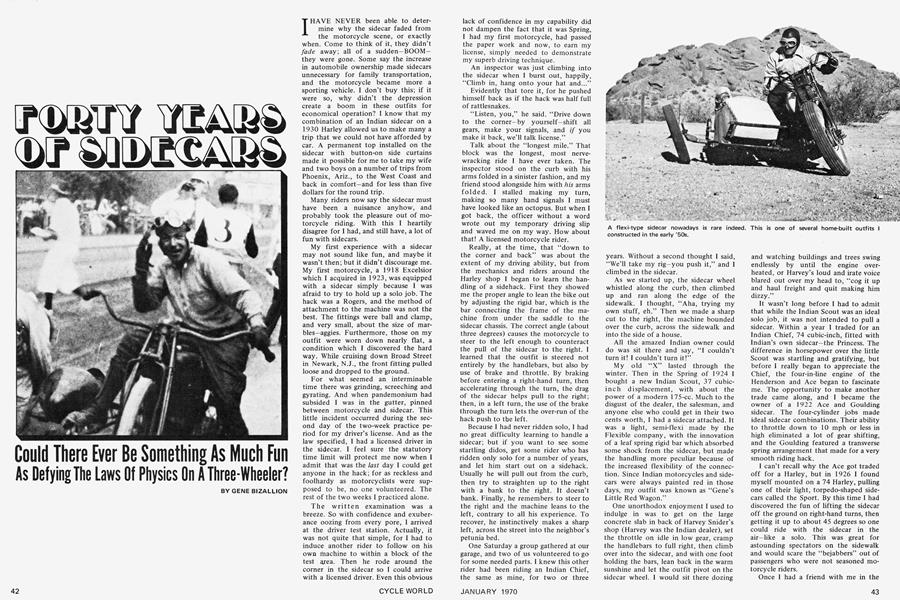
handlebars right down between the pas senger's knees and let the motorcycle saddle lean on the side of the body. Then, flinging into a left turn, it seemed as though the machine would part com pany with the sidecar. If the sidecar is a scarce article now, the flexi is practi cally unknown, even in the motorcycle trade. The only way to own a flexi is to do as I have done-build it yourself.
This sidecar racing in the twenties became faster and more competitive, and something had to give. The front forks, front wheels and sidecar wheels were under terrific stress and the col lapse of these units became too fre quent. The luckless passenger lay feet first in a torpedo-shaped body, and in the end-over-end pileups that resulted from failing equipment, he was usually the loser. The fatalities in this type of competition caused the AMA to ban sidecar racing around 1927.
In 1930, sidecar racing was again sanctioned, with modifications. The en gines were limited to 45-cubin-inch flatheads and a 130-pound sack of sand was supposed to replace the vulnerable pas senger. I say "supposed," for I doubt if there were ever more than 50 pounds in any sack, unless some suspicious referee called for a weigh-in. There were just three types of engines available at the time: the 45 Harley, Indian Scout and Super X. These engines were highly developed fuel jobs, and the machines were lightened by eliminating transmis sion, clutch and brakes. The drive was direct from engine to rigid countershaft then to rear wheel, and the start was made by lifting the exhaust valves to release compression until the pushers got the outfit rolling fast enough; then the valves were dropped to fire up the engine. This system, of course, neces sitated a starting lap.
As I had been riding Class A solo on the track since 1926, and had experi ence with the flexi on the road, I was offered a ride on an Indian outfit built by Joe Pachesa of Newark. Fortunately, the Indian Scout had a cam and lever in the timing case to lift the exhaust valves, but the Harley riders had to resort to the device of prying up the exhaust valves with a screwdriver and
putting a putty knife under each valve stem, then yanking the knives out when they got rolling. This practice some times made the starting lap a process of "tip-toe through the putty knives."
I ne tiexi racing lasted two or ttirec years, but it seemed impossible to gel more builders to get outfits running, o~ to get more riders interested in 1earnin~ to handle these jobs. It was a mystery tc me why this type of racing died out, foi the prize money was good, and usually appearance money was offered. The spectators liked these events, but the sidecars became so few that promoters stopped programming them - and there went the flexis again. It seems that, with a reviving interest in sidecars, this type of racing could be a great drawing card again on the half-mile and mile tracks. About the time sidecar racing passed on in the East, I moved to Arizona and went on with solo racing, but I always had a rigid sidecar on hand and made up my own flexi. I enjoy the flexi not only for riding, but because it is such a unique vehicle that there are not more than one or two operating in the coun try, or in the world, for that matter.
A sidecar fan can be proud that the three-wheeler is proven by statistics to be the safest vehicle on the road. Acci dent reports in England (where many are in use) have shown the sidecars to be remarkably low in the accident rate. In this country we could inform the National Safety Council that there has not been a fatal accident involving a sidecar in 25 years. Of course, this is largely so because there have been no sidecars for 25 years-but let us not confuse the National Safety Council with facts.
I have a 74 Harley which I have built into "gas modified" for the drag strip, but it is for road use and should make a good sidecar hauler. The temptation to try some sort of light hack on my 55 (cc, that is) Yamaha has been resisted with the thought that one should not go "ape" with the idea.
Well, I have seen the sidecar go, and judging by the letters and articles in the magazines, I may see it come back. And when it does, I will already be there with one ortwo.