Dan Gurney
Dan Gurney
In Profile: The Fair-Haired Boy Who Is A Man Too Fast for Motorcycles
CALIFORNIA'S one-time fair-haired boy of racing noW is 36 years old. The kid who raced sports cars, who could give Stirling Moss a run for his money, now is a man deeply involved in seeking the world Formula I driving championship, in building the Grand Prix cars for that global battle, and in motorcycles.
Dan Gurney has driven everything there is to drive — Group VII sports/racing machines, the more or less unlimited class among cars; stock cars, the race cars disguised in Detroit sheet metal; sports cars and modifieds from the tiny Triumph TR-2 to the furious 4.9-liter Ferrari; and that peculiar form of vehicular inbreeding, the Indianapolis 500 special.
Victory has come to Gurney at Le Mans, Spa and Riverside. Defeat has haunted him at those places, and elsewhere.
In the heat of desire to win, trying to force a car to go faster than it can, Gurney's huge, hard hands can bend the spring steel of a steering wheel rim, or pluck a gear shift lever as though it were a long-stemmed tulip.
The tall, wide-shouldered driver carries this same intense urgency into Ail-American Racers, the Gurney organization that intends to beat the world at the business of automobile racing. AAR maintains a shop in Santa Ana, Calif., a south-of-thesmog country town that in 20 years has grown to become part of the meandering megalopolis. In this shop are the facilities to breed Eagles, to build the super/ strong monocoque chassis that are powered by V-12 engines from the Gurney/Weslake operation in Rye, England, or dohc V-8s from Ford of Detroit.
Gurney must supervise — nitpick among the bits and pieces of yet to be assembled Formula I and Indianapolis racing machines. Gurney must drive — mentally prepare himself to compete next Sunday, and next Sunday, and next Sunday. Gurney must control — oversee the business end, the bookkeeping of AAR, and the contractual agreements with manufacturers and race promoters. All of the frenetic activity, physical and mental, involves cars, not motorcycles, and this is Gurney's regret.
Since his military discharge after the Korean conflict, Gurney has owned 10 motorcycles, yet, he says, "I've been wanting to get on a motorcycle for six months." A dirt rider for relaxation, Gurney finds his enforced separation from two-wheelers a matter of too few hours in the day, not a matter of choice. "I really miss motorcycles — I need 'em."
The GP driver had his first motorcycle ride in freezing Long Island cold on a Harley-Davidson sidevalve 74. "They had to pry me off the bike and help me into the house to get warm — but I loved every minute of it."
However, Gurney said, "My folks wouldn't let me have a motorcycle of my own. It wasn't until I got back from Korea — and I was old enough — that I got a bike. My first bike was a 650 Triumph — a Thunderbird I think they called it. I bought it used — wrecked. I painted it up, rebuilt it, then blew the engine. Then I got another Triumph.
"I used to ride every weekend. And I like the dirt better than pavement. You get the balance — the feel — of a motorcycle on the dirt, and you're not going so darn fast that you'll hurt yourself.
(Continued on following page)
"There's nothing better, nothing greater."
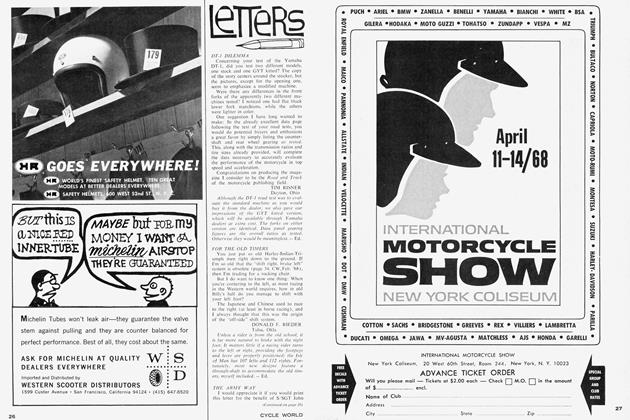
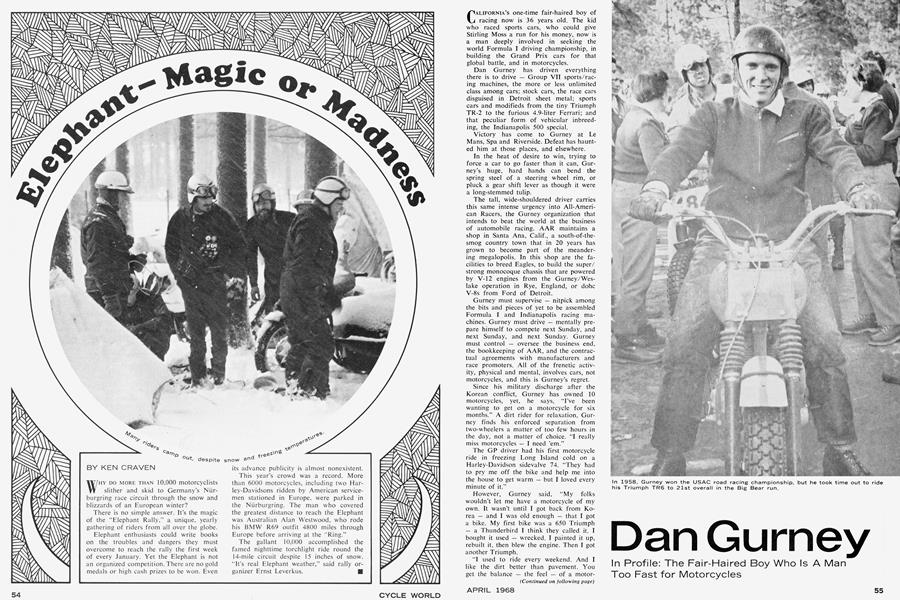
The dirt riding led to Gumey's entry in the Big Bear Enduro in 1957. He and his Matchless earned a DNF. Two years later, Dan was able to finish 21st among the 700 or so man-and-machine entries. That 1959 Big Bear was the last competitive motorcycle event for Gurney. By this time, Gurney was on his way to becoming a professional automobile driver — forced by reason of an ever-tightening schedule to put the bikes aside. By this time, Gurney was sought after to drive Ferrari and Lotus sports cars, and was winning a name for himself among the road racing buffs at Laguna Seca, Riverside, Santa Barbara and other Pacific Coast raceways. His driving potential earned for Gurney the grudging admiration of European sponsors. He started to appear in Formula I racing on the Grand Prix circuit, Monte Carlo, Spa, Zandvort, the Nürburgring, Monza and others. During one of those years he saw the German GP for motorcycles at Stuttgart. "Surtees won it on an MV Agusta Four," Gurney recalled.
What of Surtees? Has his motorcycle competition stood him in good stead as a Formula I car driver? "Racing is racing," Gurney answered. "In motorcycle racing, all the basic things apply. It's obvious that Surtees knows most of the fundamentals."
Of another motorcycle racer who has had a shot at GP racing, Gurney said, "Hailwood certainly deserves his title as motorcycle champion. I don't think he's ever had a real first class go at car racing. I don't think he has had the machinery. I don't know if he's a good driver or not."
Gurney cited Joe Leonard, Paul Goldsmith and Joe Weatherly as former motorcycle racers who have made the grade in the automotive major leagues of USAC and NASCAR.
"It takes a lot of natural ability to be a race driver," Gurney said. "No, it takes more than ability nowadays. You have to listen to the car and know what it's telling you. You have to be a mechanic, and be able to talk to another mechanic. "
Bruce McLaren, a New Zealander, and Jack Brabham, an Australian, both Grand Prix drivers, drove a variety of automobiles on the GP circuit. Their natural ability, the native engineering skill they both possess, has been put to use in building their own Formula I and II, and Group VII sports/racing cars. Somewhere along the line, Gurney decided that if New Zealand and Australia are well represented in Europe, so should be the USA. The idea grew. Contact was made with engine wizard Harry Weslake in England. Late in 1965, formation of All-American Racers, and initiation of the Eagle car project were announced.
"I've always wanted to go road racing — as far as I can go," said Gurney, with the characteristic wide smile he sometimes employs to mask the cold truth of his desire so flatly stated. "I'm proud of being an American. And, I'm proud of the fact we've got a shop in Santa Ana. I'm proud of the Grand Prix car that we build in Santa Ana, California." He swept an arm to encompass the two large bays of the Eagle manufactory. "This represents my home, my work and my business."
The Eagle cars made their debut in 1966 with Weslake modified Ford engines. The cars went well — and not so well. Gurney recalled that first year of the Eagle. "We were as quick as anyone is at the start of a race — then the rot set in. You know, the harder you stand on it, the slower it goes." The Gurney grin came again.
With the new Gurney/Weslake V-12, which displayed some potential toward the end of the 1967 season, and improved chassis for 1968, Gurney seemed eager for competition — Monte Carlo, Brands Hatch and Monza. "There's nothing like it when you see a car you really want to race in. The engine is a great engine, at least in my judgment, and I guess if you're going racing you have to have faith in your own judgment." , In addition to the GP effort, the Gurney operation is involved in a Mercury Cougar sedan racing project, and in development of the Indianapolis 500 car for 1968. Former GP driver and long-time friend of Gurney, Richie Ginther, is a member of the AAR squad and is chief trouble shooter/team manager on the associated projects. The Gurney grin came again. "You can call him 'Special Assistant to the President,' " he said. The special assistant was crew chief for Gurney's winning effort in the Rex Mays 300, at Riverside, Calif., the final USAC points event of the 1967 season. Gurney holds Ginther's talents in high esteem. "We plug him in where we need him," Gurney said. Only one part of the spreading Gurney enterprise involves motorcycles. Some years ago, after he had owned Ariel, Matchless and Triumph machinery, Gurney explained, "I began looking for somethink new. I saw an ad in a magazine for a nice looking street machine. It was a Montesa — a 175 Gran Sport. It looked racy. I took it for a ride — and did 96 miles per. I liked the motorcycle."
So impressed with the Montesa was Gurney that in 1962 he joined Kim Kimball in Montesa Motors, Inc., of Los Angeles. Kimball is president of the organization; Gurney is vice president. Since 1962, the firm has sold (Viva!) 4000 machines in the U. S. Montesa Motors plans to equal that figure during 1968.
There he is, Dan Gurney, the driver/ builder/owner who plans to put "at least one driver and one car in every race for the 1968 season, Dan Gurney the motorcycle dealer/distributor/rider who no longer rides, Dan Gurney who has ridden in enduros, and who has helped lay out courses with chalk and marker signs for that type of event.
Dan Gurney may be a world beater as a driver of cars, but he'll be totally frustrated until the day he can put a twowheeler in the dirt.
"A motorcycle makes you feel like an individual. You come over a rise and you think maybe no one has been here before. Maybe you imagine yourself on a horse — 200 years ago. A motorcycle is a tremendous kind of time machine. You can get away from the 20th Century."
"in no other way can a man get closer to a machine. With a motorcycle, you become one. it's a fabulous feeling.
"Cars aren't that way," said the driver of cars.