Husqvarna 360 Motocross
HUSQVARNA 360 MOTOCROSS
CYCLE WORLD ROAD TEST
A Big Gun for Hunting the Hare
IF A MAN'S TRADE involves a tool, it stands to reason that he will want the very best tool available. And when that trade is professional motocross racing, it follows that the tool, a motorcycle, like any other tool, must be designed to perform its given task efficiently and consistently, without unduly fatiguing its operator.
And what does this have to do with the American motorcycling scene? Well, first imagine two jobs to be done, each in a different work environment. The first is a tacky, rock strewn scrambles course in New England, and the second is deep-sand, hare-and-hound country in California. The requirements are the same in both settings: Get from point A to point B faster than anyone else and keep yourself together in the process. And now, sit back and relax, for the tool we are about to unveil for these hypothetical jobs is a reality, capable of handling either task with a minimum of fuss and bother and only a few personalizing modifications.
The Husqvarna 360 Motocross is, in the strictest sense of the word, a well-designed tool that accurately reflects the sophisticated state of the art of European motocross machine design.
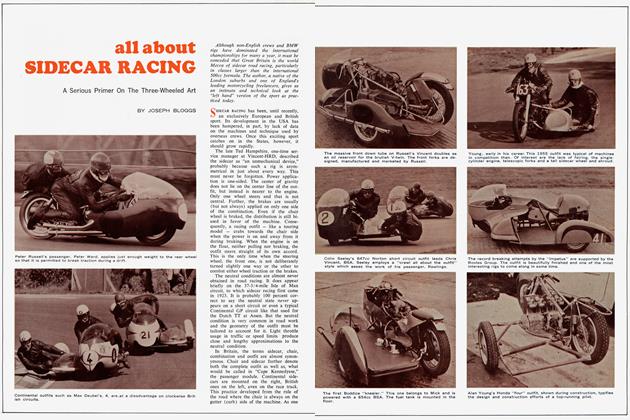
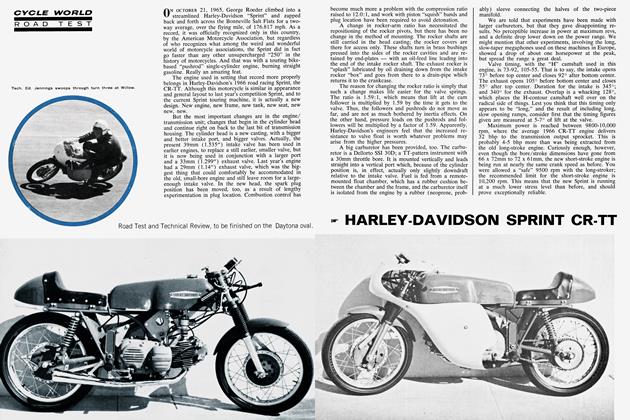
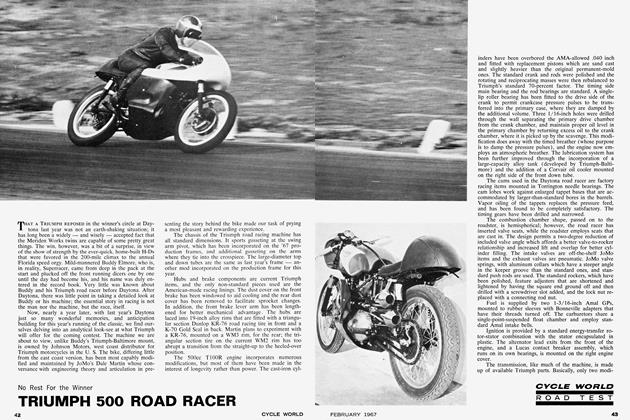
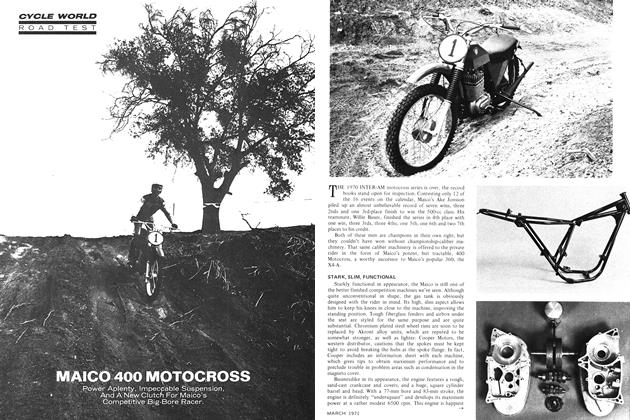
Out of the crate the Husky embodies most of the things that serious racers strive for years to attain in a machine, frequently settling for marginal factors in some areas that are partially made up for by exceptional qualities in others. The Husky is virtually devoid of such compromises. In three rather important areas — power-toweight ratio, handling and dependability — it is outstanding. All of these factors are interdependent: At 215 pounds (curb) the Husky does not need 50-plus horsepower to make it competitively swift (its 37 bhp gives it a power-toweight ratio of less than 6:1; as a result, it can employ a light two-stroke engine (an additional plus-factor in .keeping the weight down) that can be tuned to perform well within design limits, thus maintaining a high degree of reliability; and finally, the very low weight of the Husky has given the suspension designers an easy row to hoe, with lighter, long-travel springs which respond to terrain rather than resist it.
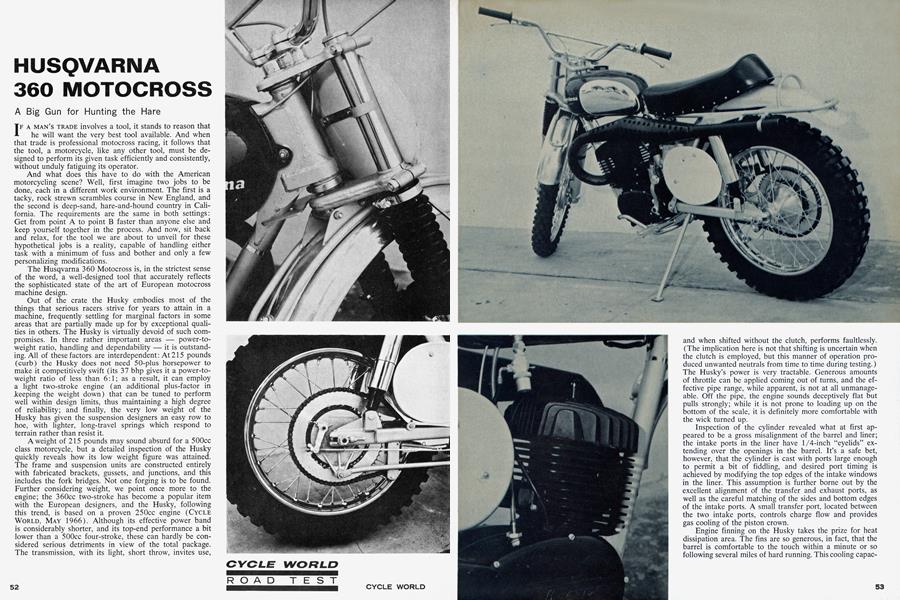
A weight of 215 pounds may sound absurd for a 500cc class motorcycle, but a detailed inspection of the Husky quickly reveals how its low weight figure was attained. The frame and suspension units are constructed entirely with fabricated brackets, gussets, and junctions, and this includes the fork bridges. Not one forging is to be found. Further considering weight, we point once more to the engine; the 360cc two-stroke has become a popular item with the European designers, and the Husky, following this trend, is based on a proven 250cc engine (CYCLE WORLD, MAY 1966). Although its effective power band is considerably shorter, and its top-end performance a bit lower than a 500cc four-stroke, these can hardly be considered serious detriments in view of the total package. The transmission, with its light, short throw, invites use, and when shifted without the clutch, performs faultlessly. (The implication here is not that shifting is uncertain when the clutch is employed, but this manner of operation produced unwanted neutrals from time to time during testing.) The Husky's power is very tractable. Generous amounts of throttle can be applied coming out of turns, and the effective pipe range, while apparent, is not at all unmanageable. Off the pipe, the engine sounds deceptively flat but pulls strongly; while it is not prone to loading up on the bottom of the scale, it is definitely more comfortable with the wick turned up.
Inspection of the cylinder revealed what at first appeared to be a gross misalignment of the barrel and liner; the intake ports in the liner have 1/4-inch "eyelids" extending over the openings in the barrel. It's a safe bet, however, that the cylinder is cast with ports large enough to permit a bit of fiddling, and desired port timing is achieved by modifying the top edges of the intake windows in the liner. This assumption is further borne out by the excellent alignment of the transfer and exhaust ports, as well as the careful matching of the sides and bottom edges of the intake ports. A small transfer port, located between the two intake ports, controls charge flow and provides gas cooling of the piston crown.
Engine finning on the Husky takes the prize for heat dissipation area. The fins are so generous, in fact, that the barrel is comfortable to the touch within a minute or so following several miles of hard running. This cooling capacity, combined with numerous small features such as the quick-cable-change Magura controls, high-volume paper element air cleaner, self-locking aircraft nuts and hefty fork bridge pinch bolts cap off what is, in most respects, an excellent long, rough-course machine.
The qualification "most" is intentional. For long distances something will have to be done with the seat. Several inches of foam should correct its lack of padding without destroying stand-up comfort and "feel" that might be adversely altered with a wider fanny platform. A bash plate is essential for rocky going. And finally, the expansion chamber could stand a bit more shrouding (possibly an asbestos batt) aft of the tank.
The entire 360 Husky — not just the engine — is based on the 250cc Husqvarna Motocross. A couple of design features pointed out in the test of the 250 bear repeating. The first of these is the floating rear brake arrangement which permits the rear suspension to function during hard braking on irregular surfaces, resulting in excellent control going into turns or on long cobby downhill sections. Another welcome item is the Norton-pattern front suspension. These excellent forks afford the 360 a most-forgiving and pleasantly stable ride. Sliding through turns with the Husky is unnecessary — steering through them is de rigueur, even on hard, bumpy surfaces. Dampening is excellent on both ends, and rear-end rebound is totally absent.
The 19-inch front wheel is not a concession to the American market; the Swedes are as nutty about 19-inch wheels as they are for Aquavit. While the narrow section tire may be a bit skimpy for loose sand, it is well to remember that the weight distribution of the Husky keeps it on its tip-toes most of the time, and an argument for having a wider platform to float on top of sand holds little water for a 215-pound motorcycle with 37 active and willing horses. The front end can be brought up on top anytime one wishes it there. Additionally, a narrow-section front tire tends to provide more precise control on loamy surfaces.
The finish on the Husky is quite good for an all-out competition bike. In addition, a great deal of thought has been given to many seemingly insignificant points, including such things as the rubber stop for the kick starter, the front number plate mounting bracket, the quickly-removed air cleaner cover, the sturdy handlebar mounts, two-piece fiberglass rear fender, and the like.
The Husky is a cinch to service. Spark plug, carburetor, rear chain, fork drains and all those other delightful points that so frequently need attention are easily accessible and require no jockeying about.
The overlay wheel sprocket, by the way, seems at first to be a long-way-around solution to gearing, but it turns out that it is really a sensible economy measure; the hub, with integrally cast sprocket and drum, is an off-theshelf item used on Swedish military bikes. The unit, as it turns out, is well suited to the motocross bike, so Husqvarna saw little sense in designing and manufacturing a new hub just to eliminate the sprocket — which, by the way, plays a significant role in the speed trials portions of events like the International Six Days Trial. Both front and rear brakes are quite good, no matter how slight they may appear to be, and evidenced no appreciable fade during hard running on a tight, twisty course.
The Husqvarna 360 Motocross carries the same admonishment as the 250: This is primarily a motorcycle for the serious racer. It would be to a trail-riding party what an IBM 7090 would be to tallying up the week's groceries. As racing hardware it is competitively priced. As a toy it is expensive, but if you wish to play in style, who are we to say you nay.
In summing up, we feel that Husqvarna 360 Motocross is an accurate execution of a near-optimum design for a high-speed, rough-and-tumble-duty motorcycle. ■
HUSQVARNA 360 MOTOCROSS
SPECIFICATIONS
$1150
PERFORMANCE