Bridgestone 175 Street Scrambler
BRIDGESTONE 175 STREET SCRAMBLER
CYCLE WORLD ROAD TEST
The Same, Only Better
THE CONCEPT, "street scrambler," may seem curious to some of our readers, who will conjure up the image of a rider in chinos and suede boots jumping curbstones in downtown Urbsville. Curious it is not, judging by the response of the buying public, who may show the greatest apathy for the most revolutionary of new models in street trim, only to snap up copies of essentially the same thing as soon as they appear with the veneer (if not all the characteristics) of a scrambler. One may wonder at the fascination such a machine holds for the buyer. Maybe it has something to do with the appearance itself; anything that looks like it "goes" in the dirt has a certain competitive allure to it. Indeed, a street scrambler may be a Godsend to the mostly-street rider who has crunched the pipes on a more conventional model after he discovered the joy of hooking slides in a nearby back lot.
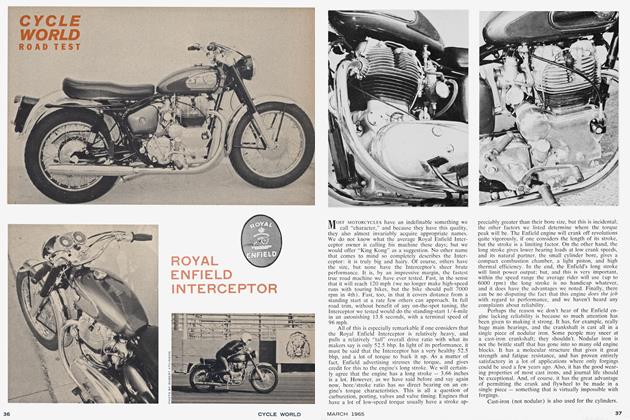
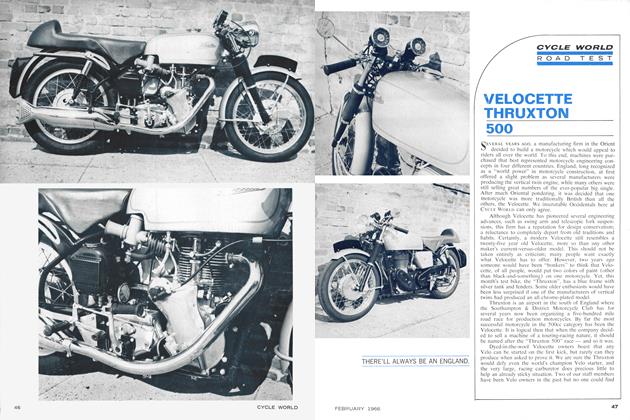
And so we come to the Bridgestone 175cc quasiscrambler, which carries the model name, Hurricane. It is essentially a Bridgestone 175 Dual-Twin, and owners of this street model could order most of the changes neces sary to come up with the Hurricane (or better it, if they were inclined to spend the money). These changes are, basically, upswept exhaust system, installation of fatter tires, crosspiece handlebars, a similar seat with a suede finish, and a ½-turn throttle. Engine tuning, suspension, frame, lighting, tank, brakes, fenders, rolling gear and instrumentation remain the same as on the street bike.
The lack of "changes" should by no means be construed to imply that the bike is ill-suited for other than street riding. For example, the frame is a tough affair, offering rigidity and extra bracing uncommon to a road bike of 175cc displacement. As it is heavy for strictly street usage, one may suspect that Bridgestone had a spot of trailing in mind when they built the frame for the road bike. The top tube, for instance, is reinforced by a secondary pair of top tubes coming from the subframe, which are bolted to a gusset below the steering head. The rear downtubes are liberally linked with crossbracing. There is certainly no lack of strength-producing triangulation of frame members.
The Bridgestone's rotary disc valve engine, also, is more appropriate to dirt play than the conventional piston port two-stroke engine, as the rotary version may be tuned to produce a wider power band. This characteristic shows up in the smooth-running Hurricane, which has adequate punch high in the rev range, while still being able to "tractor" (relatively speaking, to be sure), a fair accomplishment for a two-cylinder machine of this displacement. Our only complaint is that the engine feels like it could be turned up another 1,000 rpm, without losing too much reliability, thereby gaining in overall performance. This is particularly true with the five-speed gearbox, a luxury which helps to ensure that one won't run out of power no matter how low the speed.
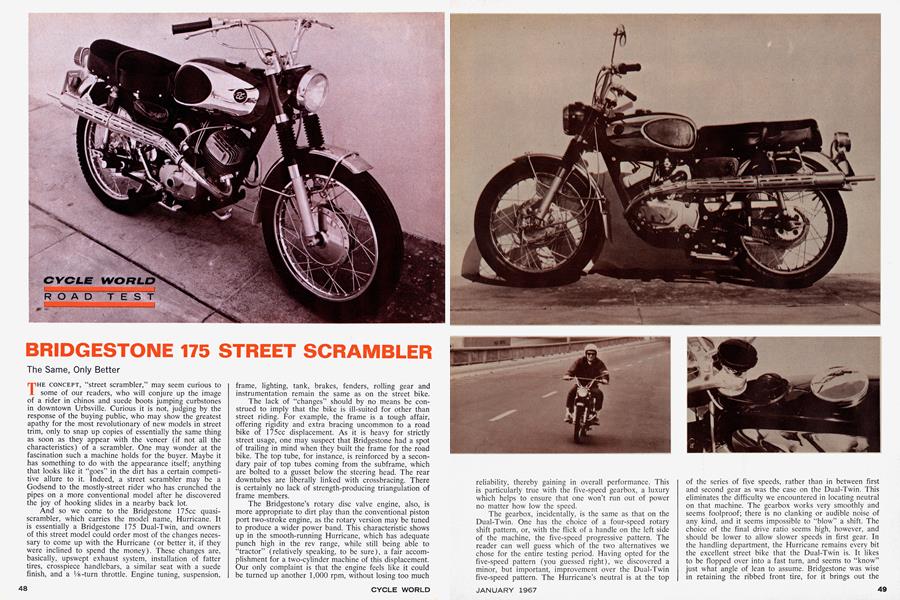
The gearbox, incidentally, is the same as that on the Dual-Twin. One has the choice of a four-speed rotary shift pattern, or, with the flick of a handle on the left side of the machine, the five-speed progressive pattern. The reader can well guess which of the two alternatives we chose for the entire testing period. Having opted for the five-speed pattern (you guessed right), we discovered a minor, but important, improvement over the Dual-Twin five-speed pattern. The Hurricane's neutral is at the top of the series of five speeds, rather than in between first and second gear as was the case on the Dual-Twin. This eliminates the difficulty we encountered in locating neutral on that machine. The gearbox works very smoothly and seems foolproof; there is no clanking or audible noise of any kind, and it seems impossible to "blow" a shift. The choice of the final drive ratio seems high, however, and should be lower to allow slower speeds in first gear. In the handling department, the Hurricane remains every bit the excellent street bike that the Dual-Twin is. It likes to be flopped over into a fast turn, and seems to "know" just what angle of lean to assume. Bridgestone was wise in retaining the ribbed front tire, for it brings out the already excellent tracking characteristics of the machine.
We wouldn't recommend this bike for serious dirt work, and would rather see a rider who was so inclined get a mount that had been designed for the dirt first and then had a set of lights added as an afterthought. For one thing, the Bridgestone's wheelbase is too short to be safe going lickety-split over the real boonies. But within limits, the bike is surprisingly well-behaved. These limits include speeds more appropriate to an enduro than to a hare scrambles, and terrain that has had the kiss of man's hoe, if not the bite of his steel grader.
In 40 mph travel up a rutted, muddy bridle path, the machine bottomed out, not at the front, which is surprising, but at the back. The front forks seem quite good as far as travel and damping goes, but the rear suspension is too soft (even, perhaps, for the street) and not adjustable. Nonetheless, the Hurricane had very little yaw and gave no suggestion that it might jack the rider up over the handlebars. If a reasonably crafty tuner could snip himself a wilder set of rotary valves and strip the frame of the rather excessive weight, he could conceivably come up with a competitive machine for TT scrambles, using basically the suspension that comes on the bike, save for a much stiffer set of rear springs. We do have a few complaints. One is that there is a gap in the shielding on the forward part of the exhaust pipe where one may burn his leg if he rides in normal dress. The second is that the stingers issuing from the silencers become oil-covered, and, in addition to being unsightly, pose a possible menace to a clean pair of slacks; we wonder if they are really necessary, seeing as that the Dual-Twin comes without them. Fortunately, they are removable. Also, the center and side stands bottom over rather slight obstacles. The Hurricane could use a skid plate, but the engine is protected somewhat by the juncture of three heavy frame tubes at the most likely point of impact.
On the other hand, the Hurricane has much going for it, including intake and exhaust silencing that sets a standard which should be met by every two-stroke that runs in the city. The brakes are good, and promise to be of adequate size, even if the bike is hot-rodded to more prodigious outputs. The labeled oil filler is on the gas tank just forward of the gasoline filler and serves as a visible reminder to check the oil level each time one stops for fuel. The finish and styling — chrome and deep candy-apple red — are among the best we have seen on any machine. ■
BRIDGESTONE HURRICANE 175
SPECIFICATIONS
$650
POWER TRANSMISSION
DIMENSION, INCHES
PERFORMANCE