4th Japan Gp
4TH JAPAN GP
IVAN J. WAGAR
THE DEAFENING, almost invincible wail of four, five and six-cylinder Hondas. that has been part of the atmosphere at all the Grand Prix circuits this year, was not heard during the home ground Japanese GP. Although this was a disappointment for the spectators and meant effortless wins for the opposition, it was no surprise to anyone who follows GP racing.
Honda's absence was not a last minute decision, but one that has been brewing for considerable time. It probably started more than four years ago when Honda, already successful in European racing, wanted Japan to have a Grand Prix to demonstrate to the home crowds what it was all about. However, there was no circuit suitable for approval by the FIM, so Honda built a multi-million dollar course at Suzuka, which was duly certified by the FIM and became the site of the first three Japanese Grands Prix.
Last year, some of the other manufacturers voiced their disapproval of racing on a manufacturer-owned circuit, with reasons ranging from the course rental being too expensive, to lack of secrecy during testing. Real or imaginary, feelings ran so high on the matter that a second course was built near Mount Fuji, called FISCO, which, in July of this year, was also approved for a world championship race.
Honda, quite naturally, was upset by what was happening, and before the 1966 season started, announced that if the race were held at Fisco, then Honda would win all five solo championships before the Japan GP and therefore would not need to support the race. And they did just exactly that! The only Hondas at the race were the converted CBs of "Pop" Yoshimura which, although quite quick, were no match for the factory Yamahas.
Honda has to be admired for sticking to their guns, and even more for being able to pull off a championship string never matched in racing history. The boycott, though, did have a staggering effect on the amount of spectator interest, with two manufacturers parading their latest racing hardware. To make things even worse for the organizers, only the 50cc individual crown was to be settled at Fisco, so there was not much inducement for Europeans to make the long trip.
In Europe, one can more or less make a loop and hit most of the GPs in succession; but Japan is rather on the way to nowhere, and this means the organizers pay out some rather large sums of money for a very few riders. Performances put in by all but one or two of the Europeans on Japanese factory machines were just short of deplorable. John Cooper and Chris Vincent, on their Nortons, formed an extremely effective road block for the few laps they ran. In fact, the most interesting part of the day's racing was how fast American Gary Nixon would have to go to win.
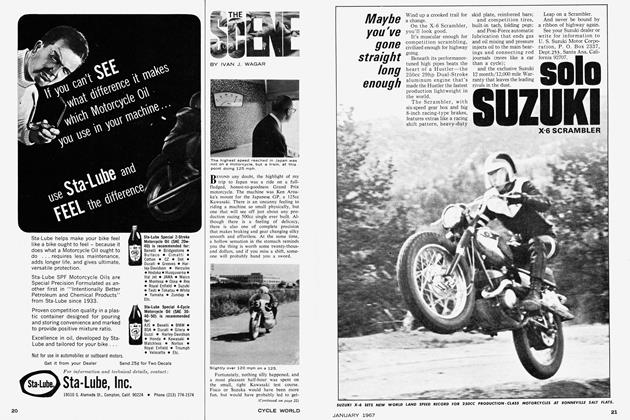
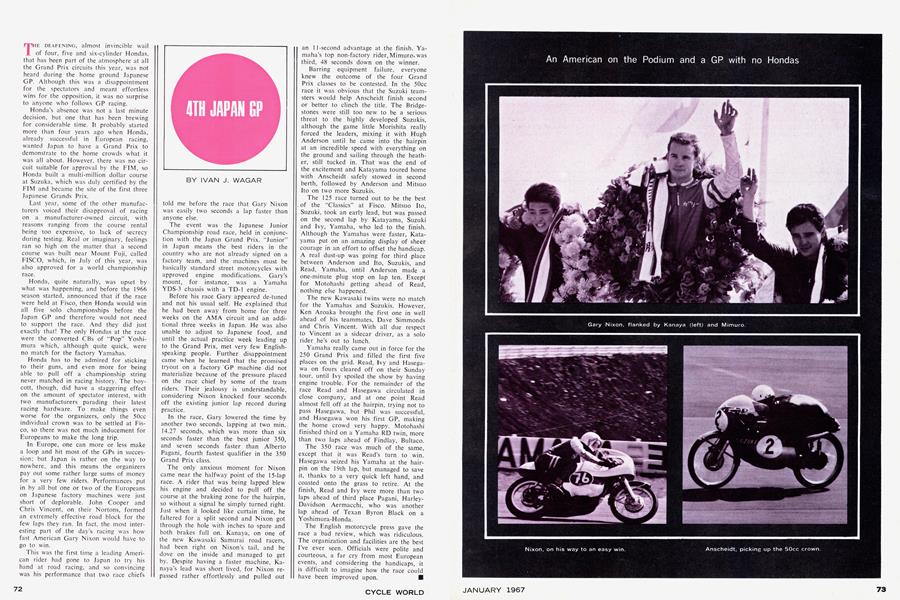
This was the first time a leading American rider had gone to Japan to try his hand at road racing, and so convincing was his performance that two race chiefs told me before the race that Gary Nixon was easily two seconds a lap faster than anyone else.
The event was the Japanese Junior Championship road race, held in conjunction with the Japan Grand Prix. "Junior" in Japan means the best riders in the country who are not already signed on a factory team, and the machines must be basically standard street motorcycles with approved engine modifications. Gary's mount, for instance, was a Yamaha YDS-3 chassis with a TD-1 engine.
Before his race Gary appeared de-tuned and not his usual self. He explained that he had been away from home for three weeks on the AMA circuit and an additional three weeks in Japan. He was also unable to adjust to Japanese food, and until the actual practice week leading up to the Grand Prix, met very few Englishspeaking people. Further disappointment came when he learned that the promised tryout on a factory GP machine did not materialize because of the pressure placed on the race chief by some of the team riders. Their jealousy is understandable, considering Nixon knocked four seconds off the existing junior lap record during practice.
In the race, Gary lowered the time by another two seconds, lapping at two min. 14.27 seconds, which was more than six seconds faster than the best junior 350, and seven seconds faster than Alberto Pagani, fourth fastest qualifier in the 350 Grand Prix class.
The only anxious moment for Nixon came near the halfway point of the 15-lap race. A rider that was being lapped blew his engine and decided to pull off the course at the braking zone for the hairpin, so without a signal he simply turned right. Just when it looked like curtain time, he faltered for a split second and Nixon got through the hole with inches to spare and both brakes full on. Kanaya, on one of the new Kawasaki Samurai road racers, had been right on Nixon's tail, and he dove on the inside and managed to get by. Despite having a faster machine, Kanaya's lead was short lived, for Nixon repassed rather effortlessly and pulled out an 11-second advantage at the finish. Yamaha's top non-factory rider, Mimuro, was third, 48 seconds down on the winner.
Barring equipment failure, everyone knew the outcome of the four Grand Prix classes to be contested. In the 50cc race it was obvious that the Suzuki teamsters would help Anscheidt finish second or better to clinch the title. The Bridgestones were still too new to be a serious threat to the highly developed Suzukis, although the game little Morishita really forced the leaders, mixing it with Hugh Anderson until he came into the hairpin at an incredible speed with everything on the ground and sailing through the heather, still tucked in. That was the end of the excitement and Katayama toured home with Anscheidt safely stowed in second berth, followed by Anderson and Mitsuo Ito on two more Suzukis.
The 125 race turned out to be the best . of the "Classics" at Fisco. Mitsuo Ito, Suzuki, took an early lead, but was passed on the second lap by Katayama, Suzuki and Ivy, Yamaha, who led to the finish. Although the Yamahas were faster, Katayama put on an amazing display of sheer courage in an effort to offset the handicap. A real dust-up was going for third place between Anderson and Ito, Suzukis, and Read, Yamaha, until Anderson made a one-minute plug stop on lap ten. Except for Motohashi getting ahead of Read, nothing else happened.
The new Kawasaki twins were no match for the Yamahas and Suzukis. However, Ken Aroaka brought the first one in well ahead of his teammates, Dave Simmonds and Chris Vincent. With all due respect to Vincent as a sidecar driver, as a solo rider he's out to lunch.
Yamaha really came out in force for the 250 Grand Prix and filled the first five places on the grid. Read, Ivy and Hasegawa on fours cleared off on their Sunday tour, until Ivy spoiled the show by having engine trouble. For the remainder of the race Read and Hasegawa circulated in close company, and at one point Read almost fell off at the hairpin, trying not to pass Hasegawa, but Phil was successful, and Hasegawa won his first GP, making the home crowd very happy. Motohashi finished third on a Yamaha RD twin, more than two laps ahead of Findlay, Bultaco.
The 350 race was much of the same, except that it was Read's turn to win. Hasegawa seized his Yamaha at the hairpin on the 19th lap, but managed to save it, thanks to a very quick left hand, and coasted onto the grass to retire. At the finish, Read and Ivy were more than two laps ahead of third place Pagani, HarleyDavidson Aermacchi, who was another lap ahead of Texan Byron Black on a Yoshimura-Honda.
The English motorcycle press gave the race a bad review, which was ridiculous. The organization and facilities are the best I've ever seen. Officials were polite and courteous, a far cry from most European events, and considering the handicaps, it is difficult to imagine how the race could have been improved upon. ■
An American on the Podium and a GP with no Hondas