Kreidler Race-Record Bikes
KREIDLER RACE-RECORD BIKES
SLON IGER
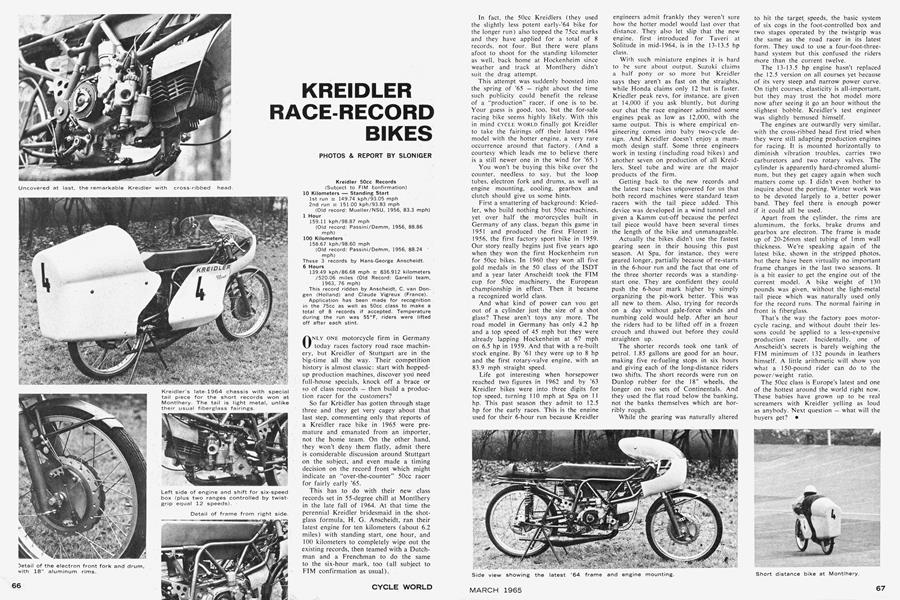
Kreidter 50cc Records (Subject to FIM t~onfirmation) 10 Kilometers - Standing Start 1st run = 149.74 kph/93.05 mph 2nd run = 151.00 kph/93.83 mph (Old record: Mueller/NSU, 1956, 83.3 mph) 1 Hour 159.11 kph/98.81 mph (Old record: Passini/Demm, 1956, 88.86 mph) 100 Kilometers 158.67 kph/98.60 mph (Old record: Passini/Delnm, 1956, 88.24 mph) These 3 records by Hans.George Anscheidt. 6 Hours 139.49 kph/86.68 mph = 836.912 kilometers /520.06 miles (Old Record: Garelli team, 1963, 76 mph) This record ridden by Anscheidt, C. van Don gen (Holland) and Claude Vigreux (France). Application has been made for recognition in the 75cc as well as 50cc class to make a total of 8 records if accepted. Temperature during the run was 55°F, riders were lifted off after each stint.
ONLY ONE motorcycle firm in Germany today races factory road race machin-
ery, but Kreidler of Stuttgart are in the big-time all the way. Their competition history is almost classic: start with hoppedup production machines, discover yod need full-house specials, knock off a brace or so of class records — then build a production racer for the customers?
So far Kr~idler has gotten through stage three and they get very cagey about that last step, commenting only that reports of a Kreidler race bike in 1965 were pre mature and emanated from an ir'nporter, not the home team. On the other hand, they won't deny them flatly, admit there is considerable discussjon around Stuttgart on the subject, and even made a timing decision on the record front which might indicate an "over-the-counter" 50cc racer for fairly eafly `65.
This has to do with their new class records set in 55-degree chill at Montihery in the late fall of 1964. At that time the perennial Kreidler bridesmaid in the shotglass formula, H. 0. Anschéidt, ran their latest engine for ten kilometers (about 6.2 miles) with standing start, one hour, and 100 kilometers to completely wipe out the existing records, then teamed with a Dutch man and a Frenchman to do the same to the six-hour mark, too (all subject to FIM confirmation as usual).
In fact, the 50cc Kreidlers (they used the slightly less potent early-'64 bike for the longer run) also topped the 75cc marks and they have applied for a total of 8 records, not four. But there were plans afoot to shoot for the standing kilometer as well, back home at Hockenheim since weather and track at Montlhery didn't suit the drag attempt.
This attempt was suddenly boosted into the spring of '65 — right about the time such publicity could benefit the release of a "production" racer, if one is to be. Your guess is good, too, but the for-sale racing bike seems highly likely. With this in mind CYCLE WORLD finally got Kreidler to take the fairings off their latest 1964 model with the hotter engine, a very rare occurrence around that factory. (And a courtesy which leads me to believe there is a still newer one in the wind for '65.)
You won't be buying this bike over the counter, needless to say. but the loop tubes, electron fork and drums, as well as engine mounting, cooling, gearbox and clutch should give us some hints.
First a smattering of background: Kriedler, who build nothing but 50cc machines, yet over half the mo'orcycles built in Germany of any class, began this game in 1951 and produced the first Florett in 1956, the first factory sport bike in 1959. Our story really begins just five years ago when they won the first Hockenheim run for 50cc bikes. In 1960 they won all five gold medals in the 50 class of the ISDT and a year later Anscheidt took the FIM cup for 50cc machinery, the European championship in effect. Then it became a recognized world class.
And what kind of power can you get out of a cylinder just the size of a shot glass? These aren't toys any more. The road model in Germany has only 4.2 hp and a top speed of 45 mph but they were already lapping Hockenheim at 67 mph on 6.5 hp in 1959. And that with a re-built stock engine. By '61 they were up to 8 hp and the first rotary-valve engine, with an 83.9 mph straight speed.
Life got interesting when horsepower reached two figures in 1962 and by '63 Kreidler bikes were into three digits for top speed, turning 110 mph at Spa on 11 hp. This past season they admit to 12.5 hp for the early races. This is the engine used for their 6-hour run because Kreidler engineers admit frankly they weren't sure how the hotter model would last over that distance. They also let slip that the new engine, first introduced for Taveri at Solitude in mid-1964, is in the 13-13.5 hp class.
With such miniature engines it is hard to be sure about output. Suzuki claims a half pony or so more but Kreidler says they aren't as fast on the straights, while Honda claims only 12 but is faster. Kriedler peak revs, for instance, are given at 14,000 if you ask bluntly, but during our chat the race engineer admitted some engines peak as low as 12,000, with the same output. This is where empirical engineering comes into baby two-cycle design. And Kreidler doesn't enjoy a mammoth design staff. Some three engineers work in testing (including road bikes) and another seven on production of all Kreidlers. Steel tube and wire are the major products of the firm.
Getting back to the new records and the latest race bikes uncovered for us that both record machines were standard team racers with the tail piece added. This device was developed in a wind tunnel and given a Kamm cut-off because the perfect tail piece would have been several times the length of the bike and unmanageable.
Actually the bikes didn't use the fastest gearing seen in their housing this past season. At Spa, for instance, they were geared longer, partially because of re-starts in the 6-hour run and the fact that one of the three shorter records was a standingstart one. They are confident they could push the 6-hour mark higher by simply organizing the pit-work better. This was all new to them. Also, trying for records on a day without gale-force winds and numbing cold would help. After an hour the riders had to be lifted off in a frozen crouch and thawed out before they could straighten up.
The shorter records took one tank of petrol. 1.85 gallons are good for an hour, making five re-fueling stops in six hours and giving each of the long-distance riders two shifts. The short records were run on Dunlop rubber for the 18" wheels, the longer on two sets of Continentals. And they used the flat road below the banking, not the banks themselves which are horribly rough.
While the gearing was naturally altered to hit the target, speeds, the basic system of six cogs in the foot-controlled box and two stages operated by the twistgrip was the same as the road racer in its latest form. They used to use a four-foot-threehand system but this confused the riders more than the current twelve.
The 13-13.5 hp engine hasn't replaced the 12.5 version on all courses yet because of its very steep and narrow power curve. On tight courses, elasticity is all-important, but they may trust the hot model more now after seeing it go an hour without the slightest bobble. Kreidler's test engineer was slightly bemused himself.
The engines are outwardly very similar, with the cross-ribbed head first tried when they were still adapting production engines for racing. It is mounted horizontally to diminish vibration troubles, carries two carburetors and two rotary valves. The cylinder is apparently hard-chromed aluminum. but they get cagey again when such matters come up. I didn't even bother to inquire about the porting. Winter work was to be devoted largely to a. better power band. They feel there is enough power if it could all be used.
Apart from the cylinder, the rims are aluminum, the forks, brake drums and gearbox are electron. The frame is made Up of 20-26mm steel tubing of 1mm wall thickness. We're speaking again of the latest bike, shown in the stripped photos, but there have been virtually no important frame changes in the last two seasons. It is a bit easier to get the engine out of the current model. A bike weight of 130 pounds was given, without the light-metal tail piece which was naturally used only for the record runs. The normal fairing in front is fiberglass.
That's the way the factory goes motorcycle racing, and without doubt their lessons could be applied to a less-expensive production racer. Incidentally, one of Anscheidt's secrets is barely weighing the FIM minimum of 132 pounds in leathers himself. A little arithmetic will show you what a 150-pound rider can do to the power/weight ratio.
The 50cc class is Europe's latest and one of the hottest around the world right now. These babies have grown up to be real screamers with Kreidler yelling as loud as anybody. Next question — what will the buyers get? •