South Jersey Sand Trailinc
FOR THE NEW YOUR Philadelphia rider who has a week's vacation, there are innumerable good places to tour with his bike. He can go to New England, the Smokey Mountains, Cape Hatteras, or even to Canada. He can plan his trip around Williamsburg, Virginia and the other historic sites on the Chesapeake Bay. But if he has only a weekend or a single free day to spend touring, it is difficult to know where he can escape from traffic circles, stoplights, and divided highways.
Until five years ago, I thought of the Newr Jersey pine barrens as an unavoidable evil on the trip from Philadelphia to the seashore. The area is not appealing, when seen at speed from the main highways. Billboards, gas stations, and cheap bars are frequent, as if seeds from Jersey City had blown down to the pine barrens and sprouted thinly in the sandy soil. From the highway you do not see the unexpected copse of white birch, the narrow black creek that cuts through the woods, the thousands of miles of unfrequented sand trails, the silence.
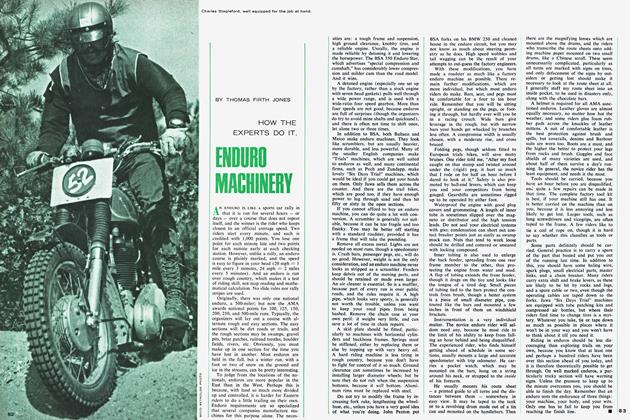
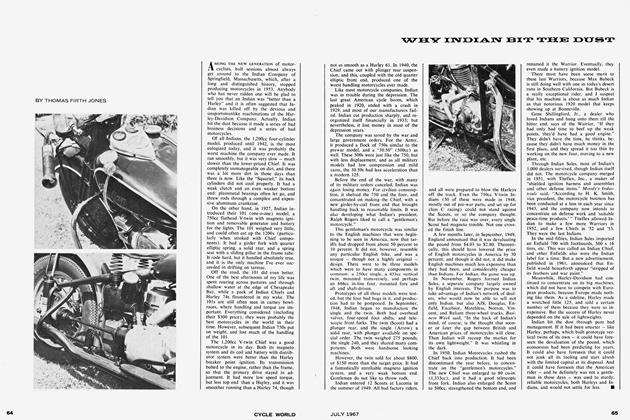
Through this 2000 square mile area (the least densely populated area between Philadelphia and northern Maine) Sandy Lane Enduro is run every fall. It was my introduction to the pine barrens five years ago, and though I have come back many times on my own, I have not missed a Sandy Lane since then. Covering South Jersey from one side to the other and back again, frequently by fire cuts, abandoned railroad beds, sand pits and swamps, Sandy Lane shows every kind of terrain that a bike can be ridden over, and a few that a bike must be pushed through as well. I especially remember one sink hole on the 1963 run (it rained all that day, and the day before, and the day before that ) where we waited our turn to ride our bikes in and carry them out. Stepping off my bike, I found myself up to my waist in cold, mucky water. I have since talked to other riders, and they assure me it w'as cedar trunks I stepped through which were keeping the bike from going more than three feet down into the hole. But I was sure that I had felt a gas tank and the crunch of a spark plug down there under the water, and someone’s arm flailing indignantly at me.
Sink holes are not an essential part of a day’s motorcycling in the pine barrens, though they are sought out by the ingenious organizers of Sandy Lane. It is possible to spend the whole day on smooth, undulating trails that wind in and out through the trees. Where there is water, a wooden bridge crosses it. Many places suggest themselves as ideal for a picnic or a “discussion” with your girl, for the vegetation is sparse here, by Eastern standards, and meadows of soft grass grow between the bases of the pine trees.
The trails should be ridden in a relaxed manner. It is a mistake to try to steer your bike or to put down your foot, which will act like a rudder in the loose sand. It is especially important to run in as high gear as your machine will pull, keeping the revs down to hold traction. The trails are so enticing that the hours go by rapidly, and I know' many a rider who thought he would run Sandy Lane like a scrambles course, and found himself sitting beside the trail late in the day with his rings laminated to his barrel, waiting for the clean-up crew to come through. But if you ride relaxed, the worst that can happen is that you will slide out, which does little harm in the loose sand.
Having ridden many hikes on the sand trails, I advise owners of 125cc and smaller machines not to try them. Pow'er is needed, and power over a wide range of revs, because shifting is not always practicable, and at less than 20 mph a bike will not handle properly. Although a 250 Zundapp was at home there, my Jawa 250 scrambler did best. It seemed to anticipate the turns by itself, and no sand got through its well-sealed chain case and hidden air cleaner. My present bike, a BMW R-69, is less at home on loose surfaces. It tends to wobble at high speeds, and to bog down at low ones. It is work, though still enjoyable work, to ride it over the sand trails. Other large machines may have similar problems, though many oldtimers say that you can't beat a flathead Harley in bottomless sand.
It is impossible to get lost in the pine barrens. The trails branch often, but if you set your mind on getting out, you need only pick a direction and be guided by the sun. Ten miles will always take you to a blacktop road, and from there to a crossroads where a sign will tell you where you are ... or where you ought to be.
For the touring rider who would rather stay on blacktop, there are attractions well worth visiting all over South Jersey, and roads to take him there without red lights or traffic (provided he stays off the main arteries going back and forth to the shore). Mays Landing is a quiet, pretty town, though it is the seat of Atlantic County, which includes Atlantic City. Food is good, and cheap by city standards. There is an aura of New England about the village square, whth the church, the white frame houses around it and the brick courthouse dow'n the street. People walk slow'er here, and do not mind stopping to talk.
At Mauricetown you may see the draw' bridge across the Maurice River being operated: a pivoting affair, reached by a long causeway over the swamps and motivated by two men who walk around and around on the pivoting part, themselves providing the power through a set of primeval gears.
SOUTH JERSEY SAND TRAILINC
THOMAS FIRTH JONES
Chatsworth station has been sold by the railroad to a blueberry entrepreneur, who has moved it back from the right-of-way and jacked it up with cinder blocks. There it sits, a small frame building with a huge slate roof, a monument to Victorian shingling technique and to the elaboration of what was never necessary in the first place. It is deserted except for a couple of months a year, when it is used for berry sorting and packing. Its roof gives heavier shade than do the scrub pines surrounding it: a good place to have a smoke and rest.
But Batsto is the most interesting site in the pine barrens. It is on the edge of the Wharton Tract, a huge piece of land which, according to legend, was bought up by one Joseph Wharton late in the nineteenth century, with the idea that he would tap its watershed and sell the water to New York or Philadelphia. The Jersey legislature, in special session, passed an eleventh hour law forbidding the export of water from New' Jersey. This left Wharton with 150 square miles of useless land, and in the course of time his descendants, showing more charity than the legislature had, gave it to New Jersey for a park.
Batsto is chiefly interesting because it was once a bog iron tow'n, like many other towns in South Jersey. Before the revolution, and before the Indians w'ere driven out of the Appalachians, America’s chief source of iron ore was the swamps of New Jersey, w'here a low grade of ore was dug out of the ground, smelted with charcoal, and floated down the rivers in spring flood. Something is left of Batsto’s foundry, and an ancient barge has been discovered there. There is a row of company houses for men who worked in a glass factory after the days of iron w'ere over. There is a stone retaining wall capped with slabs of bog iron w'hich have rusted very little in 150 years. There is a store where you can sit on the wide porch and eat a popsicle. You do not have to take the guided tour.
Other interesting sites are accessible only by sand trails. Clark’s Landing, up the Mullica from Port Republic, was a town of 150 houses in the early eighteenth century. Now the last house is falling down, and the landing is only a piece of high ground along an otherwise swampy riverbank, an island of oak and holly surrounded by water on one side and cattails on the other. Whitesbog, southwest of Lakehurst, offers several miles of sand trail running on narrow dykes between the cranberry bogs. They are like the sand trails farther south, except that the penalties for missing a turn are much greater, and the game becomes that much more exciting as a result.
But anyone who runs the sand trails for long must eventually find himself at Quaker Bridge. Six or seven trails converge here, to get across the Batsto River about ten miles north of Batsto. The river is not more than thirty feet wide, and appears to be stagnant. Even a glassful has a brown color, stained by the sap of cedar trees; but the water is perfectly clear, so that the sand bottom is easily visible from the bridge. It is surprising to find that the water is over your head, and that you must swim constantly against the invisible current if you want to stay in the same place. Shaded by trees, the Batsto is cold any month of the year. I have “skinny-dipped” at Quaker Bridge on a weekday in summer, but the Wharton Tract is enough used on weekends to make a bathing suit advisable to avoid embarrassment.
There are few places to stay overnight in the pine barrens. It is so little populated (and so desolate, say those who do not know) that the few motels are largely found on the main highways. Some back country bars also have cabins behind them, but only the very hardy or the very drunk are comfortable there. By tradition, the veteran Sandy Lane rider reaches the starting point (the Pic-A-Lil Inn at Atsion) on Saturday afternoon, sits at the bar until closing time, sleeps in a Pic-A-Lil cabin, and works off his hangover on the sand trails the next day. But to me the pine barrens are too interesting to see in a blur.
There is also a scarcity of cycle shops In South Jersey. Around the edges are the famous Volkmar brothers in Elmer and another Harley dealer in Burlington, Yamaha in Fairton, Honda in Camden, and the importer of Polish and Hungarian machinery, hiding out in a bicycle shop in Atlantic City. However, you will find that when you have trouble with your machine, you limp into the nearest crossroads gas station. You show the owner your problem, and are surprised at how small a problem he thinks it to be. While he is welding a new bracket for your muffler or digging in a drawer for a set of ’26 Essex points that wind up fitting your '64 English machine, he tells you about the tankshift Harley or the leafsprung Indian he owned before the war. “There was a whole gang of us, and we were out there every Sunday, running the sand trails.”
South Jersey has been motorcycling country a long time. •