Tempo Motocross
TEMPO MOTOCROSS
Trail Test:
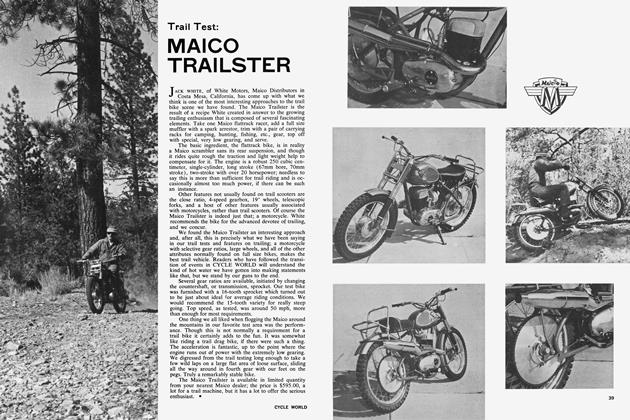
FAST BECOMING ONE of the most competitive segments of the motorcycle market is the trail machine field. Now Norway enters the fight with the 175cc Tempo, though to say that Norway is building the Tempo is a little ambiguous since several important parts used are either from Germany or England. These “imported” parts include the German made Sachs two-stroke engine, British built Girling shock absorbers, Lucas electrics, Dunlop knobby tires, and the wheel hubs and rims appear to be made in England but they are not marked so.
The Tempo should first be identified as a full-size motorcycle, not a miniature lightweight. It sports 19-inch wheels, a truly robust 175cc engine in unit with a four-speed gearbox, weighs 220 pounds, is controlled completely by standard motorcycle levers, and as such requires the rider be a more than average trail-type rider to attempt such back country traveling. It obviously differs from most other “trail bikes” in that its standards more closely resemble those of a motorcycle than a trail scooter. We do not mean this to be construed as a drawback, rather that the prospective Tempo buyer realize he is dealing with a better than average trail bike. We must not neglect to mention the price of $498.00, F.O.B. North Hollywood, California, at least one feature not too far removed from the trail machine class.
We noticed several little features that could be of immeasurable use on any kind of motorcycle, one being a handlebar mounted lever that places the gearbox in neutral with a simple flick, the other a compression release lever, also handlebar mounted, which allows the engine to turn over freely when descending steep grades. The compression release is not common to two-strokes but is often employed on four-strokes for the same purpose and for ease of starting. Evidence of much thought towards making Tempo owners a happy breed are the sets of double cables on all controls, one an extra that is not connected but lies alongside the active cable for emergency use.
This attention to uneventful possibilities lies in the purpose for which Tempo builds the Moto-Cross, that of life as a European long-distance trials machine, an event popular in Europe, particularly in the Eastern and Northern countries.
More experienced motorcycle enthusiasts will recognize the Sachs engine from the old JB Sachs, very popular in scrambling circles a few years back. Other items common to European competition machines also found on the Tempo are folding foot pegs, a high mounted and wheel shielded exhaust pipe, rugged, well mounted steel fenders, flat and wide handlebars, and vast ground clearance. All of which are verv useful when trailing, of course, since the machine is designed to travel over country far worse than any the average trail rider might encounter.
Handling is exceptional as would be exoected. suspension absorbs the worst irregularities, and a generally comfortable ride adds to the appeal of the Tempo. Full lighting equipment fits somewhat incongruously, but could be useful. We objected to the handlebar width; though wide they could be even wider for more control when truly difficult conditions are encountered.
Gearing was a bit “tall”, allowing a quite high cruising speed on the streets, and under most trailing conditions it did not seem to hamper the Tempo’s off the road abilities. A genuinely delightful dual Durpose bike at a very reasonable price accounts for the pleasant taste the little Norwegian bike left with us. G