Timberline
TIMBERLINE
Trail Test:
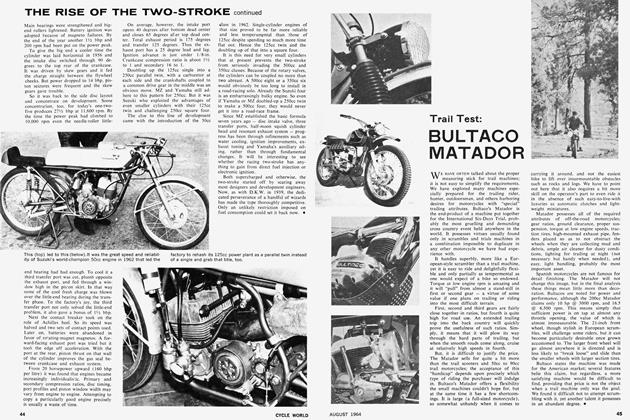
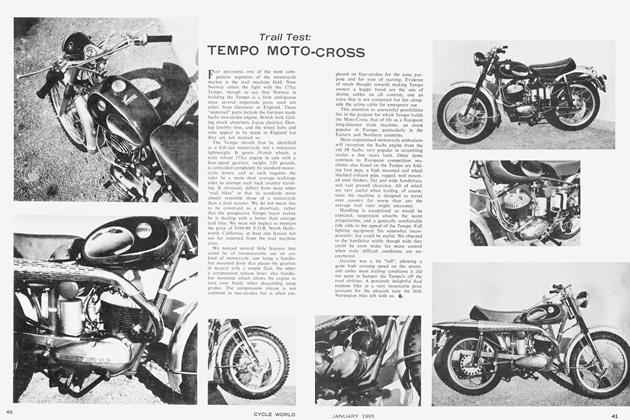
THE CYCLE WORLD testing trails got a better than average workout this month when we attacked them with the Steen Timberline, a new trail scooter sporting some features that qualify it for more than a passing glance.
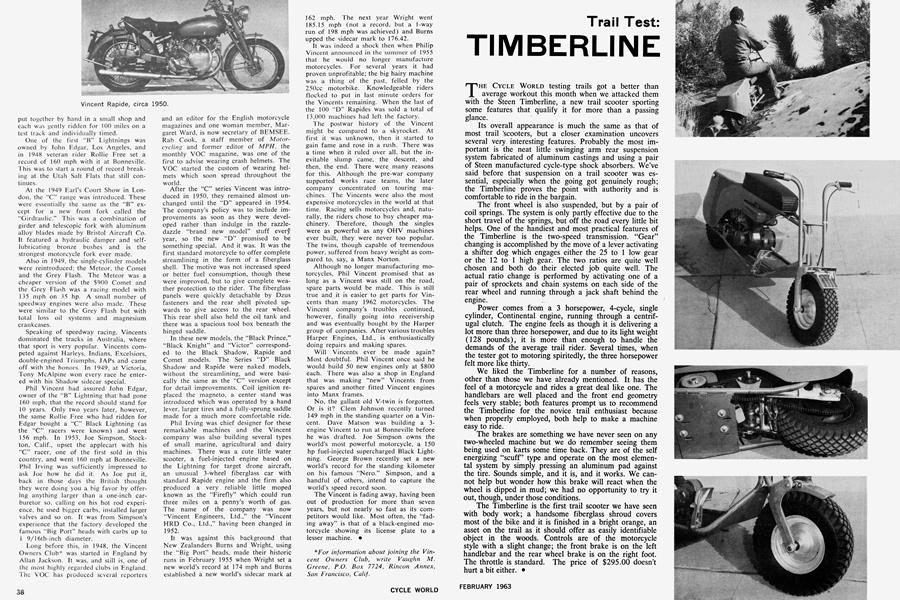
Its overall appearance is much the same as that of most trail scooters, but a closer examination uncovers several very interesting features. Probably the most important is the neat little swinging arm rear suspension system fabricated of aluminum castings and using a pair of Steen manufactured cycle-type shock absorbers. We've said before that suspension on a trail scooter was essential, especially when the going got genuinely rough; the Timberline proves the point with authority and is comfortable to ride in the bargain.
The front wheel is also suspended, but by a pair of coil springs. The system is only partly effective due to the short travel of the springs, but off the road every little bit helps. One of the handiest and most practical features of the Timberline is the two-speed transmission. "Gear" changing is accomplished by the move of a lever activating a shifter dog which engages either the 25 to 1 low gear or the. 12 to 1 high gear. The two ratios are quite well chosen and both. do their elected job quite well. The actual ratio change is performed by activating one of a pair of sprockets and chain systçms on each side of the rear wheel and running through a jack shaft behind the engine.
Power comes from a 3 horsepower, 4-cycle, single cylinder, Continental engine, running through a centrif ugal clutch. The engine feels as though it is delivering a lot more than three horsepower, and due to its light weight (128 pounds), it is more than enough to handle the demands of the average trail rider. Several times, when the tester got to motoring spiritedly, the three horsepower felt more like thirty.
We liked the Timberline for a number of reasons, other than those we have already mentioned. It has the feel of a motorcycle and rides a great deal like one. The handlebars are well placed and the front end geometry feels very stable; both features prompt us to recommend the Timbeiline for the novice trail enthusiast because when properly employed, both help to make a machine easy to ride.
The brakes are something we have never seen on any two-wheeled machine but we do remember seeing them being used on karts some time back. They are of the self energizing "scuff" type and operate bn the most elemen tal system by simply pressing an aluminum pad against the tire. Sounds simple, and it is, and it works. We can not help but wonder how this brake will react when the wheel is dipped in mud; we had no opportunity to try it out, though, under those conditions.
The Timberline is the first trail scooter we have seen with body work; a handsome fiberglass shroud covers most of the bike and it is finished in a bright orange, an asset On the trail as it should offer as easily identifiable object in the woods. Controls are of the motorcycle style with a slight change; the front brake is on the left handlebar and the rear wheel brake is on the right foot. The throttle is standard. The price of $295.00 doesn't hurt a bit either. •