On the Uses of Semiconductors In Motorcycle Electrical Systems
ON THE USES OF SEMICONDUCTORS IN MOTORCYCLE ELECTRICAL SYSTEMS
BOB HALL
SEMICONDUCTORS is the name given to a family of electrical devices which utilizes crystals of silicon or germanium, generally with varying amounts of other elements present in the crystal in trace quantities. These crystals are made and assembled in many ways and sizes to form transistors, diodes, zener diodes, and others. Each type has its own electrical characteristics and applications.
We are going to see semiconductors come into wide use on our motorcycles. Already Lucas has come out with a 6 to 12 volt conversion kit for certain of their systems which utilizes silicon diode rectifiers and a zener diode for voltage limitation. There are excellent conversions which we can make to our own electrical and ignition systems with the use of semiconductors to reduce weight, improve performance, or increase reliability. Transistor ignition, already in use in au+omobiles, can be applied to distributor-and-coil equipped engines to give long service life to points and possibly increase sparking efficiency throughout the rpm range of the engine. Silicon diode full wave rectifier bridge assemblies can be substituted for the selenium rectifiers on alternator systems. Zener diodes are useful for limiting the voltage allowed in a circuit.
Semiconductors have the advantage of having no moving parts, nothing to wear out. However, any application must be guarded against these enemies: excessive voltage, power, and heat. By matching voltage and power characteristics of the system to the semiconductors employed and providing for dissipation of heat collected in each unit, we should have a sys-
tem which will last the lifetime of the machine. It should be pointed out that the use of a substantial safety factor in these matters will minimize troubles due to unknowns or unexpected critical loading.
Perhaps, like me, you have had the thought: “Why carry that heavy bothersome battery around? The engine has magneto ignition and I don’t care if the lights go dim while waiting at stoplights.” Perhaps you too discovered that the wetcell battery usually has another important purpose — voltage limitation. Removal of the battery from a lighting system that does not contain a regular voltage regulator can cause quick burnout of all lamps due to excessive voltage. The wet-cell battery acts as a voltage stabilizer by providing power to the lights when the generator output is insufficient (idle and slow running) and absorbing excess power at medium and high speeds. If we wish to do without the battery it is necessary to get along with low voltage at low rpms and use something to limit voltage at higher rpms. On some coil-and-distributor equipped bikes it may be impossible to do without the battery owing to poor starting or inability to run at low rpms because of low voltage output of their generators when running slowly. Anyone wishing to do away with his battery should first try starting and running the machine with the battery disconnected and all lights off. If this proves satisfactory, a conventional voltage regulator or preferably a zener diode can be used to limit maximum voltage in the lighting system.
One successful application of a zener diode-regulated batteryless lighting system was worked out by the writer and used for over a year now without maintenance on a ’61 Norton Manxman, equipped with Lucas alternator lighting system and separate magneto. This system is used on many late English high performance bikes, including Triumph T-110, TR-6 and T-120. The main change made was the addition of a Motorola IN2810B/50M12ZB 50-watt 12-volt zener diode. The normal selenium rectifier was retained, although a Lucas 12-volt silicon diode bridge assembly, part number 49072, may be used if trouble with the stock unit develops; Motorola also has some similar units available. The zener diode was mounted on a large aluminum plate, well exposed to the airstream in order to carry away the heat produced and prevent heat failure of the unit.
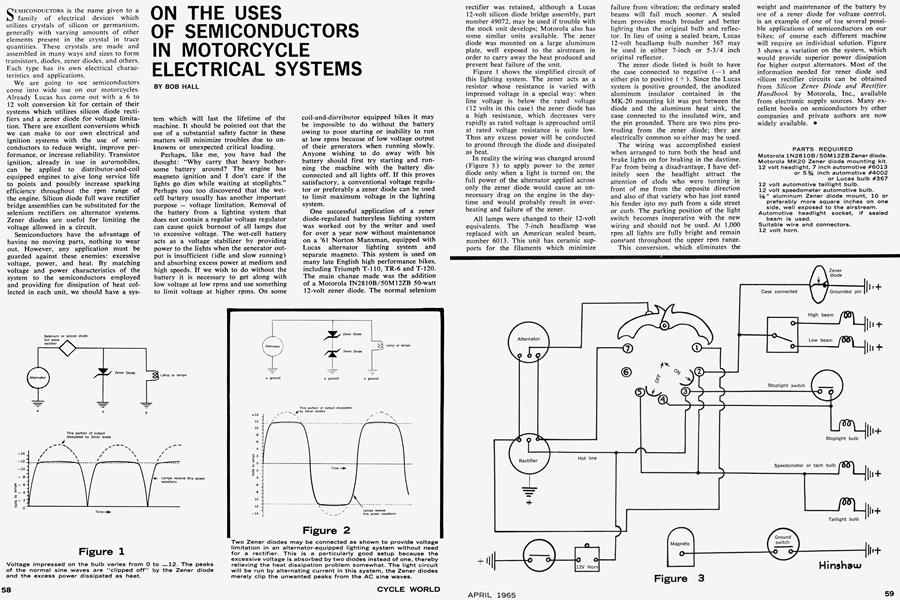
Figure 1 shows the simplified circuit of this lighting system. The zener acts as a resistor whose resistance is varied with impressed voltage in a special way: when line voltage is below the rated voltage (12 volts in this case) the zener diode has a high resistance, which decreases very rapidly as rated voltage is approached until at rated voltage resistance is quite low. Thus any excess power will be conducted to ground through the diode and dissipated as heat.
In reality the wiring was changed around (Figure 3 ) to apply power to the zener diode only when a light is turned on; the full power of the alternator applied across only the zener diode would cause an unnecessary drag on the engine in the daytime and would probably result in overheating and failure of the zener.
All lamps were changed to their 12-volt equivalents. The 7-inch headlamp was replaced with an American sealed beam, number 6013. This unit has ceramic supports for the filaments which minimize failure from vibration; the ordinary sealed beams will fail much sooner. A sealed beam provides much broader and better lighting than the original bulb and reflector. In lieu of using a sealed beam, Lucas 12-volt headlamp bulb number 367 may be used in either 7-inch or 5-3/4 inch original reflector.
The zener diode listed is built to have the case connected to negative ( — ) and either pin to positive ( + ). Since the Lucas system is positive grounded, the anodized aluminum insulator contained in the MK-20 mounting kit was put between the diode and the aluminum heat sink, the case connected to the insulated wire, and the pin grounded. There are two pins protruding from the zener diode; they are electrically common so either may be used.
The wiring was accomplished easiest when arranged to turn both the head and brake lights on for braking in the daytime. Far from being a disadvantage, I have definitely seen the headlight attract the attention of clods who were turning in front of me from the opposite direction and also of that variety who has just eased his fender into my path from a side street or curb. The parking position of the light switch becomes inoperative with the new wiring and should not be used. At 1,000 rpm all lights are fully bright and remain constant throughout the upper rpm range.
This conversion, which eliminates the weight and maintenance of the battery by use of a zener diode for voltage control, is an example of one of tne several possible applications of semiconductors on our bikes; of course each different machine will require an individual solution. Figure 3 shows a variation on the system, which would provide superior power dissipation for higher output alternators. Most of the information needed for zener diode and silicon rectifier circuits can be obtained from Silicon Zener Diode and Rectifier Handbook by Motorola, Inc., available from electronic supply sources. Many excellent books on semiconductors by other companies and private authors are now widely available. •
PARTS REQUIRED Motorola 1N2810B/50M12ZB Zener diode. Motorola MK20 Zener diode mounting kit. 12 volt headlight, 7 inch automotive #6013 or 5% inch automotive #4002 or Lucas bulb #367 12 volt automotive taillight bulb. 12 volt speedometer automotive bulb. ya" aluminum Zener diode mount, 10 or preferably more square inches on one side, well exposed to the airstream. Automotive headlight socket, if sealed beam is used. Suitable wire and connectors. 12 volt horn.