HAYDEN ROBERTS
The BUILDER
Keeper of the faith
SETH RICHARDS
“The word ‘sled,’ as applied to a motorcycle, means desert racer, and probably has its origin in the delightful scraping sensation one feels as the skid plate hits ground. But the connotation goes even farther in that the term brings to mind, more often than not, a throbbing big twin from Coventry decked out in appropriate accoutrement.” Cycle World, February 1967
“When you ride one of these old Triumphs,” Hayden Roberts says, “you get the feeling that the bike’s working at the edge of its capabilities. The feeling of flex in the frame, the motor floating the valves and stuff, the wheel coming up behind your head when you hit a square edge. You have the feeling of the torque and power of the 650 and the force of the bike behind you.”
In the long shadow of the Topatopa Mountains, in Santa Paula, California, Roberts’ shop Hello Engine builds 1960s-style desert sleds, preserving the brief but storied moment of great affinity between the desert and the British twin.
Roberts grew up in Wolverhampton, England, just around the corner from the derelict Norton Villiers factory. As a kid he’d tramp down Marston Road to play among the ruins of the British motorcycling industry.
“It was like our own little world,” he says.
He had little regard for the motorcycles once produced there, but the dust kicked up between his feet, like incense billowing from a swinging thurible, must have carried the prayers of the saints of British motorcycling. He would be a keeper of the faith.
“Growing up in England, I never wanted a Triumph,” Roberts says. “We never got the big Triumphs in England. We saw the little ones, but no one had any money, so the twins all got exported to America. I wanted a Ducati.”
After moving to California in his early 20s and getting a corporate job, the first thing Roberts bought was the 916 SPS he’d always dreamed about.
“I never got off that Ducati and thought that the bike was working hard. I was sweating and petrified. But the bike I don’t think went over 5,000 rpm,” Roberts says.
It dawned on him that riding something slower might be more fun. After growing impatient searching for a Norton Commando, Roberts picked up a beat-up old Bonneville. In the intervening months it took him to turn it into a Triton, he spent $800 on a clean Triumph T140 to replace the Ducati as his main ride. From there his obsession grew. Soon, he’d stuffed his two-car garage with 20 vintage motorcycles. Most were projects, but there were also complete and rare bikes like a Norton Manx and a CZ that once belonged to Steve McQueen.
When he realized building and restoring bikes was starting to pay for itself, he quit his long-neglected day job in favor of spinning a wrench.
After moving to Ventura County, Roberts’ hunt for parts eventually found him wandering into an outof-the-way workshop. Inside were precarious stacks of vintage Triumph parts and workbenches cluttered with every tool conceivable.
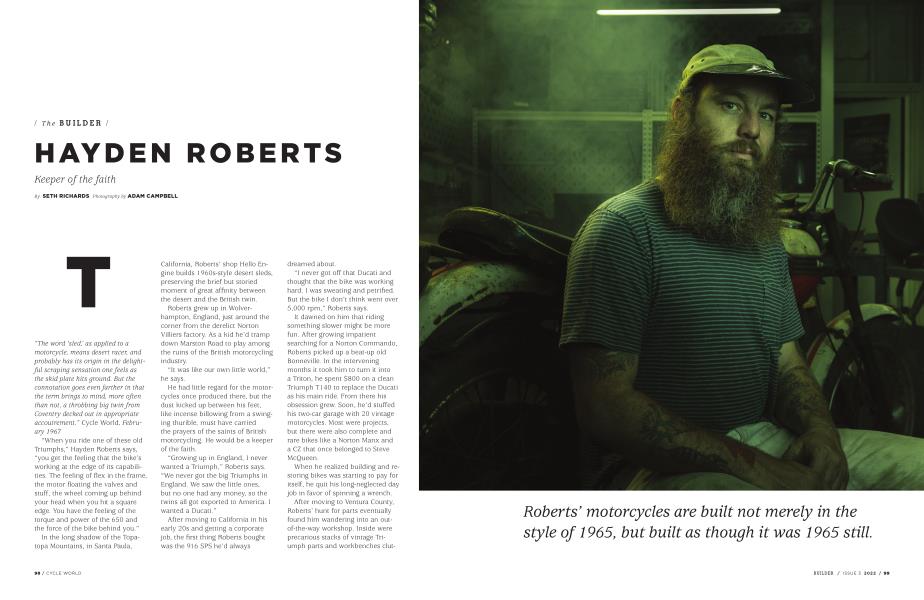
Roberts' motorcycles are built not merely in the style of 1965, but built as though it was 1965 still.
“It was unreal,” he says. The owner, a veritable encyclopedia of Triumph knowledge, was John Ireland, who had been a Triumph dealer and mechanic since 1965.
“He just got out of an accident and was getting on in years,” Roberts says. “He noticed my Triumph tattoo and said: ‘Ah, you like Triumphs. Do you want a job?’ and I was like, ‘Yeah!’ He said: ‘I’m just swamped. Can you start tomorrow?’ So I came down the next day and that was seven years ago.”
In the beginning, most of the customers were older riders whose bikes needed basic maintenance work, but over time, Roberts attracted a whole new generation of riders who were enticed by stripped-down sleds built for the desert.
As the cafe racer scene was to England in the previous decades, desert racing in Southern California was a phenomenon deeply connected to time and place. In 1967, for instance, Triumph shipped about three times as many highpiped TR6Cs, many destined for desert duty, to the western United States as it did T120R Bonnevilles; the relationship was inverse in the east, where four Bonnevilles were ordered for every one TR6C. Roberts notes that SoCal was the only place in the world that possessed both the motorcycles to ride and the desert to ride them in. Specificity breeds purpose; purpose breeds obsession.
Roberts’ own obsession is with preserving the original moment that inspired countless copies and modern iterations. His motorcycles are built not merely in the style of 1965, but built as though it was 1965 still.
“My thing is to make the bikes look like they were designed by a guy in a factory instead of a guy in a shed,” Roberts says. “On the original ones, the welding is usually terrible and everything has been cut with a hacksaw.
“We tear the crank out, balance them, recondition the rods, and go from there. I don’t like to tune the character out of them. If you want to run an old bike, you want all the fun of an old bike with none of the breakdowns. You can tune them and make them too smooth and it takes the soul out,” Roberts says.
From there he spends a lot of effort scouring eBay and haunting swap meets to get parts that are the right vintage. In the end, the motorcycle looks as if it has always been complete, rather than a Frankenstein assemblage of parts from five different machines. “Matching numbers don’t matter to me,” Roberts says.
“I use parts that were available at the time. Ceriani made really trick aluminum forks and triple trees, so I’ll use those. I’m a stickler for original nuts and bolts. There’s nothing worse than looking at a bike that’s supposed to be from 1965 that has a bunch of JH dime-store hardware on it.”
Roberts prepares his bikes for a hard life, for trips down the Baja Divide to Ojos Negros, where breakdowns could spell disaster. He puts on lighter fenders and wheels for better performance and strengthens swingarms and footpegs. They’re cleaned, but not polished. They’re meant to be run and crashed, duct taped back together, and run again. Finally, the desert resonates with the sound of a 360-degree twin from Meriden.
The desert light wakes Albion’s immortal ghosts and revives their mortal forms from the shadows of ruin. In Roberts’ hands, would-be junk otherwise fit for the scrap heap becomes resurrected history, made to run like there’s no tomorrow. The dust of Wolverhampton mixes with the dust of the California desert, and Roberts is baptized in it, keeping faith with the spirits of Britain’s desert age.