YOU BIG rebel
Honda reimagines the Rebel for beginners and beyond
Honda reimagines the Rebel for beginners and beyond
YOU BIG rebel
Honda reimagines the Rebel for beginners and beyond
MORGAN GALES
“Honda Rebel” has always been synonymous with “beginner bike.” Even with the 2017 redesign’s radical improvement on the original 250 platform introduced in 1985, Honda claims that 88 percent of Rebel 500 owners purchase a larger-displacement motorcycle within the first 18 months of ownership. Honda’s problem here is that 73 percent of those purchases are outside the Honda brand. Honda’s dilemma is to figure out how to keep those riders. Provide a larger bike they can graduate to after outgrowing the smaller model? Or provide a motorcycle that’s similar to learn on, but with enough staying power to outlast that 18-month margin?
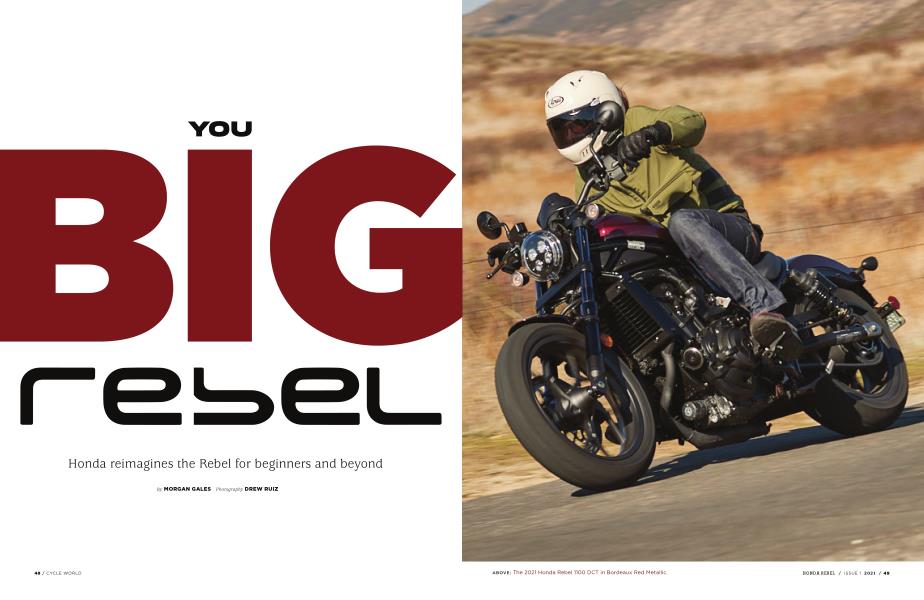
Honda may have just done both. The Rebel 1100 uses a 1,084cc parallel-twin Unicam engine, proven in the Africa Twin but modified to fit the cruiser vibe. The bike weighs just about 500 pounds, starts at $9,299, and can hit 80 mph in third gear, whether you choose the traditional manual-clutch six-speed transmission or the automatic Dual Clutch Transmission offered on the $9,999 DCT model.
As we’d hoped, the Africa Twin-sourced two-cylinder engine maintains the rider aids/mode tunability, including throttle-response maps, torque control (Honda’s traction control), engine-braking, and shift points (on DCT-equipped model like I was riding) that are all programmable on three levels. These are set to fit Rain, Sport, and Tour modes, with a User mode allowing riders to tune these to their preferences. This adjustability vastly expands the customer base of the bike. As an experienced rider, I found myself with TC off, Power to full, with Engine Braking at mid, and the shift point set to high. Hot damn. Suddenly I very much want to go to biker bars and ego-check Dyna bros (come at me, nerds). Toning settings down makes for a friendlier, more mellow motorcycle.
The Unicam engine has been remapped to deliver peak torque earlier in the rev range and is now equipped with a 20-percent larger flywheel, increasing inertia by 32 percent and giving the engine more of a cruiser feel. Different cam profiles for each cylinder vary timing to create what Honda calls a “deep pulse sound” below 4,000 rpm and a “powerful pulse sound” above 4,000 rpm. Maybe Honda’s sound lab is more sensitive than I am because it just sounded like a good old 270-degree parallel twin.
I was expecting a larger chassis on the Rebel 1100 in order to house that 1,084cc displacement. I only sort of got what I was looking for. At 59.8 inches, the 1100’s wheelbase is only 1.1 inches longer than the smaller 500 and 300 models, but rider positioning on the bike doesn’t reflect this. Sitting on both models back to back,
I was surprised to find my knee at least an inch closer to the handlebars on the 1100 than it was on the 500. Why? Honda was going for a 35-degree lean angle, emphasizing cornering performance a lot more than on the Rebel 300 and 500 models. So while there is an ergonomic compromise thanks to higher-mount, short footpegs (they didn’t even stretch the width of my admittedly large boot), the Rebel 1100 leans a lot for a cruiser and compares favorably to Harley-Davidson’s performance-oriented 2020 Low Rider R, which has claimed lean angles of 29.5/30.5 degrees left and right, respectively.
2021 HONDA REBEL 1100 SPECS
$9,299/$9,999 (DCT)
Supporting this sportiness are a good rebound-adjustable Showa suspension and solid brakes (a radial-mount four-piston caliper at the front!). Piggyback shocks imply performance, and small-bump compliance is excellent, but anything larger has potential to send a shock through the otherwise comfortable seat and up your spine. The 43mm fork is on the soft side, but maintains composure even while being ridden at a faster pace than most potential buyers are likely to see.
Handling is delightfully neutral and inspires particular confidence at low speeds. Thanks largely to the engine placement’s effect on weight distribution, the already lightweight Rebel feels well balanced and nimble. Despite using a ride-by-wire throttle and ample computer intervention in the power delivery process, throttle feel is still remarkable, allowing for precise low-speed application.
Stretching the Rebel name from its more humble beginnings to grace a pretty capable 1100 starts to make more sense when you consider Sportster 1200s and l,138cc Indian Scouts.
The dual clutch transmission’s automatic shifting functions well in this application and doesn’t take away from a connected riding experience as I feared it might, though it does add 22 pounds over the manual clutch model. With a price difference of only $700, DCT becomes a compelling option.
Even with the bare-bones styling of the Rebel, Honda has managed to sneak in a few creature comforts. Under the seat, riders will find 3 liters of storage and a USB-C charging port. Fit and finish are a step up from the 500/300, but the cruiser space has pretty high standards— the Rebel 1100 has lots of plastic paneling, exposed wiring looms, and miscellaneous plumbing throughout. There is little room for light to come through around the engine, giving the center of the bike a very dense, mechanical appearance.
Stretching the Rebel name from its more humble beginnings to grace a pretty capable 1100 starts to make more sense when you consider Sportster 1200s and 1,138cc Indian Scouts. In the Rebel’s favor here are its lightweight, midsize chassis, adjustable power modes, customizable settings, and available automatic transmission that make this bike incredibly versatile and thus more appealing to a wider range of riders. And the base-model price tag, at $9,299 or $9,999 with DCT, does the same.