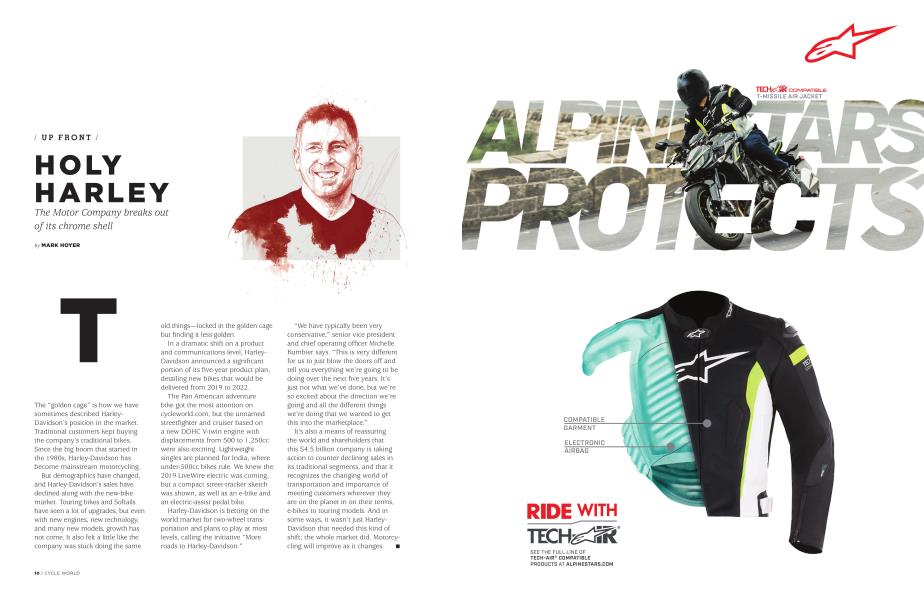
HOLY HARLEY
UP FRONT
The Motor Company breaks out of its chrome shell
MARK HOYER
The "golden cage" is how we have sometimes described Harley-Davidson’s position in the market. Traditional customers kept buying the company’s traditional bikes. Since the big boom that started in the 1980s, Harley-Davidson has become mainstream motorcycling.
But demographics have changed, and Harley-Davidson’s sales have declined along with the new-bike market. Touring bikes and Softails have seen a lot of upgrades, but even with new engines, new technology, and many new models, growth has not come. It also felt a little like the company was stuck doing the same old things—locked in the golden cage but finding it less golden.
In a dramatic shift on a product and communications level, HarleyDavidson announced a significant portion of its five-year product plan, detailing new bikes that would be delivered from 2019 to 2022.
The Pan American adventure bike got the most attention on cycleworld.com, but the unnamed streethghter and cruiser based on a new DOHC V-twin engine with displacements from 500 to 1,250cc were also exciting. Lightweight singles are planned for India, where under-500cc bikes rule. We knew the 2019 LiveWire electric was coming, but a compact street-tracker sketch was shown, as well as an e-bike and an electric-assist pedal bike.
Harley-Davidson is betting on the world market for two-wheel transportation and plans to play at most levels, calling the initiative “More roads to Harley-Davidson.”
“We have typically been very conservative,” senior vice president and chief operating officer Michelle Kumbier says. “This is very different for us to just blow the doors off and tell you everything we’re going to be doing over the next five years. It’s just not what we’ve done, but we’re so excited about the direction we’re going and all the different things we’re doing that we wanted to get this into the marketplace.”
It’s also a means of reassuring the world and shareholders that this $4.5 billion company is taking action to counter declining sales in its traditional segments, and that it recognizes the changing world of transportation and importance of meeting customers wherever they are on the planet in on their terms, e-bikes to touring models. And in some ways, it wasn’t just HarleyDavidson that needed this kind of shift; the whole market did. Motorcycling will improve as it changes.