2017 Yamaha Fz-10
Ignition
lifE RhII~ 5111ff 15 HERE
FZ-10 AT HOME’ -> CHIEFTAIN DARK HORSE -> AUTO TRANS -> BIKE LIFE -> RIDE SMART
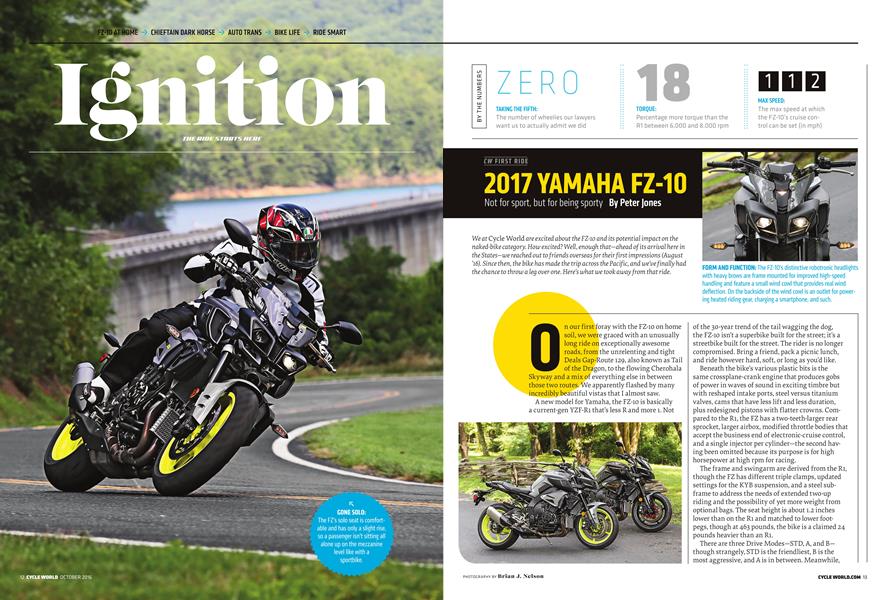
GONE SOLO:
The FZ’s solo seat is comfortable and has only a slight rise, so a passenger isn’t sitting all alone up on the mezzanine level like with a sportbike.
CW FIRST RIDE 2017 YAMAHA FZ-10
BY THE NUMBERS
ZERO
TAKING THE FIFTH:
The number of wheelies our lawyers want us to actually admit we did
18
TORQUE:
Percentage more torque than the R1 between 6,000 and 8,000 rpm
112
MAX SPEED:
The max speed at which the FZ-10’s cruise control can be set (in mph)
Not for sport, but for being sporty
Peter Jones
We at Cycle World are excited about the FZ-io and its potential impact on the naked-bike category. How excited? Well, enough that-ahead of its arrival here in the States-we reached out to friends overseas for their first impressions (August ’16). Since then, the bike has made the trip across the Pacific, and we’ve finally had the chance to throw a leg over one. Here’s what we took away from that ride.
On our first foray with the FZ-10 on home soil, we were graced with an unusually long ride on exceptionally awesome roads, from the unrelenting and tight Deals Gap-Route 129, also known as Tail of the Dragon, to the flowing Cherohala Skyway and a mix of everything else in between those two routes. We apparently flashed by many incredibly beautiful vistas that I almost saw.
A new model for Yamaha, the FZ-10 is basically a current-gen YZF-Ri that’s less R and more 1. Not
of the 30-year trend of the tail wagging the dog, the FZ-10 isn’t a superbike built for the street; it’s a streetbike built for the street. The rider is no longer compromised. Bring a friend, pack a picnic lunch, and ride however hard, soft, or long as you’d like.
Beneath the bike’s various plastic bits is the same crossplane-crank engine that produces gobs of power in waves of sound in exciting timbre but with reshaped intake ports, steel versus titanium valves, cams that have less lift and less duration, plus redesigned pistons with flatter crowns. Compared to the Ri, the FZ has a two-teeth-larger rear sprocket, larger airbox, modified throttle bodies that accept the business end of electronic-cruise control, and a single injector per cylinder—the second having been omitted because its purpose is for high horsepower at high rpm for racing.
The frame and swingarm are derived from the Ri, though the FZ has different triple clamps, updated settings for the KYB suspension, and a steel subframe to address the needs of extended two-up riding and the possibility of yet more weight from optional bags. The seat height is about 1.2 inches lower than on the Ri and matched to lower footpegs, though at 463 pounds, the bike is a claimed 24 pounds heavier than an Ri.
There are three Drive Modes—STD, A, and B— though strangely, STD is the friendliest, B is the most aggressive, and A is in between. Meanwhile,
traction control has four settings to choose from, and they are named 1,2,3,4. One is least intrusive, 3 is for wet roads, and 4 is off. Please remember that 4 is not 3, and that 4 is basically -6, so don’t confuse those two. I’ve not mentioned what 2 is for because it’s a concept that’s impossible to explain. Think of it as caramel swirl when what you might desire is maple walnut.
Fortunately, TC is ultra friendly, coming on smoothly and undetectably by your butt, this despite the FZ being devoid of the Ri’s IMU sensor, which reads the attitude of the motorcycle for managing that particular model’s rider aid systems.
To love any engine is to love this engine.
Its sound, its power delivery, and the power of its power are all exceptional.
Truly hard acceleration doesn’t happen until cresting into
8,000 rpm, but when it does it is truly quick. I don’t do wheelies, but on the FZ-101 do wheelies. Handling, meanwhile, is light and neutral for a big bike, helped by the wide bars and slick speedvariable steering damper. Whether the electronics or the tires are to blame—who knows—the bike was always exceptionally planted, providing awesome feel and feedback.
The front brakes use different
pads than the Ri and a Brembo master cylinder (rather than Nissin), resulting in a very linear feel, without any spiking grabbiness. I’m tempted to ask for a little more initial bite, but since I’d engaged the ABS a couple of times that might not be a great idea. I’d be remiss not mentioning also that it was 90-bagillion degrees with a humidity index of 7,000 during our ride, yet the FZ-10 never felt hot. That degree of heat management is an achievement.
In the end, one might conclude that the FZ-10 is simply what Yamaha’s flagship literbike would be if the company wasn’t engaged in production Superbike racing. It’s a nimble performance literbike yet powerful enough for two-up touring and smooth enough for all-day riding. Fill
2017 YAMAHA FZ-10
ENGINE TYPE
Liquid-cooled, DOHC, inline-four
DISPLACEMENT
998cc
SEAT HEIGHT
32.5 in.
FUEL CAPACITY
4.5 gal.
CLAIMED CURB WEIGHT
463 lb.
BASE PRICE
$12,999