2016 Kawasaki Zx-10r
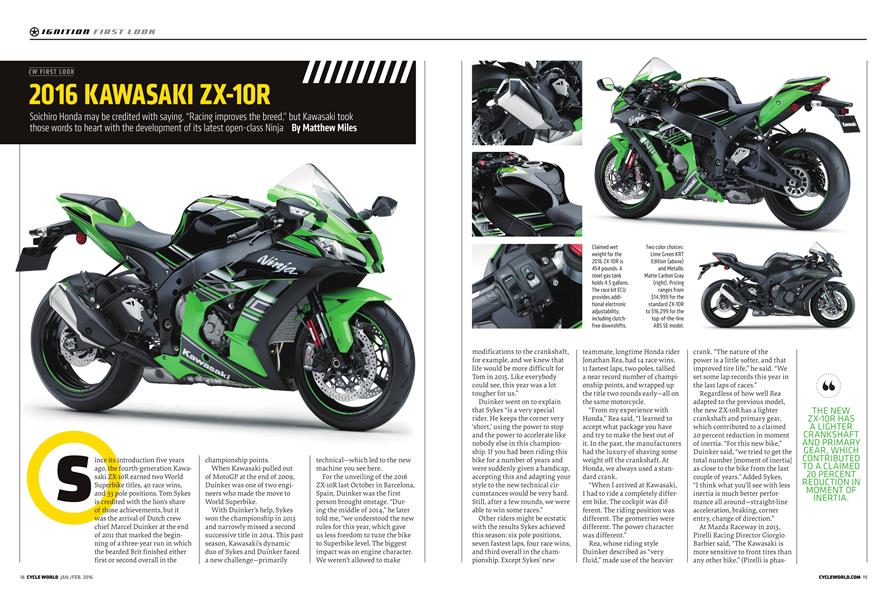
2016 KAWASAKI ZX-10R
IGNITION
FIRST LOOK
Soichiro Honda may be credited with saying, “Racing improves the breed,” but Kawasaki took those words to heart with the development of its latest open-class Ninja
Matthew Miles
Since its introduction five years ago, the fourth-generation Kawasaki ZX-10R earned two World Superbike titles, 40 race wins, and 33 pole positions. Tom Sykes is credited with the lion's share of those achievements, but it was the arrival of Dutch crew chief Marcel Duinker at the end of 2011 that marked the beginning of a three-year run in which the bearded Brit finished either first or second overall in the championship points.
When Kawasaki pulled out of MotoGP at the end of 2009, Duinker was one of two engineers who made the move to World Superbike.
With Duinker’s help, Sykes won the championship in 2013 and narrowly missed a second successive title in 2014. This past season, Kawasaki’s dynamic duo of Sykes and Duinker faced a new challenge—primarily technical—which led to the new machine you see here.
For the unveiling of the 2016 ZX-ioRlast October in Barcelona, Spain, Duinker was the first person brought onstage. “During the middle of 2014,” he later told me, “we understood the new rules for this year, which gave us less freedom to tune the bike to Superbike level. The biggest impact was on engine character. We weren’t allowed to make modifications to the crankshaft, for example, and we knew that life would be more difficult for Tom in 2015. Like everybody could see, this year was a lot tougher for us.”
Duinker went on to explain that Sykes “is a very special rider. He keeps the corner very ‘short,’ using the power to stop and the power to accelerate like nobody else in this championship. If you had been riding this bike for a number of years and were suddenly given a handicap, accepting this and adapting your style to the new technical circumstances would be very hard. Still, after a few rounds, we were able to win some races.”
Other riders might be ecstatic with the results Sykes achieved this season: six pole positions, seven fastest laps, four race wins, and third overall in the championship. Except Sykes’ new teammate, longtime Honda rider Jonathan Rea, had 14 race wins,
11 fastest laps, two poles, tallied a near record number of championship points, and wrapped up the title two rounds early—all on the same motorcycle.
“From my experience with Honda,” Rea said, “I learned to accept what package you have and try to make the best out of it. In the past, the manufacturers had the luxury of shaving some weight off the crankshaft. At Honda, we always used a standard crank.
“When I arrived at Kawasaki, I had to ride a completely different bike. The cockpit was different. The riding position was different. The geometries were different. The power character was different.”
Rea, whose riding style Duinker described as “very fluid,” made use of the heavier crank. “The nature of the power is a little softer, and that improved tire life,” he said. “We set some lap records this year in the last laps of races.”
Regardless of how well Rea adapted to the previous model, the new ZX-10R has a lighter crankshaft and primary gear, which contributed to a claimed 20 percent reduction in moment of inertia. “For this new bike,” Duinker said, “we tried to get the total number [moment of inertia] as close to the bike from the last couple of years.” Added Sykes,
“I think what you’ll see with less inertia is much better performance all around—straight-line acceleration, braking, corner entry, change of direction.”
At Mazda Raceway in 2013, Pirelli Racing Director Giorgio Barbier said, “The Kawasaki is more sensitive to front tires than any other bike.” (Pirelli is phasing out Rea’s favored SC2 front slick.) On the new ZX-ioR, the steering head is 7.5mm closer to the rider, and the bridged aluminum swingarm is 15.8mm longer. Wheelbase is 56.6 inches, a smidge more than the previous model. Position adjustment for both steering head (4mm forward and backward) and swingarm pivot (2mm up and down) aids tuning. “The changes Kawasaki has made to the chassis,” Duinker said, “especially front-end geometry, are straight development from our World Superbike history.”
THE NEW ZX-10R HAS A LIGHTER CRANKSHAFT AND PRIMARY GEAR, WHICH CONTRIBUTED TO A CLAIMED 20 PERCENT REDUCTION IN MOMENT OF INERTIA.
More track heritage: The Showa Balance Free Fork (BFF) with its 43mm sliders and external compression chambers is claimed to provide a big step in comfort, feel, and braking stability. According to Duinker, the race version of this fork that Sykes first tried several years ago was worth four-tenths of a second per lap. The Balance Free Rear Cushion (BFRC) shock likewise features pressurized twin-tube damping. Brembo now supplies the entire front brake system: four-piston M50 calipers, 330mm discs (up from 310), and a radial-mount master cylinder.
“THE CHANGES KAWASAKI HAS MADE TO THE CHASSIS," DUINKER SAID, “ESPECIALLY FRONT-END GEOMETRY, ARE STRAIGHT DEVELOPMENT FROM OUR WORLD SUPERBIKE HISTORY."
A comprehensive electronics suite incorporating a five-axis IMU (a sixth axis is calculated within the ECU) includes SportKawasaki Traction Control (S-KTRC), Kawasaki Launch Control Mode (KLCM), Kawasaki Intelligent antilock Brake System (KIBS), and Kawasaki Engine Brake Control. A Kawasaki Quick Shifter (KQS) and an Öhlins electronic steering damper are standard. We anticipate learning more about the electronics and their actual functions at the overseas track launch in January.
Rea rode a preproduction machine for a photo shoot, outtakes from which were shown to the press in Barcelona. “I’ve never experienced electronics on a streetbike,” he admitted. “Straight away, I was so impressed. In the back of my mind, I was thinking, When is ABS going to make it in top-level racing?’ I was having fun at the end trying to do big, rolling stoppies, and it seemed almost impossible to get the bike really out of shape. From a safety point of view, it’s really good.”
With the 2016 ZX-10R, Kawasaki has made continued success in World Superbike job number one. “At the beginning of this project,” Large Project Leader Yoshimoto Matsuda said,
“I made an announcement to the company: We don’t develop any cosmetic features.’ ” No one is more grateful for that approach than Duinker. “Kawasaki listened very well to our needs,” he said. “Next year’s bike almost fulfills all the areas we need to improve our performance and challenge for the title. Next year is another era for us.”
NINJA NEW
“If you want to go fast on the track,” said Pere Riba, Jonathan Rea’s crew chief, “you have to make the bike really easy to ride-the rider cannot be fighting the bike. Working closely with the factory makes it much easier to understand the limitations of the bike. Step by step, we understand the best and weakest points of the bike. This is why we change the balance, the weight distribution, a little bit. Together with all the new parts inside, we made the package much stronger than the other bike.”