Update: Team Cycle World
UPDATE: TEAM CYCLE WORLD
ROUNDUP
ATTACK PERFORMANCE YOSHIMURA SUZUKI AMA PRO AMERICAN SUPERBIKE
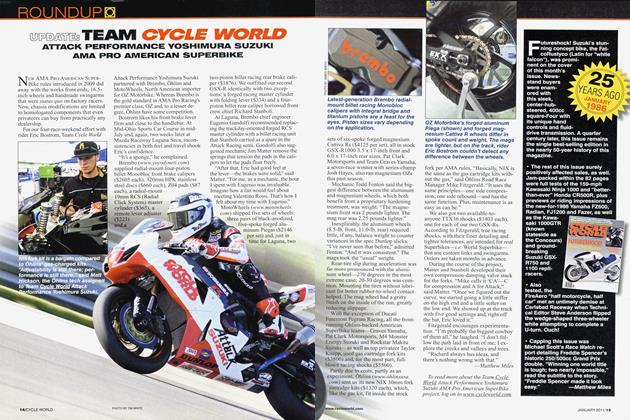
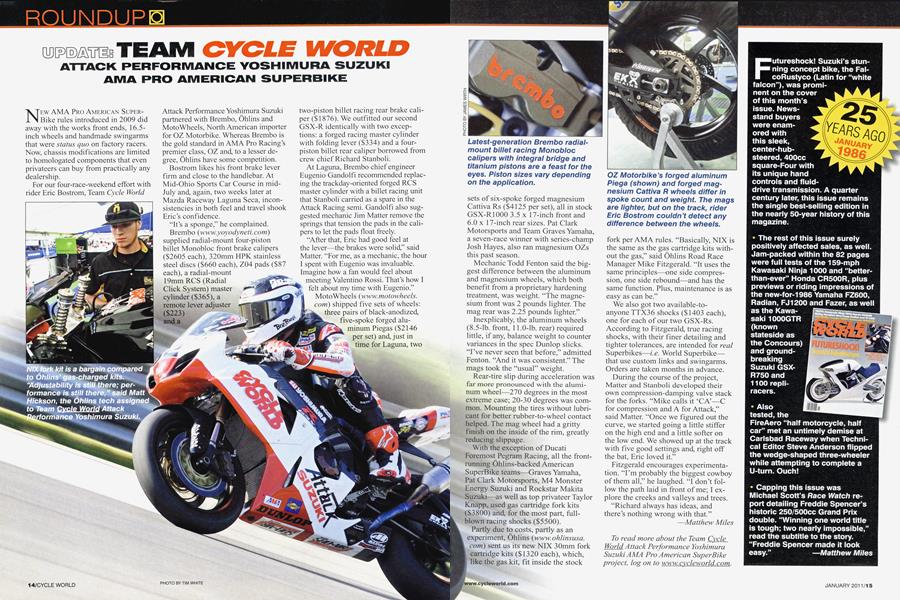
NEW AMA PRO AMERICAN SUPERBike rules introduced in 2009 did away with the works front ends, 16.5inch wheels and handmade swingarms that were status quo on factory racers. Now, chassis modifications are limited to homologated components that even privateers can buy from practically any dealership.
For our four-race-weekend effort with rider Eric Bostrom, Team Cycle World
Attack Performance Yoshimura Suzuki partnered with Brembo, Öhlins and Moto Wheels, North American importer for OZ Motorbike. Whereas Brembo is the gold standard in AMA Pro Racing’s premier class, OZ and, to a lesser degree, Öhlins have some competition.
Bostrom likes his front brake lever firm and close to the handlebar. At Mid-Ohio Sports Car Course in midJuly and, again, two weeks later at Mazda Raceway Laguna Seca, inconsistencies in both feel and travel shook Eric’s confidence.
“It’s a sponge,” he complained.
Brembo (www.yoyodyneti.com) supplied radial-mount four-piston billet Monobloc front brake calipers ($2605 each), 320mm HPK stainless steel discs ($660 each), Z04 pads ($87 each), a radial-mount 19mm RCS (Radial Click System) master cylinder ($365), a remote lever adjuster ($223) “ and a
two-piston billet racing rear brake caliper ($1876). We outfitted our second GSX-R identically with two exceptions: a forged racing master cylinder with folding lever ($334) and a fourpiston billet rear caliper borrowed from crew chief Richard Stanboli.
At Laguna, Brembo chief engineer Eugenio Gandolfi recommended replacing the trackday-oriented forged RCS master cylinder with a billet racing unit that Stanboli carried as a spare in the Attack Racing semi. Gandolfi also suggested mechanic Jim Matter remove the springs that tension the pads in the calipers to let the pads float freely.
“After that, Eric had good feel at the lever—the brakes were solid,” said Matter. “For me, as a mechanic, the hour I spent with Eugenio was invaluable. Imagine how a fan would feel about meeting Valentino Rossi. That’s how I felt about my time with Eugenio.” Moto Wheels (www.motowheels. com) shipped five sets of wheels: three pairs of black-anodized, five-spoke forged aluminum Piegas ($2146 per set) and, just in time for Laguna, two sets of six-spoke forged magnesium Cattiva Rs ($4125 per set), all in stock GSX-R1000 3.5 x 17-inch front and 6.0 x 17-inch rear sizes. Pat Clark Motorsports and Team Graves Yamaha, a seven-race winner with series-champ Josh Hayes, also ran magnesium OZs this past season.
Mechanic Todd Fenton said the biggest difference between the aluminum and magnesium wheels, which both benefit from a proprietary hardening treatment, was weight. “The magnesium front was 2 pounds lighter. The mag rear was 2.25 pounds lighter.” Inexplicably, the aluminum wheels (8.5-lb. front, 11.0-lb. rear) required little, if any, balance weight to counter variances in the spec Dunlop slicks. “I’ve never seen that before,” admitted Fenton. “And it was consistent.” The mags took the “usual” weight.
Rear-tire slip during acceleration was far more pronounced with the aluminum wheel—270 degrees in the most extreme case; 20-30 degrees was common. Mounting the tires without lubricant for better rubber-to-wheel contact helped. The mag wheel had a gritty finish on the inside of the rim, greatly reducing slippage.
With the exception of Ducati Foremost Pegram Racing, all the frontrunning Öhlins-backed American SuperBike teams—Graves Yamaha,
Pat Clark Motorsports, M4 Monster Energy Suzuki and Rockstar Makita Suzuki—as well as top privateer Taylor Knapp, used gas cartridge fork kits ($3800) and, for the most part, fullblown racing shocks ($5500).
Partly due to costs, partly as an experiment, Öhlins (www.ohlinsusa. com) sent us its new NIX 30mm fork cartridge kits ($1320 each), which, like the gas kit, fit inside the stock fork per AMA rules. “Basically, NIX is the same as the gas cartridge kits without the gas,” said Öhlins Road Race Manager Mike Fitzgerald. “It uses the same principles—one side compression, one side rebound—and has the same function. Plus, maintenance is as easy as can be.”
We also got two available-toanyone TTX36 shocks ($1403 each), one for each of our two GSX-Rs. According to Fitzgerald, true racing shocks, with their finer detailing and tighter tolerances, are intended for real Superbikes—i.e. World Superbike— that use custom links and swingarms. Orders are taken months in advance.
During the course of the project, Matter and Stanboli developed their own compression-damping valve stack for the forks. “Mike calls it ‘CA’—C for compression and A for Attack,” said Matter. “Once we figured out the curve, we started going a little stiffer on the high end and a little softer on the low end. We showed up at the track with five good settings and, right off the bat, Eric loved it.”
Fitzgerald encourages experimentation. “I’m probably the biggest cowboy of them all,” he laughed. “I don’t follow the path laid in front of me; I explore the creeks and valleys and trees.
“Richard always has ideas, and there’s nothing wrong with that.”
Matthew Miles
To read more about the Team Cycle World Attack Performance Yoshimura Suzuki AMA Pro American SuperBike project, log on to www. cvcleworld. com.