Roehr 1250sc
ROEHR 1250SC
CW RIDING IMPRESSION
Riding a Roehr in the rough
DON CANET
WHEN HARLEY-DAVIDSON BROUGHT ITS V-Rod cruiser to market in 2002, many figured that Buell would soon integrate that bike’s liquid-cooled, dohc V-Twin Revolution engine into its own sportbike line. They figured wrong. Despite having its roots in H-D’s short-lived VR1000 Superbike program, the production V-Rod engine was deemed too heavy and underachieving to serve as a viable sportbike mill.
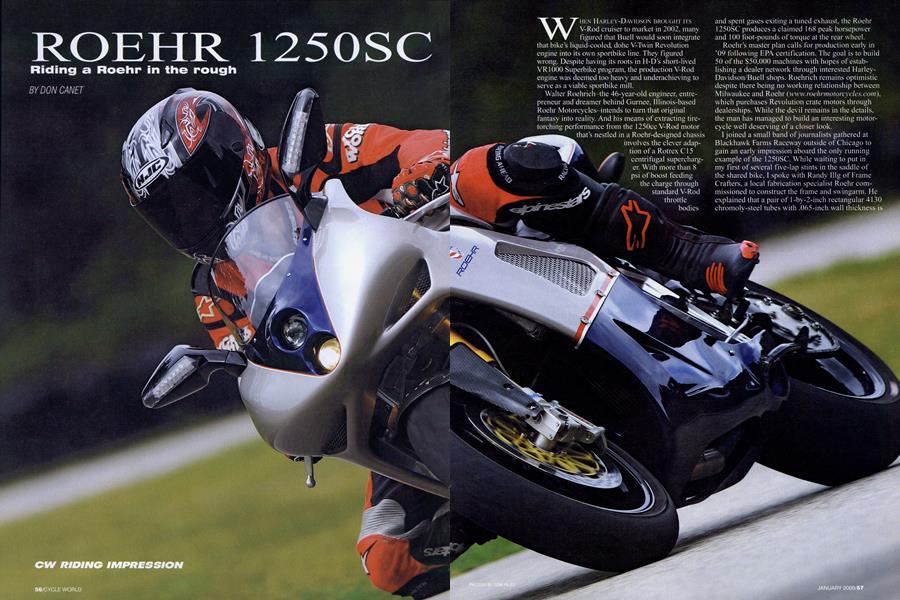
Walter Roehrich-the 46-year-old engineer, entrepreneur and dreamer behind Gurnee, Illinois-based Roehr Motorcycles-intends to turn that original fantasy into reality. And his means of extracting tiretorching performance from the 1250cc V-Rod motor that’s nestled in a Roehr-designed chassis involves the clever adaption of a Rotrex C15 centrifugal supercharger. With more than 8 psi of boost feeding the charge through standard V-Rod throttle bodies and spent gases exiting a tuned exhaust, the Roehr 1250SC produces a claimed 168 peak horsepower and 100 foot-pounds of torque at the rear wheel.
Roehr’s master plan calls for production early in ’09 following EPA certification. The goal is to build 50 of the $50,000 machines with hopes of establishing a dealer network through interested HarleyDavidson/Buell shops. Roehrich remains optimistic despite there being no working relationship between Milwaukee and Roehr (www.roehrmotorcycles.com), which purchases Revolution crate motors through dealerships. While the devil remains in the details, the man has managed to build an interesting motorcycle well deserving of a closer look.
I joined a small band of journalists gathered at Blackhawk Farms Raceway outside of Chicago to gain an early impression aboard the only running example of the 1250SC. While waiting to put in my first of several five-lap stints in the saddle of the shared bike, I spoke w ith Randy Illg of Frame Crafters, a local fabrication specialist Roehr commissioned to construct the frame and sw ingarm. He explained that a pair of l-by-2-inch rectangular 4130 chromoly-steel tubes with .065-inch wall thickness is
stacked and welded to create the main spars that connect the head stock to billet aluminum swingarm-pivot plates. Fingers insert into the main spars and are bonded with epoxy and then bolted. “It’s the epoxy that’s really doing all the work,” says Illg of the bi-metal design, the inspiration for which came from certain Bimota models. “The swingarm is the most difficult part to get correct. It’s laborintensive,” continues Illg, pointing out that while the main arm is fairly simple, the bridge part is where the challenge lies. A large manufacturer would simply stamp out these pieces, but with a short production run, welding together the geometric puzzle has been the more cost-effective approach.
Various OEM and aftermarket components are sprinkled throughout the bike. An electric waterpump circulates engine coolant through the side-mounted Honda RC51 radiators, achieving high efficiency with a rate of flow that remains constant whether the engine is at idle or running at high rpm. The projector-beam headlamps are DOT-approved units from a Buell XB, and the twin undertail Akrapovic mufflers are aftermarket Yamaha YZF-R1 items. No expense has been spared in regard to suspension, wheels and brakes, with an Öhlins R&T fork and racing shock carrying the load atop forged aluminum Marchesini wheels. Brembo radial-mount binders provide track-quality bite on 320mm floating rotors at the front.
The bike I rode had been alive for less than a month-and it showed. “The first order of business has been fuel mapping,” explained Roehrich once chassis handling came under question. “It’s supercharged, and you can’t run it if it’s not mapped correctly, so I spent a lot of time on the street and dyno totally concentrating on engine mapping.
Very little time at all was spent on suspension setup and adjustments.”
It was evident from the outset that the fork (calibrated for a Ducati 998) was too softly sprung for the 1250SC, which weighs a claimed 425 pounds dry and has a 55-percent forward weight bias. This resulted in a vague feel and a lack of feedback through the bars under braking and on comer entry. The sooner I got the power back on mid-comer the better, although softness at the rear made the chassis squat excessively driving off comers. In the Roehr’s present state, I never came even close to having the level of confidence required to use all the tire and bank angle the bike offers. The Roehr staff took note of each rider’s comments and openly acknowledged that more work needs to be done.
Even feeling the full potential of the supercharged VTwin was somewhat difficult. Shift quality suffered due to excess slop in the custom linkage that reaches back to the Suzuki GSX-R rearsets. The quick-turn ratio of the Ducati throttle assembly didn’t seem a good match for the Harley’s throttle-body cam, either, resulting in a very stiff and short rotation that lacked easy modulation. Nevertheless, thanks to its seamless, linear power delivery, the engine proved very forgiving when grabbing a sudden handful of throttle while exiting medium-speed corners.
Walter Roehrich is passionate and enthusiastic and well along the path to creating a finished product. I can only imagine it was this level of enthusiasm that prompted him to reveal his new baby before it reached full term. □