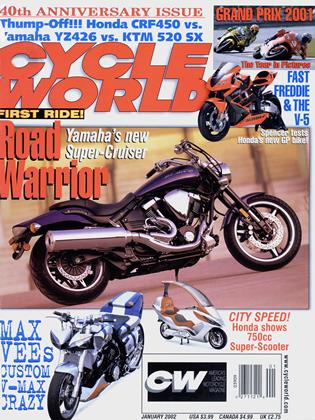
Road Warrior
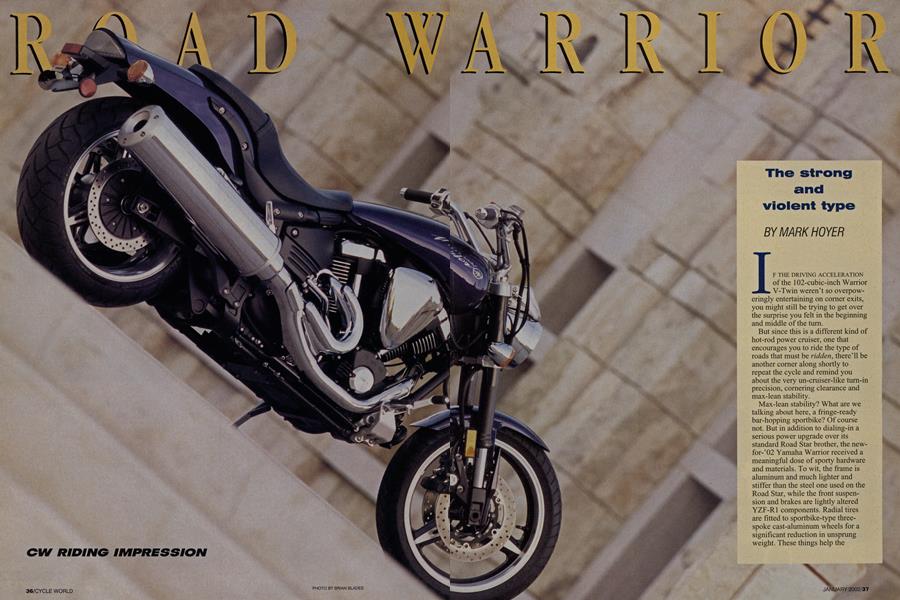
ROAD WARRIOR
CW RIDING IMPRESSION
The strong and violent type
MARK HOYER
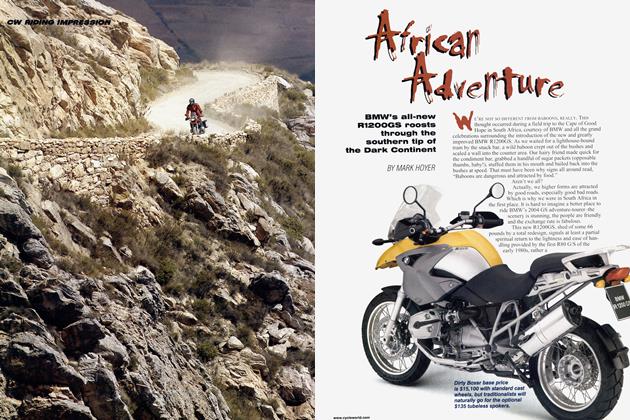
IF THE DRIVING ACCELERATION of the 102-cubic-inch Warrior V-Twin weren't so overpow eringly entertaining on corner exits, you might still be trying to get over the surprise you felt in the beginning and middle of the turn.
But since this is a different kind of hot-rod power cmiser, one that encourages you to ride the type of roads that must be ridden, there’ll be another comer along shortly to repeat the cycle and remind you about the very un-cmiser-like turn-in precision, cornering clearance and max-lean stability.
Max-lean stability? What are we talking about here, a fringe-ready bar-hopping sportbike? Of course not. But in addition to dialing-in a serious power upgrade over its standard Road Star brother, the newfor-’02 Yamaha Warrior received a meaningful dose of sporty hardware and materials. To wit, the frame is aluminum and much lighter and stiffer than the steel one used on the Road Star, while the front suspension and brakes are lightly altered YZF-R1 components. Radial tires are fitted to sportbike-type threespoke cast-aluminum wheels for a significant reduction in unspmng weight. These things help the Warrior do more than just blast from stoplight to stoplight.
Throw a leg over the Warrior’s low seat and find the ignition up on the tripleclamp-not the cruiser-usual “scratch-yerass” side mount. This is the first indication that perhaps you shouldn’t have booted up the mental “Cruiser Expectation Set, No. 01.” This psychoreference manual, compiled through years of riding bikes with the “long-n-low” silhouettes and narrow-angle V-Twin engines, includes chapters on scraping hard parts, dealing with a wallowing chassis and coming to terms with a throttle that seems more like a volume control than a rheostat for horsepower delivery.
The way the Warrior goes, turns and stops means it’s time to update expectations.
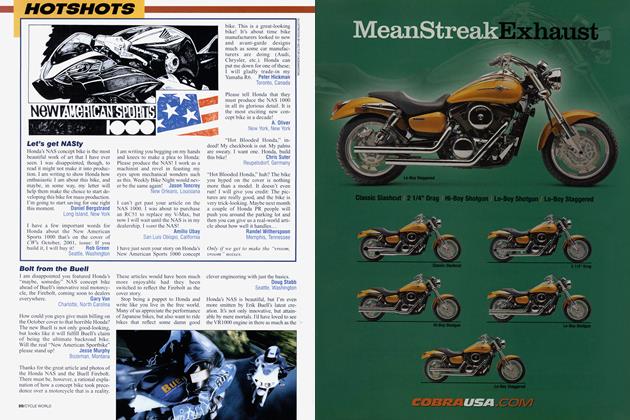
This change was already in progress, of course-we’ve already ridden other recently introduced performance cruisers from Honda (VTX1800), Harley-Davidson (V-Rod) and Kawasaki (Mean Streak 1500). So, motoring out of the
parking lot from the Ritz Carlton (site of the Yamaha press launch) and through the northern California coastal town of Half Moon Bay was not an altogether unfamiliar experience. Different in character, yes, as it’s the only air-cooler currently in the class, but the Warrior’s nonetheless got tremendous bottom-end power and a real lunge in acceleration.
It is a huge departure from the original Road Star. And the answer as to why lies in the character of the torque curve. In the Warrior’s case, the curve has twin high points, versus the single early peak and subsequent nose-dive delivered on the standard Road Star. Yamaha tried many versions of the big 1.6-liter Twin before settling on the final 1675cc Warrior spec, but, to paraphrase one of Yamaha’s own testers, until a second torque peak higher in the rev range was tuned in, the motor “felt like crap.” This motor does not feel at all crappy. It’s burly, lusty, vigorous, lively, with amazing zap, as the 102-cubic-inch pushrod Twin pounds off the line with gen-yew-ine big-block lunge. Spinning the fat 200/17 rear tire is a totally entertaining pastime for the knuckle-dragging thug in you, as easy as a big handful of throttle, which is pretty much the American Way. The engine revs to a little over 5000 rpm before the soft rev-limiter begins to do its work, but you don’t really think of the Warrior as low-revving when you’re riding it because it keeps on pulling and has so much power on tap.
How much? Yamaha’s in-house rearwheel dyno recorded 80 horsepower and 104 foot-pounds of torque. Both the VTX (89 bhp) and the V-Rod (108 bhp) make more horsepower, but the Honda can’t quite equal the Warrior at 100 ft.lbs. of torque, while the high-revving Harley can only muster 74 ft.-lbs.
So, hot-rod the Road Star, slap on some bobbed fenders and airscoops, and be done with it right? Nope, a rigid chassis, good suspension and sportbike brakes were always part of the deal. Why? Well, a few folks from the marketing side pointed out their data indicated Yamaha’s traditional cruiser buyer was kind of an older guy. These unfortunate souls, like the rest of us, are ever marching toward the Great Choir. Cadavers making poor motorcycle purchasers, the health and vibrance of the cruiser market would benefit from attracting younger buyers who will be throwing down greenbacks for a longer period of time. The Warrior is the more exciting, performance-oriented bike intended to pull in this buyer.
A few comers into Skyline Boulevard, a serpentine strip of tarmac through the coastal mountains south of San Francisco, it was clear the Warrior was meant to satisfy a different kind of cruiser audience.
The aluminum chassis lends a much more solid feel than any cruiser I’ve ridden. Tum-in isn’t lightning quick-it pretty much can’t be with 29 degrees of rake and 5.1 inches of trail working in a rangy 65.7-inch wheelbase. Still, it offers a precise, stable platform for spirited riding. The 41mm inverted fork retains preload adjustment from its use in the Rl, but lost damping adjustment. No biggie, really, because we’re dealing here with a good-quality cartridge fork that works.
Its solid feel is so good, and the suspension is so planted, that the bike in a sense tricks you. The first few comers are sort of a delightful rediscovery of lean angle until you get in too hot and touch down a footpeg, then its mount. This happens all the time on cmisers and isn’t usually a surprise, but the Warrior’s chassis doesn’t feel like a traditional, compromised cruiser chassis. Anyway, once you find your “altitude,” a sense of how much lean angle you can use, then you can start hammering this thing like few cmisers before. Sure, you still might bury the footpegs, you’re just going way faster and having a lot more fun.
But even with the fabulous Rl-sourced brakes and stout 41mm inverted fork leading the way steadily and reassuringly into comers, the best thing by far about the Warrior is pulling the trigger. Even down at 2500 rpm (not unusual when you’re ripping around on the Warrior), there’s legitimate fiiry and excellent sounds available. Sure, the muffler is freakin’ huge (makes the gargantuan airbox seem a bit smaller), but the primal music this bike makes is addicting.
So, after five or 10 miles of twisting road, you get the Warrior figured out and simply start to have a good time heeling it over in comers and listening to that pounding song when you twist the loud handle. Sort of a Cmiser heart
with a Standard soul.
It’s not that you can’t chuff along on the Warrior at 1200 rpm in your denim-covered half-helmet and fingerless gloves, heading to your favorite watering hole for a plate of hot wings and a cold one. But you won’t want to. There’s too much going on here for that.
The riding position is no more compromised than other more laid-back cmisers. Only in the Warrior’s case, it’s compromised for cornering clearance and more aggressive riding. The bars are wide, but even for a tall guy like me with ape-man arms, the upper body is canted much more forward than on your typical cmiser. Footpegs are higher than most, and seem closer, too, which might actually make this bike better than others in the class for shorter riders.
Riders short or tall will find the LCD tach interesting, but not that useful a tool. Same goes for the tripmeter (a reach for the eyes) and even the ignition key (a reach for the hand). Both are a long way from the rider. Not huge issues, really, and what would Yamaha have done with them anyway? Put them in a tank-mounted chrome sconce? And the gauges’ blue backlighting is a pretty cool riff.
In fact, the Warrior is full of cool riffs, rich in detail and tidy in its visual execution. Tactilely satisfying blacked-out surfaces interplay nicely with bmshed aluminum and flowing bodywork. And you’ll be relieved to know that the black frame coating was abrasion tested with denim just to be sure it could stand up to the abuse of your pants. The trashcansize silencer and big airbox have been at the center of some controversy, however. Some of us have begun to like this sort of overstatement of purpose, others still think of the pieces as giant eyesores. At least accept them as an honest treatment of the need for intake/exhaustsystem volume-without their help keeping the booming combustion events quiet, the Warrior wouldn’t make the impressive power it does. Should you want, both are also quite easy to remove and replace with coming aftermarket items.
A Yamaha accessory line has been tailored to match the Warrior’s less traditional cruiser styling, too. Sure, you can get chromed, ballmilled doo-dads, but there is also a new sort of bare-aluminum surface treatment added to the conventional bolt-on parts mix. An even more unconventional addition are new “Speedstar” performance parts. Yamaha is even offering an engine kit that bumps horsepower into the triple
digits and adds another 12 ft.-lbs. of stonk. Among the kit pieces are high-comp pistons, uprated fuel nozzles, lumpier cams and freer-breathing twice-pipes. See you at the dragstrip, loser!
After mulling it over for a while following a full day of honest-to-Agostini fun riding a cruiser on twisty backroads, it occurred to me that in the same way that the Ducati Monster is a rationalized version of a sportbike, so is the Warrior a rationalized version of a cruiser. The Monster retains the spiritual essence of the 996 Superbike, but carries it in a more real-world package. The Warrior sort of “normalizes” the mega V-Twin by offering a much broader performance envelope, a vigorous engine, good suspension and a more upright riding position.
The greatest success of the Warrior is that it isn’t like riding a cruiser, but like riding a motorcycle. Think of it as an American Monster built in Japan, true to the hot-rod ethos that inspired it.