Husqvarna 610 Wxc
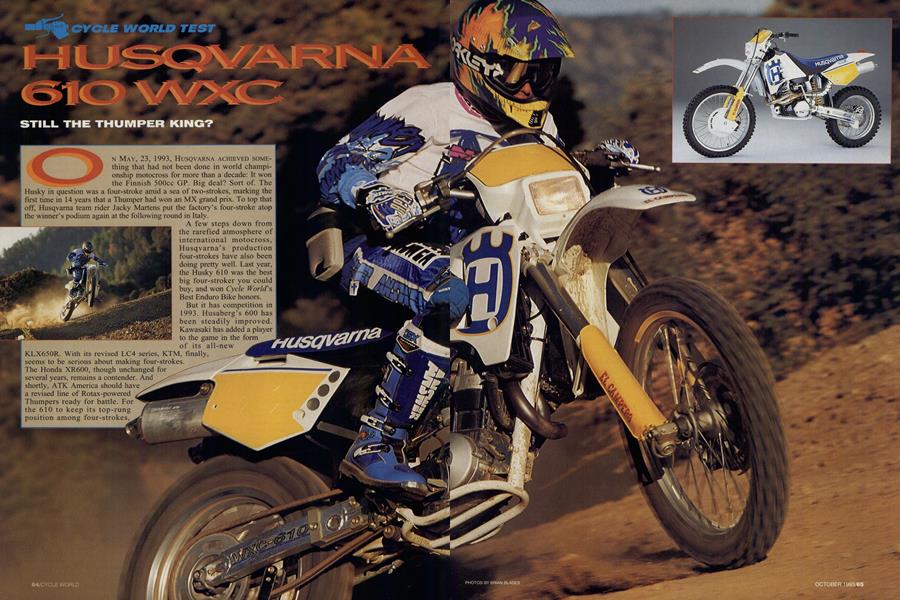
HUSQVARNA 610 WXC
CYCLE WORLD TEST
STILL THE THUMPER KING?
ON MAY, 23, 1993, HUSQVARNA ACHIEVED SOMEthing that had not been done in world championship motocross for more than a decade: It won the Finnish 500cc GP. Big deal? Sort of. The Husky in question was a four-stroke amid a sea of two-strokes, marking the first time in 14 years that a Thumper had won an MX grand prix. To top that off, Husqvarna team rider Jacky Martens put the factory’s four-stroke atop the winner’s podium again at the following round in Italy.
A few steps down fróiii' the rarefied atmosphere of international motocross, Husqvarna's production four-strokes have also been doing pretty well. Last year, the Husky 610 was the best big four-stroker you could buy, and won Cycle World's Best Enduro Bike honors. But it has competition in 1993. Husaberg's 600 has been steadily improved. Kawasaki has added a player to the game in the form of its all-new
KLX650R. With its revised LC4 series, KTM, finally, seems to be serious about making four-strokes. ....... The Honda XR600, though unchanged for several years, remains a contender. And shortly, ATK America should have a revised line of Rotax-powered Thumpers ready for battle. For the 610 to keep its top-rung position among four-strokes,
Husqvama will have to stick to the formula that’s worked so well in the recent past: Start out with a better overall package and make improvements to keep ahead of the pack.
In 1985, the 510 Husky motor started out thin, compact and light in comparison to Honda and Rotax motors in the same displacement category. The 610 that has evolved is almost as compact, and makes the kind of power that fans of big-bore Thumpers expect.
When Cagiva purchased the company and moved Husqvama production from Sweden to Italy in 1989, the componentry around the motor was upgraded, and attention to detail tossed the bike’s previous cobby, extruded look in favor of real craftsmanship.
Good as the 1993 version looks, the 610’s real strong point is its engine. Once broken-in, which takes a good 1000 miles, one or two crisp kicks is all it takes to light the Husky’s fire. The left-side kickstarter is placed a little high, so being limber helps in getting a full stroke, and as delivered, jetting was a little fat. A drop of one size on the main jet resulted in spoton carburetion from sea level to 4000 feet.
A quick run through the gears reveals the magic of the motor. Lowand midrange torque is impressive, but the surge in power on top is astonishing. If someone were to turbocharge a big four-stroke, this is what it would feel like. Make no mistake: The 610’s power delivery isn’t abrupt or wild in any way. Low-speed response is smooth and the motor will not bog unless it is about two gears high, but this is a Thumper that rewards high revs.
Shifting is smooth and drew no complaints. Clutch pull’s light as long as the cable is lubed. The double silencer/spark-arrestor is a big plus: clean looks and low sound output without too much performance loss, though racers will probably opt for a lighter aftermarket system. Zero mechanical gremlins came to light during the test; the engine never so much as hiccupped.
The Husky is a big bike, yet it fits smaller riders well. In fact, riders over 6 feet tall may want to fit a taller handlebar. As per current European trend, the seat is hard, more so towards the back where the foam is very thin. The seat positioning is level and blends nicely with the fuel tank; you can move around easily on the bike and not feel cramped.
Brakes front and rear are adequate, but receive a lot of help from engine-braking. The front feels strong initially, but when used repeatedly to haul the 280-pound WXC down from high speed you can tell it’s being taxed. At first, the rear-brake pedal was a little hard to find, but riders soon got used to its tucked-in location.
New for 1993 is the 45mm Showa fork with externalpreload adjustment and larger cartridge tubes. The same fork performed poorly on CWs test 360 two-stroke, but has been recalibrated slightly-and for the better-on the 610, resulting in a very plush ride. We’d like to see stiffer springs fitted, though, because the fork has a tendency to ride low in its suspension stroke, and it bottoms too much for our liking. Stiffening up the preload helped considerably.
The shock received a larger piston and updated valving for ‘93, changes that work beautifully. Even in ugly conditions, the shock provides a smooth ride, and keeps the rear tire on the ground and hooked-up.
Rounding out the small details, the spokes are firstrate-only one came loose during the test. The wimpy-looking kickstand actually is amazingly strong and tucks well out of harm’s way. The handlebar-mounted compression release is handy for cleaning out the motor when it gets flooded, which happens a lot if bystanders follow the normal routine of twisting the throttle while admiring the bike. The pumper on the 40mm Dell’Orto
will flood the motor with only two twists if it’s not running. The nice, thick decals on the tank last a while, even if the numberplate backgrounds need some improvement. Tires this year are Metzeier Unicross front and rear, some of the best around, especially when paired with heavy-duty Metzeler tubes.
If there is a disappointment with the 610 WXC this year, it’s that the machine has gained weight, up 8 pounds over last year’s mqdel. None of our test riders complained about the weight increase when riding, but when switching between the 610 and a Husaberg, which is 29 pounds lighter, there was a significant difference in feel. Still, the Husky feels light when compared to an XR or a KLX.
So where does this leave the 610 Husky? Overall, it’s still the best off-road Thumper you can buy, and is one of most enjoyable dirtbikes on the market regardless of engine type. But the competition is getting closer. U
HUSQVARNA 610 WXC
$5400