The Crocker V-Twin
THE CROCKER V-TWIN
SOMETIMES, BEING THE BEST ISN’T QUITE GOOD ENOUGH
ALLAN GIRDLER
AN OLD TESTAMENT philosopher, writing in the Book of Ecciesiastes, noted that the race isn't always to the swift
nor the battle to the strong. He should have been here in 1936. He could have bought a Crocker V-Twin, been the fastest guy in town and seen for himself just what can happen to the swift and strong.
The Crocker was that kind of motorcycle.
The story begins with more-than-suitable irony. Albert G. Crocker was a degreed engineer who got his practical experience working for Indian and Thor, and his kicks riding enduros and hillclimbs. He later worked as a branch manager for Indian, then had his own dealership, with a sideline of turning out special projects for the factory. When speedway racing arrived in the U.S., Crocker turned his talent to producing racebikes that more than held their own against the Harleys, J.A.P.s and Rudges that until then had ruled the roost.
When J.A.P. brought out a new, all-but-unbeatable racer, Crocker chose not to retaliate. Still, he had an experienced work force, operating capital and knew just about everything there was to know about the sport and business of motorcycles. Further, he and second-in-command P.A. Bigsby shared the firm belief that anything Harley and Indian could do, they could do better.
Plus, and just as important, Crocker’s tastes were the market’s tastes. Crocker was an enthusiast, and the only people willing to spend Depression-rare dollars on motorcycles in 1936 were enthusiasts. If you’d been looking for the best man to design and produce the best motorcycle of 1936, you’d have been hard put to come up with a better candidate than Albert Crocker.
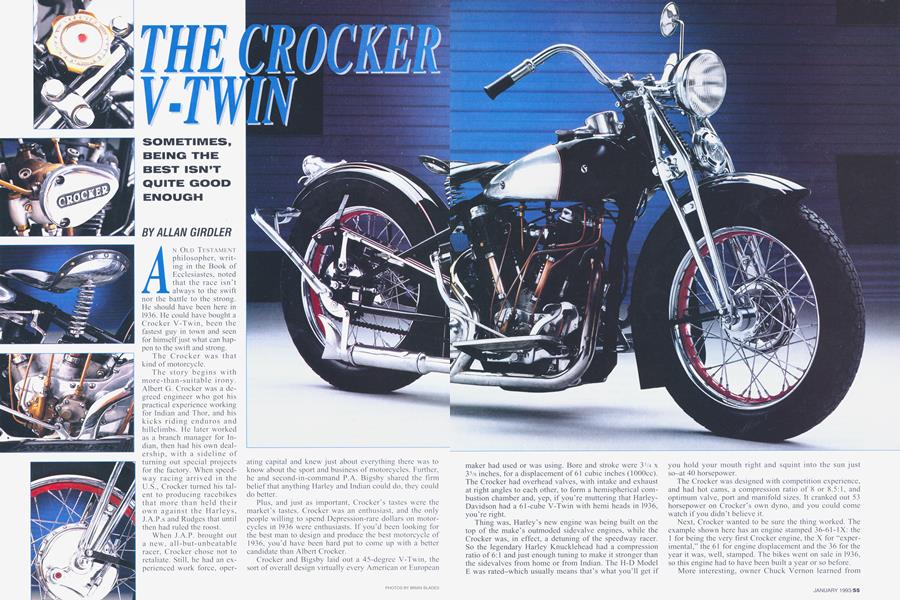
Crocker and Bigsby laid out a 45-degree V-Twin, the sort of overall design virtually every American or European maker had used or was using. Bore and stroke were 3'A x 3-V8 inches, fora displacement of61 cubic inches (lOOOcc). The Crocker had overhead valves, with intake and exhaust at right angles to each other, to form a hemispherical combustion chamber and, yep, if you’re muttering that HarleyDavidson had a 61-cube V-Twin with hemi heads in 1936, you’re right.
Thing was, Harley’s new engine was being built on the top of the make’s outmoded sidevalve engines, while the Crocker was, in effect, a detuning of the speedway racer. So the legendary Harley Knucklehead had a compression ratio of 6:1 and just enough tuning to make it stronger than the sidevalves from home or from Indian. The H-D Model E was rated-which usually means that’s what you’ll get if you hold your mouth right and squint into the sun just so-at 40 horsepower.
The Crocker was designed with competition experience, and had hot cams, a compression ratio of 8 or 8.5:1, and optimum valve, port and manifold sizes. It cranked out 53 horsepower on Crocker’s own dyno, and you could come watch if you didn’t believe it.
Next, Crocker wanted to be sure the thing worked. The example shown here has an engine stamped 36-61-IX: the 1 for being the very first Crocker engine, the X for “experimental,” the 61 for engine displacement and the 36 for the year it was, well, stamped. The bikes went on sale in 1936, so this engine had to have been built a year or so before.
More interesting, owner Chuck Vernon learned from former factory staff that the engine began life powering an Indian Chief chassis. Seems Crocker wanted to be sure he had a working and workable engine before proceeding to the cycle parts.
Said parts began with a conventional frame, using steel tubing welded to cast-iron junctions. It was innovative in that the junction for the rear tubes was a casting that also held the transmission gears, a true gearbox. Crocker had never liked needing to adjust or align the drivetrain.
Primary-drive housing and crankcases mounted on the gearbox, and the front downtube attached to the front of the cases, a “keystone” frame in engineering talk, with the engine as a stressed member. The engine-and thus the entire machine-was lower than rivals with full engine cradles.
The rest of the description is normal for the time, with girder fork, rigid rear end, a foot-operated clutch and three forward speeds shifted by hand. One carb, in the center of the vee, drum brakes on both wheels.
Crocker’s operation included a complete machine shop and even a foundry. He liked to make all the parts he could, and he liked using brass and aluminum. So, the fuel tanks were cast alloy, done in two
halves and fastened to the frame backbone with through-bolts, and the oil pumps were brass. Boughtout parts included carburetors, generators, seats and wheel rims. Legend says that when Harley management leaned on the wheelrim vendor to cut off the upstart company’s supply,
Crocker simply had the customer bring in rims bought elsewhere.
This was a unique operation. The shop-it wasn’t big enough for the term plant or factory-was in an industrial section of Los Angeles. There was no assembly line as such. Instead, when an order came in, the guys built the bike to whatever specs the customer had in mind, then rolled the machine down the street to be painted any color the buyer wanted.
The slogan could have been “No Two Alike.” Some of this, the paint for instance, was simply because there was no catalog or dealer network. Nominal engine size was 61 cubic inches, but because the engine had been designed with beef in the barrels and space in the crankcase, bore and stroke could be expanded or extended, and 74and 80cubic-inch Crockers were common. You could get magneto or coil-and-battery ignition, 8 or 8.5:1 compression ratio, coilor cantilever-sprung seat, and a couple of the roadbikes were sold with racing carburetors.
Some of the differences were the result of evolution. The first models had forks with one spring, but there was an early change to two. The first model, built from 1936 until early in 1939, had a 2-gallon fuel tank. That wasn’t enough for the lonely highways of the time, so the second series’ tanks held 3 gallons.
An extra inch of wheelbase was also added to later machines, but the major change was made, put bluntly, because the engine didn’t work as well as it should have.
This is surprising, considering the depth of talent and experience of the team, and facts like testing the engine before the chassis was built, but the fact is the first versions of hemi heads cracked. So Crocker did a second set of castings. Those failed, so he did a third set, and when they didn’t solve the problem, he laid out a new design with valves above the bore, and parallel to the bore and each other, with a beveled piston and a squish area chamfered into the edge of the barrel that matched the contour of the piston.
This was creative and innovative engineering, literally years ahead of its time-in fact, Honda’s car engines used something of the sort many years later.
Also, the first engines had a two-stage oil pump-two sets of gears in one housing. But the crankcases filled with oil, a sign that the scavenge half wasn’t keeping up with the pressure half, or that the breathers and timers needed to scavenge a Vworked out. Later engines They were better
Twin with dry sump weren’t had two pumps-pressure and scavenge, when new and cool, but had the same problem when worn or hot.
The actual gears in the box were three times stronger than they needed to be, but the shifter forks were weak and bent under the speed-shifts inflicted by the sort of rider who’d buy a Crocker. There" was no throw-out bearing for the clutch, and the contact areas wore early.
Perhaps what we have here is proof that sometimes it wouldn’t hurt to have a committee. There was no lack of commitment, in that Crocker paid for three sets of castings for the hemi heads and used them on only 17 engines. But, other makers, H-D for one, managed to make the hemi idea work fine. The parallel-valve heads gave trouble, too-there were early and late versions of those, as well, so there must have been some factor of heat or stress that nobody managed to find in time. The oil-pump problem could be fixed with a scavenge pump that had more capacity. Indian had one, it’s said, but the factory never made that change.
Hindsight is cheap, but even so, what it looks like 50plus years later is that there weren’t enough resources to tackle all that needed to be done, with perhaps an extra handicap that came from pride.
Discouraging words, eh? But the flaws didn’t kill the Crocker.
CROCKER
A big Harley or Indian might hit 90 mph; a stock Crocker had 106 on tap. Crocker was the fastest and everybody knew it, period.
A chunk of the reason for that is hard to imagine today, but for perspective, note that the early Knuckleheads had problems too numerous to list here, and that the Indian Four, a new version of which came out at about the same time as the Crocker, was that make’s worst product ever. Not until the builders to the west of us arrived in the late 1950s did motorcycle nuts suspect you could ride a bike for longer than it took to fix it.
For another factor, a parallel jump: Couple of years ago, our companion publication, Road & Track, surveyed the owners of a certain English sports car. That survey set two records. First, it tied the dismal service record of another English make, and second, it tied the loyalty record of a vaunted German brand. This looked at first like a contradiction of consumer logic, in that the least reliable car you could buy was one its owners would buy again.
But no enthusiast would be baffled for a second. If a motorcycle/car/product gives you what you really want, you’ll put up with defects intolerable in consumer goods with less to offer the soul.
The Crocker lived up to its promise. The big Harley and Indian might hit 90 mph on their best day; the stock Crocker 61 had 106 on tap any time the road was clear. Vernon has surveyed the records from the California dry lakes and says the average for all the Crockers clocked there was a full 20 mph faster than the other two brands’. The factory’s stock-but-prepped bike was timed at 128 mph. Plus, the Crocker had a close-ratio gearbox and was even better at going through the gears (drag racing hadn’t acquired that name yet) than the others. The Crocker was the fastest and everybody knew it, period.
In the long run, though, there was no long run.
Crocker was there to make motorcycles, not history, so the records are sometimes vague. By the best Vernon can trace, there were 33 of the small-tank Crockers actually produced, 17 with the hemi heads and the rest with parallelvalve heads. Then came 15 big-tank versions, in 1939 and 1940. There were five machines built in 1941 before production was interrupted and Crocker turned to making parts for military aircraft. A handful of machines was assembled from leftover parts in 1942.
That was that. Crocker did well in the aircraft-parts business. One assumes he recalled how he made a small fortune in the motorcycle business by beginning with a large one, so this time, when he did well, he stayed away from bikes.
Remember what your old granny told you when your kite came out crooked, how there’s never enough time to do it right, but always enough time to do it over? Albert Crocker had it the other way. Because all available time and money went to do it over, there never was time and money to do it right, and the fastest motorcycle of the day lost to the slower ones that could be fixed to stay fixed.
There’s a makeshift happy ending. Sixty-four Crocker V-Twins were made for sure. There are still about 30 authentic Crockers, running in shows if not on the dry lakes. In 1936, you’d pay $500 to $700 for a Crocker, against $400 to $500 for a Harley or an Indian. In 1993, you’d have to sell all five of your restored, $15,000 Knuckleheads to get one Crocker, assuming you could find one on the market.
Which is nice for collectors. The rest of us are left to wonder, as Vernon does, “just how many motorcycles do you have to make before it becomes routine?”
And to wish Albert Crocker had managed to make a few more.