Bimota Db2
BIMOTA DB2
EXOTICA FOR EVERYMAN?
THERE WAS A TIME WHEN THE only Bimota you could buy came equipped not only with the marque’s usual monster price tag, but with a Japanese
engine. This was, it developed, a passport to near-bankruptcy for the tiny Italian company.
The bike that bailed Bimota back into profitability was the DBl, the company’s first Ducati-powered model. With its relatively low-tech 750cc belt-drive Pantah engine, the DBl provided a semi-affordable entry
into Bimota-class motorcycling.
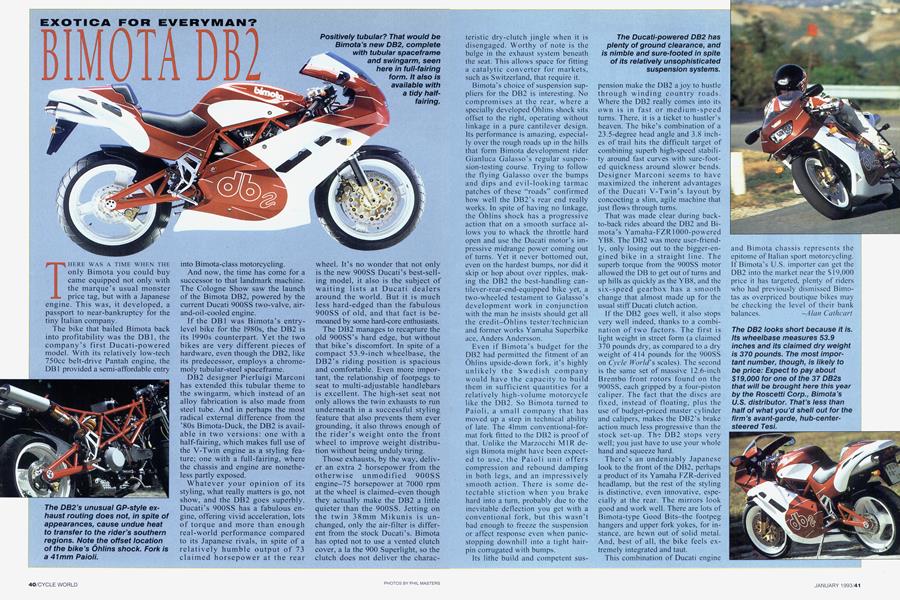
And now, the time has come for a successor to that landmark machine. The Cologne Show saw the launch of the Bimota DB2, powered by the current Ducati 900SS two-valve, airand-oil-cooled engine.
If the DBl was Bimota’s entrylevel bike for the 1980s, the DB2 is its 1990s counterpart. Yet the two bikes are very different pieces of hardware, even though the DB2, like its predecessor, employs a chromemoly tubular-steel spaceframe.
DB2 designer Pierluigi Marconi has extended this tubular theme to the swingarm, which instead of an alloy fabrication is also made from steel tube. And in perhaps the most radical external difference from the ’80s Bimota-Duck, the DB2 is available in two versions: one with a half-fairing, which makes full use of the V-Twin engine as a styling feature; one with a full-fairing, where the chassis and engine are nonetheless partly exposed.
Whatever your opinion of its styling, what really matters is go, not show, and the DB2 goes superbly. Ducati’s 900SS has a fabulous engine, offering vivid acceleration, lots of torque and more than enough real-world performance compared to its Japanese rivals, in spite of a relatively humble output of 73 claimed horsepower at the rear wheel. It’s no wonder that not only is the new 900SS Ducati’s best-selling model, it also is the subject of waiting lists at Ducati dealers around the world. But it is much less hard-edged than the fabulous 900SS of old, and that fact is bemoaned by some hard-core enthusiasts.
The DB2 manages to recapture the old 900SS’s hard edge, but without that bike’s discomfort. In spite of a compact 53.9-inch wheelbase, the DB2’s riding position is spacious and comfortable. Even more important, the relationship of footpegs to seat to multi-adjustable handlebars is excellent. The high-set seat not only allows the twin exhausts to run underneath in a successful styling feature that also prevents them ever grounding, it also throws enough of the rider’s weight onto the front wheel to improve weight distribution without being unduly tiring.
Those exhausts, by the way, deliver an extra 2 horsepower from the otherwise unmodified 900SS engine-75 horsepower at 7000 rpm at the wheel is claimed-even though they actually make the DB2 a little quieter than the 900SS. Jetting on the twin 38mm Mikunis is unchanged, only the air-filter is different from the stock Ducati’s. Bimota has opted not to use a vented clutch cover, a la the 900 Superlight, so the clutch does not deliver the characteristic dry-clutch jingle when it is disengaged. Worthy of note is the bulge in the exhaust system beneath the seat. This allows space for fitting a catalytic converter for markets, such as Switzerland, that require it.
Bimota’s choice of suspension suppliers for the DB2 is interesting. No compromises at the rear, where a specially developed Öhlins shock sits offset to the right, operating without linkage in a pure cantilever design. Its performance is amazing, especially over the rough roads up in the hills that form Bimota development rider Gianluca Galasso’s regular suspension-testing course. Trying to follow the flying Galasso over the bumps and dips and evil-looking tarmac patches of these “roads” confirmed how well the DB2’s rear end really works. In spite of having no linkage, the Öhlins shock has a progressive action that on a smooth surface allows you to whack the throttle hard open and use the Ducati motor’s impressive midrange power coming out of turns. Yet it never bottomed out, even on the hardest bumps, nor did it skip or hop about over ripples, making the DB2 the best-handling cantilever-rear-end-equipped bike yet, a two-wheeled testament to Galasso’s development work in conjunction with the man he insists should get all the credit-Öhlins tester/technician and former works Yamaha Superbike ace, Anders Andersson.
Even if Bimota’s budget for the DB2 had permitted the fitment of an Öhlins upside-down fork, it’s highly unlikely the Swedish company would have the capacity to build them in sufficient quantities for a relatively high-volume motorcycle like the DB2. So Bimota turned to Paioli, a small company that has moved up a step in technical ability of late. The 41mm conventional-format fork fitted to the DB2 is proof of that. Unlike the Marzocchi MIR design Bimota might have been expected to use, the Paioli unit offers compression and rebound damping in both legs, and an impressively smooth action. There is some detectable stiction when you brake hard into a turn, probably due to the inevitable deflection you get with a conventional fork, but this wasn’t bad enough to freeze the suspension or affect response even when panicstopping downhill into a tight hairpin corrugated with bumps.
Its lithe build and competent suspension make the DB2 a joy to hustle through winding country roads. Where the DB2 really comes into its own is in fast or medium-speed turns. There, it is a ticket to hustler’s heaven. The bike’s combination of a 23.5-degree head angle and 3.8 inches of trail hits the difficult target of combining superb high-speed stability around fast curves with sure-footed quickness around slower bends. Designer Marconi seems to have maximized the inherent advantages of the Ducati V-Twin’s layout by concocting a slim, agile machine that just flows through turns.
That was made clear during backto-back rides aboard the DB2 and Bimota’s Yamaha-FZR 1000-powered YB8. The DB2 was more user-friendly, only losing out to the bigger-engined bike in a straight line. The superb torque from the 900SS motor allowed the DB to get out of turns and up hills as quickly as the YB8, and the six-speed gearbox has a smooth change that almost made up for the usual stiff Ducati clutch action.
If the DB2 goes well, it also stops very well indeed, thanks to a combination of two factors. The first is light weight in street form (a claimed 370 pounds dry, as compared to a dry weight of 414 pounds for the 900SS on Cycle World's scales). The second is the same set of massive 12.6-inch Brembo front rotors found on the 900SS, each gripped by a four-piston caliper. The fact that the discs are fixed, instead of floating, plus the use of budget-priced master cylinder and calipers, makes the DB2’s brake action much less progressive than the stock set-up. The DB2 stops very well; you just have to use your whole hand and squeeze hard.
There’s an undeniably Japanese look to the front of the DB2, perhaps a product of its Yamaha FZR-derived headlamp, but the rest of the styling is distinctive, even innovative, especially at the rear. The mirrors look good and work well. There are lots of Bimota-type Good Bits-the footpeg hangers and upper fork yokes, for instance, are hewn out of solid metal. And, best of all, the bike feels extremely integrated and taut.
This combination of Ducati engine and Bimota chassis represents the epitome of Italian sport motorcycling. If Bimota’s U.S. importer can get the DB2 into the market near the SI9,000 price it has targeted, plenty of riders who had previously dismissed Bimotas as overpriced boutique bikes may be checking the level of their bank balances. Alan Cathcart