Abiding Pleasures
ABIDING PLEASURES
THREE DECADES LATER, SOME OF US STILL HAVEN'T GROWN UW
PETER EGAN
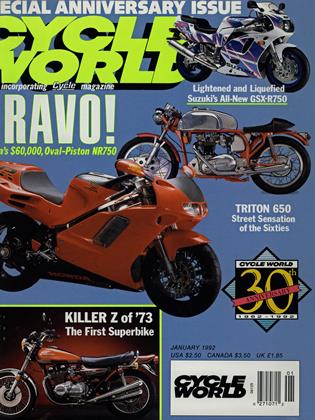
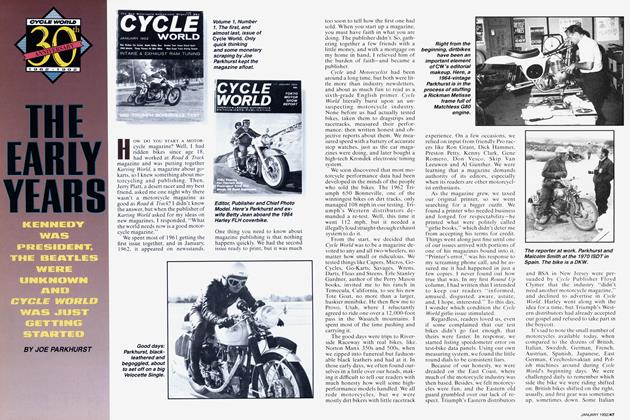
THIRTY YEARS IS A BIG ONE FOR a magazine. And for this special occasion I am forced to admit that, when the first issue of Cycle World came out in 1962, I was not only old enough to read, but old enough to think about possibly shaving soon. I was also in the market for a motorcycle.
It would be nice to say that I saw that first issue on the newsstand, grabbed it in both hands, eyes bug ging out, and immediately plunked down my hard-earned 35-cent cover price. Not so. I simply read it in our school library. A quick perusal of my complete set of old Cycle Worlds shows that I did not actually buy an issue until March of 1964, appar ently seduced by either the full-page ad for my own 50cc Bridgestone 7 or the sultry bikini-clad model in the Parilla ads. Or maybe it was the road test of the 2 50cc Royal Enfield Cru sader. I can't remember.
In any case, it was Editor/Publisher
Joe Parkhurst who drew a whole gen eration of us into these pages. He caught our adolescent attention with Karting World, which delivered us into the temptation of the inexpen sive, unlicensed minibike craze, and then he lowered the hammer with Cycle World. We never knew what hit us. And some of us, like me, still don't. A technological paw! engaged with a philosophical ratchet and locked solid. The fad thing was over; we were lifers.
Before Cycle World, most bike magazines were pretty bad. They were industry-promotion journals, full of grainy photos of Shriner pa rades and retailers cutting the ribbon on new showrooms. Road tests con tained remarkable performance numbers supplied by the manufac turers and told us that one new model went like stink, while another one really cut the mustard. That sort of thing.
Parkhurst, on the other hand, ap plied the concept of honest journal ism to the business and was rewarded with a flood of reader mail that said, essentially, "At last!" He also intro duced another first: good writing. The magazine was urbane, sophisti cated and witty. College professors could read it, and 14-year-old high school freshmen (comme moi) could feel that we were participating in an intelligent portion of the adult world, rather than being written down to. Or, worse yet, up to.
Shortly thereafter, other motorcy cle magazines grabbed themselves by the bootstraps and raised their own standards, creating lively compe tition, as well as adding to a collective body of actual literature about motorcycles.
This Is important. During the Six ties and Seventies, motorcycle maga zines developed a quality and a style that made young writers (at least those tuned into the subject) wish fervently that they could write not for East Coast literary journals, but for motorcycle magazines. Amazing.
A well-meaning relative of mine looked over a copy of CW when I first came on the staff in 1980 and said, "I'm surprised how good the writing is. Really too good for the subject matter. .. ." . -
I~ simply smiled to myself. Even though the motorcycle market was at its peak, motorcyclists were still a sort of secret society, like mountain climbers, with a literature that could be read and appreciated by doctors, beatniks, opera singers, mechanics, Zen hermits. engineers, global vaga bonds and English teachers. And high school freshmen. But before you could climb, you first had to be attracted to the mountain. Not every body was.
Beyond writing, of course, the main draw was motorcycles. And during the Seventies, while cars were getting slower and uglier as they grap pled with safety and emissions laws. motorcycles were actually becoming faster and more reliable. And, in the case of Japanese bikes, better han dling. At last.
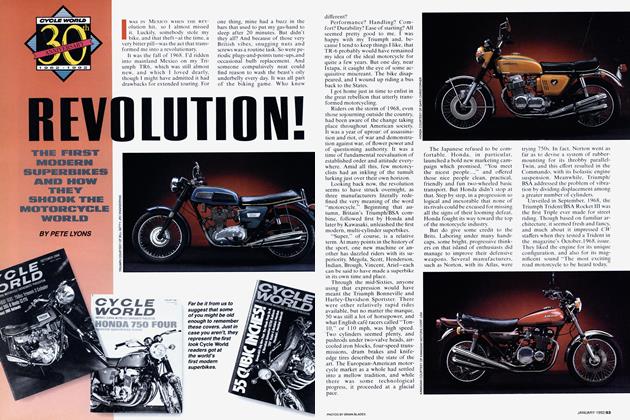
The Superbike Era began shortly before 1970 and picked up steam through the decade. Into the arena poured Triumph/BSA Triples. Hon da 750 Fours, Kawasaki two-stroke Triples, Sportsters, Ducati and Moto Guzzi Twins, Norton Commandos, BMW 900s and Z1 Kawasakis.
Sadly, by 1976 all the great British companies had effectively gone out of business, mostly from self-in flicted wounds. But elsewhere life was good. The motorcycle market was still growing like crazy, and in 1978 Suzuki released its GS1000, perhaps the ultimate UJM. It han dled well on the racetrack, burned up the dragstrip, carried two people in sumptuous touring comfort and it never broke. It set the standard for the late Seventies and early Eighties.
This is where I came into the maga zine business. First as a freelance contributor in 1978, and later hired by then-Editor Allan Girdler as CW's Tech Editor. I started work on Janu ary 2, 1980, after driving my rustedout Volkswagen from Wisconsin to California. I left home on Christmas Day and arrived at the office on three cylinders. My Honda CB750 arrived a month later in the moving van.
What, then, was the industry pic ture in January of 1980? Well, fourcylinder Universal Japanese Motor cycles ruled the Earth. Or at least the part with roads on it. Honda, Suzuki, Yamaha and Kawasaki all had com peting Fours of roughly 550, 750 and 1000cc displacements, with a few odd niches in between. These were all-purpose bikes with conventional (traditional British-style) handlebar footpeg arrangements. triangular sidecovers and teardrop-shaped tanks. You could race them, ride to work, or install a fairing and tour the USA. Your call.
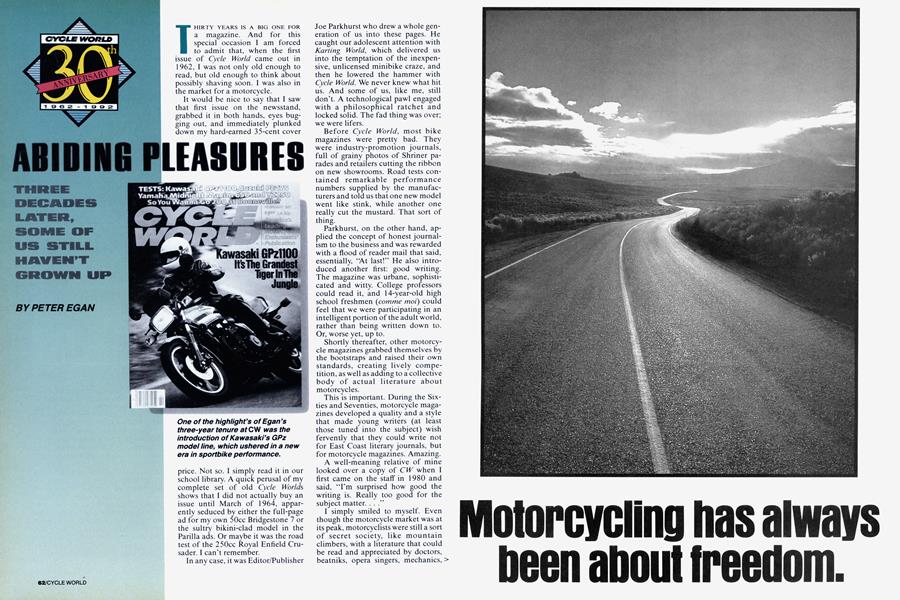
I bought a Kawasaki KZ550 and roadraced it all summer, then took the numbers off and toured northern Baja, two-up. In 1981, Kawasaki re placed the KZ with its GPz55O and also introduced the GPz1 100, which we labeled "The Grandest Tiger in the Jungle" on our cover. These bikes had triple disc brakes, small fairings, relatively flat "sport bend" handlebars and striking red paint with silver and blue stripes. They were the harbingers of a whole new generation of roadracers for the street, the beginning of a movement toward the specialized Japanese sportbikes we have today.
What else? Ah, yes, the Japanese cruiser phenomenon. In 1980, the cruisers, or "specials," were just be ginning to appear. Some staff mem bers were ambivalent about these bikes~ others of us didn't want to be seen on them, and racked up our test miles at night. It wasn't the cruiser seating position that bothered us so much as the phony styling touchesglitz without substance, shape unre lated to function. Nevertheless, we took a "to each his own" approach and bent over backward to test these bikes fairly, and grudgingly admitted that some of them worked pretty well. At least they did at night. I per sonally can't speak for the daytime.
And what of American bikes? What were the Harley-Davidson guys up to in the early Eighties? Well, they were working on it. During the Sev enties, they'd developed a terrible reputation for unreliability and poor quality control, and were trying to re cover their good name-literally (from AMF) and figuratively. I did a touring story in which my wife Bar bara and I rode a 1981 FLH Heritage up the West Coast on Highway 1 and back. I loved the look and character of the bike, but engine vibration shook the floorboards apart and caused stress fractures in the engine guards and luggage rack, with only 3000 miles on the bike. We all wanted Harleys to be better than they were, and grew weary of making al lowances. Would Harley-Davidson end up like the British bikes? Loyalty had its limits. There was no way of knowing.
In 1982, 1 went to Japan for the first time, on a Yamaha press trip. They were introducing the 650 Seca, XJ650 Turbo, 550 Vision, 920 Vi rago and 750 Maxim. On a plant tour, we saw the 550 Visions being assembled, then walked out into a vast warehouse where a virtual sea of Visions sat, awaiting shipment. Thousands of them. A very nice, so phisticated little V-Twin, but it had a price just over $3000. That was an expensive 550 at the time. Kawa saki's quicker, more powerful 550 GPz was $500 cheaper. "How are they ever going to sell all these bikes?" I asked anotherjournal ist. `It doesn't seem possible. But I guess they must know what they're doing."
Asit turned out, they didn't.
We were witnessing the end of an era. The Visions didn't sell well. U.S. warehouses remained full of the things, and three years later, you could still buy a brand-new one, for $1300, off the dealer's floor. Many of the Japanese companies overpro duced in the early Eighties, anticipat ing ever-expanding sales that first leveled off, then declined. It sud denly became a buyer's market.
In~1983, about tile time I left Cycle World, I bought a 1980 Kawasaki KZ1000, still brand new in the crate, for $2000. The original 1980 price had been $3400.
Miscalculation of the market, or dumping? In either case, it worked more to the buyer's advantage than to the manufacturer's. All through the Eighties and into the Nineties, motorcycle companies have had to compete with that huge raft of per fectly good, long-lasting UJMs, and many of them are still around.
In order to sell motorcycles to an ever-smaller (but more particular) group of buyers, the Japanese began to specialize, developing the highly refined niche bikes we have today. Too refined, some said, growing jaded with the complexity, cost and ephemeral life span of high-tech mo torcycles. Permanence and simplicity seemed tobe coming back into favor.
Har1ey-Davidson~ meanwhile, got a grip on its own heritage, introduc ing a whole new generation of en gines-the Evolution series-and vastly improving its product quality, offering buyers both reasonable value and a piece of history. Their $3995 Evolution Sportster, intro duced in 1986, may have been the first recorded case of an American product actually being cheaper than
the Japanese copy. And better look ing. The result was an increase in market share and sales, at a time when the industry had fallen into a general funk. And so it remains.
This latter day success story seems to prove three things: (1) Value sells; (2) motorcycling is more than just Science; and (3) you never can tell. Which brings us up to the present. The motorcycle market is smaller now than it was in those halcyon days of the late Seventies. There have been hard adjustments, but the smaller market (we keep telling our selves) may end up being a better one. Growth and quality are not a! ways related. -
bespite all these ups and downs, it's been a fun and fascinating three decades of motorcycling. But even with all the great bikes and good memories, I would never wish myself back into the Sixties, Seventies or Eighties. Why not? Lots of reasons.
First, old bikes, for those of us who want them, are still available now. Many are restored to a better-than new standard. But you couldn't buy today's bikes back then. We have street-legal 600cc sportbikes now that could have won Daytona or the Isle of Man outright when I came to work here in 1980.
Furthermore: Dirtbikes now have real suspension; dual-purpose bikes have finally lost weight; the local bike shop sells street tires that grip better than racing slicks used to, yet still work in the rain; electronic igni tion (even available for Norton Com mandos!) has eliminated the tyranny of the timing wheel and the centrifu gal advance mechanism; Ducatis are still winning races; vintage racing is better than ever; America still has the best roadracers in the world; and Har leys not only don't shake apart any more, but people from Europe and Japan are standing in line waiting to buy them.
And there are at least four new bikes now sitting in local showrooms that I would buy in about one second if I hadn't foolishly told my long-suf fering spouse that we would someday renovate the kitchen.
It's been a long, strange, excellent trip since Joe Parkhurst put out that first copy of the magazine in 1962. But in all those 30 years, the next is sue has always been my favorite. In that continual human need to look over the next hill. see what's around the corner or wait for the other shoe to drop, motorcycles remain the abid ing pleasure.