Journey To World's End
JOURNEY TO WORLD'S END
A far-out ride to central Sri Lanka's Farr Inn
PETER McLENNAN
WITH MY FEET PROPPED up on a white wicker chair and my tired body slumped in another, I was enjoying a quiet evening on the lawn of a vintage hotel in the heart of a tropical paradise. Marco Polo called it “the finest island to sail on any sea,” and, hundreds of years before him, the Chinese had named it “the land without sorrow.“ Today, we call the 41,000-square-mile island, populated by 14 million souls and located off the southern tip of the Indian subcontinent, Sri Lanka.
My wife Dorothy and I were here, aboard a rented Honda CB250, for a second look. Three years earlier, we had toured Sri Lanka on another Honda, an ancient-but-reliable 185 Twin, and now we had returned to see if the best ride of our lives could be bettered.
As I pondered our options from the security of our hotel room, the chorus of sounds from the valley below the hotel and the smells of curry from the kitchen window nearby made it hard to concentrate on my map, and the close warmth of the evening and the effects of my third cold beer were making me drowsy. I was examining a remote portion of central Sri Lanka known as Horton Plains, searching for a likely destination for tomorrow’s ride, when my senses would be back to full alert.
Aha! Here, in the middle of an empty space on the plains, was a spot labeled “World's End." Who could resist visiting a place with a name as tempting as that?
“How about we go to World's End tomorrow?” I called to my wife in the next room.
“Where’s World’s End?” came the vague reply from Dorothy, suffering from a case of the Bike Stupids, a temporary mental deficiency brought
about by too many miles on a toosmall motorcycle.
“It’s only a few kilometers away,” I promised, knowing that another long ride tomorrow would not be approved. “Besides,” I continued, knowing her weakness for wonderful and exotic hotels, “there’s a hotel there called Farr Inn.”
“Far out,” she called. Right answer. It was settled. I set about choosing a route. But I soon discovered that even though Horton Plains was just a few kilometers away, it just wasn't possible to ride from our hotel in the city of Haputale to World’s End and back in a day. The mountain terrain of central Sri Lanka is so complex that two places just a few miles apart, as the crow flies, may be several hours apart by road.
According to the map, Farr Inn can only be reached by road if you turn hard-left at a place called Agrapatna. But before that, you have to find Bandarawala and Nanu Oya, and Pattipola, and maybe even Nuwara Eliya (the map folded just there, and it was hard to read). Even assuming we found all these places, and managed to locate Agrapatna, our best possible ETA at World's End would be long after lunch, and it wouldn't do to reach The End on an empty stomach. Besides, there was no guarantee the inn would be open, much less ready to accommodate foreign motorcyclists, so it was important that we be able to return to Haputale before nightfall.
Enter the Aussies. Jack and Sandra were well acquainted with the district, having explored it for months by Jeep. After dinner, we explained our problem to them over several bottles of Swan Lager.
“It’s a piece of cake, mate,” said Jack, “There’s a beaut road to Horton Plains and World's End from a place called Ohiya, and that’s just a few miles from here. Once you're up on the plains it's just a few miles to Farr Inn. You can make it there and back easily in a day, 'specially on a motorcycle.”
A tiny alarm sounded in the back of my mind as I recalled that their vehicle was a four-wheel-drive machine, and I wondered why people assume that motorcycles always travel over impossible terrain at just under the speed of light. But Jack was a sensible sort, and he did seem to know the countryside well, so I put aside my doubts and agreed to try his route.
"It should be easy for you two, especially on a motorcycle."
Later, we examined the map carefully. and eventually found the dot on the map labelled Ohiya. No roads joined the village to the rest of the world. Ohiya was a railway station.
“Yes. well it is a rail line, mate," said Jack, when I asked for more details. “Just look for the Ohiya road near the military base at Diyatalawa, and once you make the train station, you're fine, 'cause there's a bloody great sign on the platform. ‘Farr Inn 3 Miles.' it says. You can't miss it." Jack said.
Of course we could. Several times. Matter of fact, it took us nearly until noon just to lind Ohiya station, because we kept making wrong turns at the naval base. We never did find out why there was a Sri Lankan Navy base at 4300 feet, though eventually we did find the road to Ohiya. But not until we had visited the terminus of several long and winding dead ends, and amazed the populace of three or four villages not found on anv map. did we find the sleepy railway station and the sign.
Á decaying piece of board nailed to a convenient tree just off the station platform promised in faded letters “Farr Inn 6 Miles.” A narrow thread of road disappeared into the jungle. At last! The backroad to World's End.
We had little time to waste. We bought some fruit from a vendor whose premises happened to be a large tree, made a quick check of the bungee cords, and plunged into the blessed cool of the forest.
From Ohiya. the road got steadily worse. What had been a pleasant country road, twisting and winding its way through the hills and rice paddies, now turned straight up a sheer mountain face. Instead of gently winding, the road began to /ig-/ag wi 1 d 1 \ in an endless series of hairpin turns as it struggled to gain altitude.
As the civilized world receded quicklv below us. the forest soon began to change. Dense grov es of leafy trees, huge ferns and thickets of bamboo soon gave wav to sweet-smelling gum trees, stands of dwarf conifers and gnarled rhododendron bushes 30 feet high. Cool mists swirled around us, great clumps of moss covered the ground and exotic orchids grew in the tree limbs. We had entered an eerie fairytale land where the only sound was the steady beat of the little Honda battling its way, in second gear, onto the very top of this tropical world.
ii "With little traction and no power to spare, forward momentum had to be hoarded like gold.”
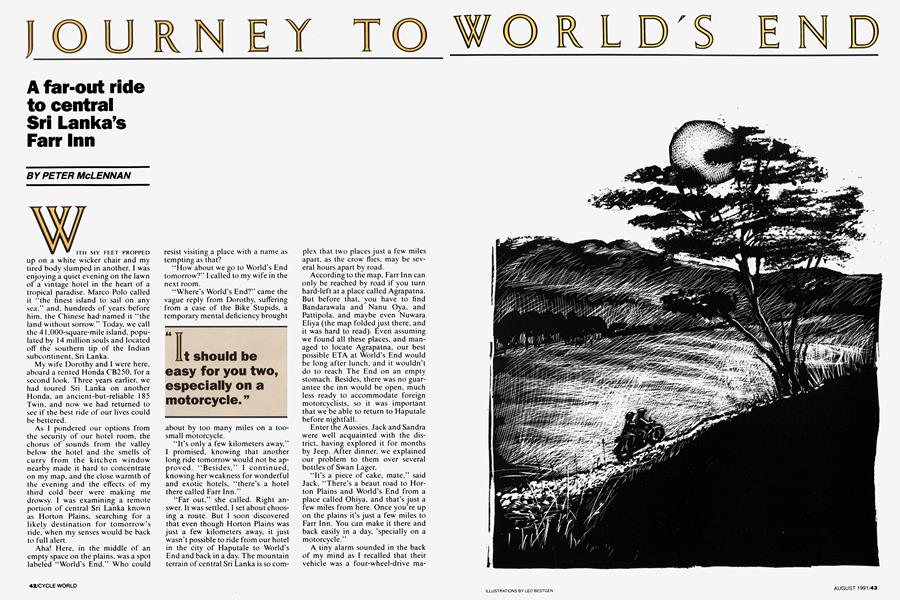
The road surface became more and more broken, and the already narrow track of pavement finally ceased to exist altogether. Now. we labored upa tiny dirt track littered with rocks and gravel, and cut every few feet by dry stream beds. Our rented motorcycle, already overloaded with two people and all our baggage, was beginning to feel the effects of altitude sickness.
l imes like this are a challenge to both man and machine. No, make that man. woman and machine. With a steep grade, a heavy load, hairpin corners, little traction and no power to spare, momentum becomes a resource to be hoarded like gold. Once lost, forward speed is nearly impossible to regain, and when we eventually wound down to the bottom of first gear, it became necessary to lighten the load. Priorities being what they were, the first thing to go was the passenger, who would have to hike this steep, rough section.
As I watched Dorothy’s tiny image receding in the mirrors as she trudged up the road in my dusty wake, it occurred to me that 6000 feet up a mountain in tropical Asia was as good, or as bad, a place as any to leave one’s wife.
But my smugness was short-lived, for soon I w'as walking, too, the road so rough and steep that I had no choice but to run along beside the bike, struggling to keep the power on and the machine aimed in the general direction of uphill.
The region's monsoons had beaten thejungle in their race to reclaim this road and. in its losing end of the battle, the road had become a watercourse paved with loose gravel and strewn with rocks as big as footballs. Soon, it became just too much work to go on.
Leaving the Honda to cool for a bit. I walked ahead a few corners, just to see if it could possibly get any worse. Picking my way through the boulder field, I was amazed to see the route begin to level off and the familiar two ruts of civilization emerge once more. Other vehicles had passed this way. And so would we. I returned to the bike, where Dorothy was busy devouring a piece of fruit, and voiced a firm resolve to push on.
Ten minutes later, we were riding across the moors of northern Scotland, or so it appeared. We were on top of Horton Plains. Wide vistas of gray-brown hills strewn with clumps of low, scrubby trees opened up around us. The air had become cold, and the sky an impossibly dark shade of blue. Low, fast-moving clouds hid the sun. and we were soon chilled by the biting wind. As we fumbled to pull on our sweaters, it seemed impossible that just an hour ago we were sweltering in T-shirts.
We soon located Farr Inn, not too difficult a task, since it's the only building on Horton Plains. What we found, to our amazement, was a rambling white structure with leaded glass windows, oak doors, highbeamed ceilings and a perfect English country garden. It seemed strange, to say the least, to find this 19th-century manor house on a remote plateau in the midst of a tropical jungle, but we learned that it had been built more than a century earlier by English tea-estate owners who found that the landscape reminded
"I wondered why people always assume that motorcycles travel over impossible terrain at just under the speed of light.”
them of their distant home.
Like most hotels run by the Ceylon Tourist Board, Farr Inn offers excellent value in both room and board. The staff graciously accommodated our late arrival by serving us a delicious lunch, taking little notice of our bedraggled appearance.
As we had feared, the hotel was fully booked, so we had only a quick peek at a couple of the five rooms, but it was obvious that the original owners had* spared no expense in recreating their bit of England. The rooms were spacious, immaculately kept and, at about $12 per night, in-
eluding breakfast, real bargains.
To complete the Old England image, the inn was located at the intersection of four tiny paths, and the crossroads was attended by a large stone signpost. Two of the roads led to villages in the outside world, and were so marked on the sign. A third side, indicating the way we had come, w'as simply blank. But the fourth side said “WORLD’S END: 2km.” We were nearly there.
Actually, we found that there are two World's Ends: Big World's End and Little World's End. both of them steep escarpments where the plateau drops off suddenly to the coastal plains thousands of feet below. But the reality of standing there defies a simple geographic description. There are no signs, no safety barriers, no hawkers selling programs, no other people, just a gentle grassy meadow that ends abruptly with a 1000-foot cliff and a spectacular view of hundreds of square miles of paradise.
World’s End is, suitably, a quiet place, so quiet that in straining to hear the sounds of the jungle far below, you find yourself listening to the sounds of your own pulse, so quiet that if you hold your breath.
you can hear the w ing beats of living birds.
We stood there for half an hour or so, reluctant to leave this peaceful scene for the realities of the long ride home, and, as 1 began to walk back to the motorcycle, Dorothy called me back to the edge of the precipice for one last look.
From this strategic position, a large part of the southern island is visible, and there, thousands of feet below, she had found a tiny village. It was Belihul Oya, another tiny dot on the map, where several days before we had spent the night. In the early morning, w'e had stood gazing up at the high cliffs above that village, wondering what w'as up there, wondering if we eould climb them, just to see the view.
It was now late afternoon, and the thought of a hot meal back at our hotel drew us reluctantly away from the precipice. The ride back to Haputale was short and uneventful. We took the well-marked main road off the plateau and back down into the perpetual springtime of the mid altitudes, and w'ere sipping beers in the wicker chairs with Jack and Sandra in a couple of hours.
“You know.” mused Jack, as we gazed out over the lush valley, “there’s a beaut Buddhist temple ruin off to the south a pieee. Couple a thousand years old. at least. Not exactly sure of the road, mind, but it should be easy enough for you two, ’specially on a motorcycle.”
Hmm. Tempting. Now. where’s the map? ¡a
"I had no choice but to run alongside the bike, struggling to keep the power on and the machine aimed uphill.'”
Editor's Note: Peter McLennan is a film maker and cameraman from Vancouver, B.C., who, along with his wife, spends his vacations in exotic places on rented motorcycles. This article is his second story for Cycle World. His first, ”For the Ride, " appeared in the January, 1991, issue. Since McLennan went to Sri Lanka, some changes have occured that travelers to that island country should be aware of. The U.S. State Department warns that conditions in the north and east are unsettled and volatile due to continuing civil war involving the Sri Lankan military and the Eelam Tigers, a Tamil separatist group. The state department advises against travel outside Colombo, the Sri Lankan capital city, after dark, but says that conditions in the center and south of the island are generally calm, though the possibility of terrorism in those areas can V be overlooked.