The First American Customs
THE FIRST AMERICAN CUSTOMS
It all started with something called a California Bobber
LIKE JAZZ, MARILYN MONROE and chicken-fried steak, custom motorcycles are a peculiarly American art form.
No less a literary potentate then Tom Wolfe, he of the recent bestseller The Hon fire of the Vanities. and before that The Right Stuff and The Electric Kool-Aid Acid Test, once turned his writing skills loose on choppers—those raked-out, metal-flake creations with sissy bars and
exhaust pipes that reached for the clouds—especially popular in the early 1970s following release of the movie Easy Rider. In a 197 I essay that appeared in Esquire magazine. Wolfe saw the customizing of motorcycles as a legitimate branch of the art world, saying. ** . . . the chopper builders have brought Kinetic Art to an ideal state. They have not only unified the mechanism and the design—they have also created a piece of sculpture that the artist, or the spectator, for that matter. can get up on and ride... and thereby experience the motion, the very ‘kinetics' of the Kinetic Art himself» in the utmost weird and hairy way."
Custom motorcycles didn't begin with Peter Fonda and Dennis Hopper. though, and certainly won't end with Arlen Ness' magnificent “Big Red" seen on the previous pages. To find the genesis of the American custom motorcycle, we have to go back to the late 1930s and early '40s. and to the young men who. in a few short years. would be manning the front lines of a war that engulfed the world. Fora time, though, with the country coming out of The Great Depression and with Pearl Harbor jusf another naval base somewhere in the Pacific. there was time for some fun.
Art Bishop remembers those times. Now a gas-company official in his 60s. he serves as vice-president of the San Diego Automotive Museum and president of the San Diego Antique Motorcycle Club. Before the war. neither he nor his riding buddies knew that by modifying their Harley-Davidson 6Is and 45s they were setting a styling trend. They were sinvply after increased performance.
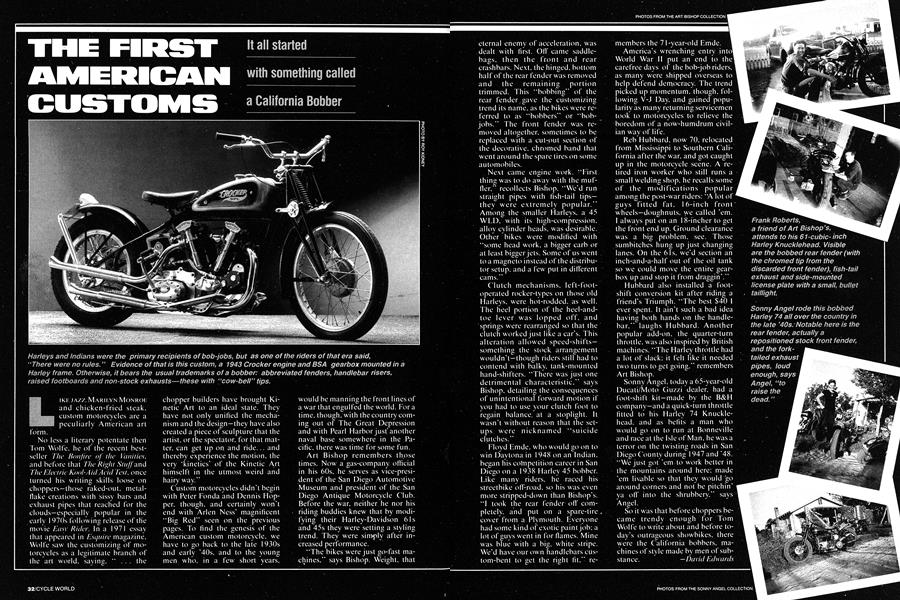
“The bikes were just go-fast machines.” says Bishop. Weight, that eternal enemy of acceleration, was dealt with first. Off came saddlebags. then the front and rear crashbars. Next, the hinged, bottom half of the rear fender was removed and the remaining portion trimmed. This “bobbing" of the rear fender,gave the customizing trend its name, as the bikes were referred to as “bobbers" or “bobjobs." The front fender was removed altogether, sometimes to be replaced with a cut-out section of the decorative, chromed band that went around the spare tires on some automobiles.
Next came engine work. “First thing was to do away with the muflier." recollects Bishop. “We'd run straight pipes with fish-tail tips— they were extremely popular." Among the smaller Harlevs. a 45 WLI). with its high-compression, alloy cylinder heads, was desirable. Other bikes were modified with “some head work, a bigger carb or at least bigger jets. Some of us went to a magneto instead of the distributor setup, and a few put in different cams."
Clutch mechanisms, left-footoperated rocker-types on those old Harleys, were hot-rodded, as well. The heel portion of the heel-andtoe lever was lopped off. and springs were rearranged so that the clutch worked just like a car's. This alteration allowed speed-shifts— something the stock arrangement wouldn't—though riders still had to contend with balky, tank-mounted hand-shifters. “There was just one detrimental characteristic." says Bishop, detailing the consequences of unintentional forward motion if you had to use your clutch foot to regain balance, at a stoplight. It wasn't without reason that the setups were nicknamed “suicide clutches."
Floyd Emde. who would go on to win Daytona in 1948 on an Indian, began his cohi petit ion career in San Diego on a 1938 Harley 45 bobber. Like many riders, he raced his streetbike off-road, so his was even more stripped-down than Bishop's. “I took the rear fender off completely. and put on a spare-tire cover from a Plymouth. Everyone had some kind of exotic paint job: a lot of guys went in for flames. Mine was blue with a big. white stripe. We'd have our own handlebars ciístom-bent to get the right fit." remembers the 71-year-old Emde.
America's wrenching entrv in World War II put an end to the carefree days of the bob-job riders, as many were shipped overseas to help defend democracy. The trend picked up momentum, though, following V-.l Day. and gained popularity as many returning servicemen took to motorcycles to relieve the boredom of a now-humdrum civilian wav of life.
J
Reb Hubbard, now 70. relocated from Mississippi to Southern California after the war. and got caught up in the motorcycle scene. A retired iron worker who still runs a small welding shop, he recalls some of the modifications popular among the post-war riders: “A lot of guys fitted fat. 16-inch front' wheels—doughnuts, we called 'em.
I always put on an 18-incher to get the front end up. Ground clearance was a big problem, see. Those sumbitches hung up just changing lanes. On the 61s. we'd section an inch-and-a-half out of the oil tank so we could move the entire gearbox up and stop it from draggin'."
Hubbard also installed a footshift conversion kit after riding a friend's Triumph. “The best $40 1 ever spent. It ain't such a bad idea having both hands on the handlebar." laughs Hubbard. Another popular add-on. the quarter-turn throttle, was also inspired by British machines. “The Harley throttle had a lot of slack: it felt like it needed two turns to get going." remembers Art Bishop.
Sonny Angel, today a 65-year-old Ducati/Moto Guzzi dealer, had a loot-shift kit—made by the B&H company—and a quick-turn throttle fitted to his Harley 74 Knucklehead, and as befits a man who would go on to run at Bonneville and race at the Isle of Man, he was a terror on the twisting roads in San Diego County during 1947 and '48. “We just got 'em to work better in the mountains around here: made 'em livable so that they would go around corners and not be pitchin' ya off into the shrubbery." says Angel.
So it was that before choppers became trendy enough for Tom Wolle to write about and before today's outrageous showbikes. there were the California bobbers, machines of style made by men of substance.
David Edwards
More From This Issue
-
 Up Front
You Meet the Nicest People...
January 1991 -
 At Large
Legacy of the Hustler
January 1991 -
 Leanings
The Gold Wing From Red Wing
January 1991 -
Letters
Letters
January 1991 -
 Roundup
Euro-Enduros: the Rally Rage Rolls On
January 1991 -
Roundup
Yamaha's New Approach: Buy A Bike, Get Insurance As Part of the Package
January 1991