You Meet the Nicest People...
You meet the nicest people...
UP FRONT
David Edwards
MOTORCYCLES, THE MACHINES, ARE held together with simple nuts and bolts, but motorcycling, the sport, is bound together by something as complex as the human spirit.
Just why certain people are drawn to machines so illogical that they’ll fall over without some manner of prop stand is a mystery, but as the poet Matthew Arnold—who would have gone on to ride an Earles-fork BMW. I'm sure, had he not had the bad luck to die in 1 858—once wrote: We cannot kindle when we will The fire that in the heart resides,
The spirit bloweth and is still.
In mystery our soul abides This past month, I had the opportunity to spend time with several motorcyclists whose hearts are ablaze with enthusiasm for the sport, whose spirits are in no danger of being extinguished.
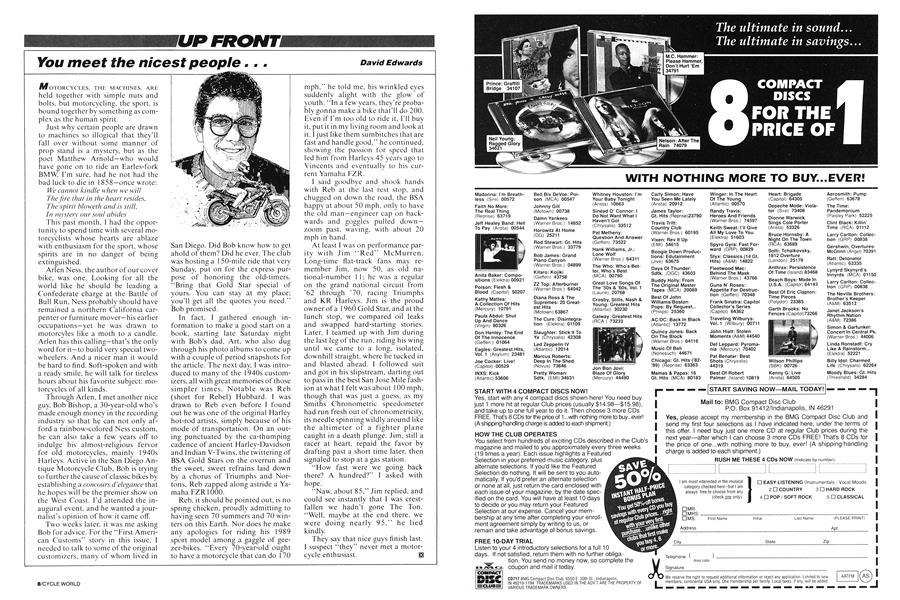
Arlen Ness, the author of our cover bike, was one. Looking for all the world like he should be leading a Confederate charge at the Battle of Bull Run, Ness probably should have remained a northern California carpenter or furniture mover—his earlier occupations—yet he was drawn to motorcyles like a moth to a candle. Arlen has this calling—that’s the only word for it —to build very special twowheelers. And a nicer man it would be hard to find. Soft-spoken and with a ready smile, he will talk for tireless hours about his favorite subject: motorcycles of all kinds.
Through Arlen, I met another nice guy. Bob Bishop, a 30-year-old who’s made enough money in the recording industry so that he can not only afford a rainbow-colored Ness custom, he can also take a few years off to indulge his almost-religious fervor for old motorcycles, mainly 1940s Harleys. Active in the San Diego Antique Motorcycle Club, Bob is trying to further the cause of classic bikes by establishing a cont ours d'elegance that he hopes will be the premier show on the West Coast. I’d attended the inaugural event, and he wanted a journalist’s opinion of how it came off.
Two weeks later, it was me asking Bob for advice. For the “First American Customs” story in this issue, I needed to talk to some of the original customizers, many of whom lived in San Diego. Did Bob know how to get ahold of them? Did he ever. The club was hosting a 1 50-mile ride that very Sunday, put on for the express purpose of honoring the old-timers. “Bring that Gold Star special of yours. You can stay at my place; you'll get all the quotes you need.” Bob promised.
In fact, I gathered enough information to make a good start on a book, starting late Saturday night with Bob’s dad. Art, who also dug through his photo albums to come up with a couple of period snapshots for the article. The next day, I was introduced to many of the 1940s customizers, all with great memories of those simpler times. Notable was Reb (short for Rebel) Hubbard. I was drawn to Reb even before I found out he was one of the original Harley hot-rod artists, simply because of his mode of transportation. On an outing punctuated by the ca-thumping cadence of ancient Harley-Davidson and Indian V-Twins, the twittering of BSA Gold Stars on the overrun and the sweet, sweet refrains laid down by a chorus of Triumphs and Nortons, Reb zapped along astride a Yamaha FZ.RI000.
Reb. it should be pointed out, is no spring chicken, proudly admitting to having seen 70 summers and 70 winters on this Earth. Nor does he make any apologies for riding his 1989 sport model among a gaggle of geezer-bikes. “Every 70-year-old ought to have a motorcycle that can do 170 mph,” he told me, his wrinkled eyes suddenly alight with the glow of youth. “In a few years, they’re probably gonna make a bike that’ll do 200. Even if I’m too old to ride it. I’ll buy it, put it in my living room and look at it. I just like them sumbitches that are fast and handle good,” he continued, showing the passion for speed that led him from Harleys 45 years ago to Vincents and eventually to his current Yamaha FZR.
I said goodbye and shook hands with Reb at the last rest stop, and chugged on down the road, the BSA happy at about 50 mph, only to have the old man—engineer cap on backwards and goggles pulled down — zoom past, waving, with about 20 mph in hand.
At least I was on performance parity with Jim “Red” McMurren. Long-time flat-track fans may remember Jim, now 50. as old national-number 1 1; he was a regular on the grand national cireuit from '62 through ’70, racing Triumphs and KR Harleys. Jim is the proud owner of a 1 960 Gold Star, and at the lunch stop, we compared oil leaks and swapped hard-starting stories. Later, I teamed up with Jim during the last leg of the run, riding his wing until we came to a long, isolated, downhill straight, where he tucked in and blasted ahead. I followed suit and got in his slipstream, darting out to pass in the best San Jose Mile fashion at what I felt was about 100 mph, though that was just a guess, as my Smiths Chronometrie speedometer had run fresh out of chronometricity, its needle spinning wildly around like the altimeter of a fighter plane caught in a death plunge. Jim, still a racer at heart, repaid the favor by drafting past a short time later, then signaled to stop at a gas station.
“How fast were we going back there? A hundred?” I asked with hope.
“Naw, about 85,” Jim replied, and could see instantly that I was crestfallen we hadn't gone The Ton. “Well, maybe at the end there, we were doing nearly 95,” he lied kindly.
They say that nice guys finish last.
I suspeet “they” never met a motorcycle enthusiast. E2
More From This Issue
-
 At Large
Legacy of the Hustler
January 1991 -
 Leanings
The Gold Wing From Red Wing
January 1991 -
Letters
Letters
January 1991 -
 Roundup
Euro-Enduros: the Rally Rage Rolls On
January 1991 -
Roundup
Yamaha's New Approach: Buy A Bike, Get Insurance As Part of the Package
January 1991 -
Roundup
Great Beemer Hunt
January 1991