Elefant Over Africa
ELEFANT OVER AFRICA
What's a rally bike really like?
Most races are just races—nothing more. But the ParistoDakar Rally is a phenomenon w ith boundaries that extendfar beyond the course itself. The rally 's image is so pow erful that it influences w hat manufacturers on the other side of the world build, and what riders on different continents ride.
Kawasaki's new Tengai is a tribute to that race. While nobody will claim that the Tengai, or any other production bike, is a legitimate Paris-Dakar racer, there's no denying that this new class of streetbikes owes its very existence to the rally. Just how different the production machines are from their racing counterparts is privileged information, known to few besides the elite who have actually ridden the rally. But, months before the start of this year's race. Israeli motojournalist Tal Shavit went to Varese, Italy, to ride the
1989 Cagiva Lucky Explorer, a bike almost identical to the
1990 version that Edi Orioli rode to victory last January. In the process, Shavit learned how serious true rally bikes are. And he also gained some insight into what it takes to be a Paris-Dakar rider.
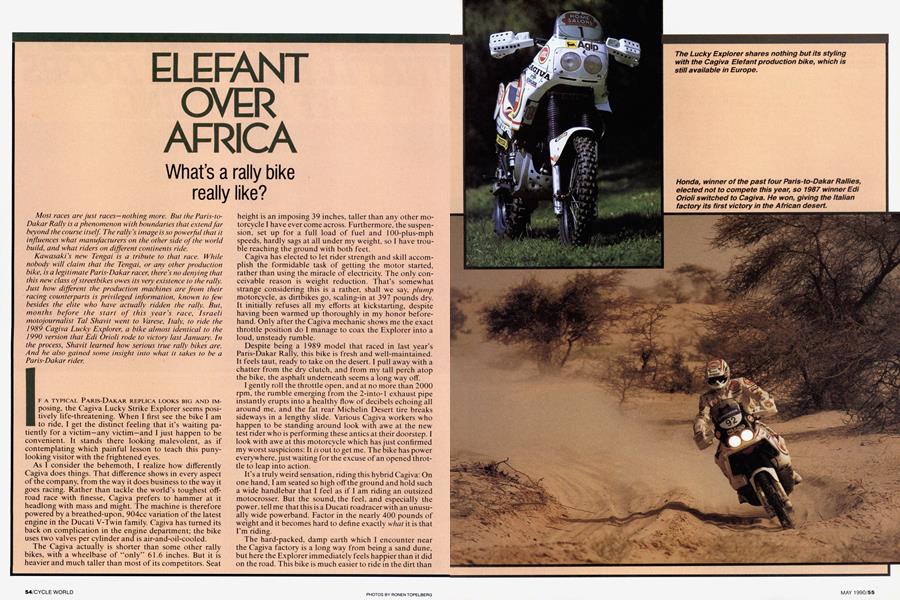
IF A TYPICAL PARIS-DAKAR REPLICA LOOKS BIG AND IMposing, the Cagiva Lucky Strike Explorer seems positively life-threatening. When I first see the bike I am to ride, I get the distinct feeling that it’s waiting patiently for a victim—any victim—and I just happen to be convenient. It stands there looking malevolent, as if contemplating which painful lesson to teach this puny-looking visitor with the frightened eyes.
As I consider the behemoth, I realize how differently Cagiva does things. That difference shows in every aspect of the company, from the way it does business to the way it goes racing. Rather than tackle the world's toughest offroad race with finesse, Cagiva prefers to hammer at it headlong with mass and might. The machine is therefore powered by a breathed-upon, 904cc variation of the latest engine in the Ducati V-Twin family. Cagiva has turned its back on complication in the engine department; the bike uses two valves per cylinder and is air-and-oil-cooled.
The Cagiva actually is shorter than some other rally bikes, with a wheelbase of “only” 61.6 inches. But it is heavier and much taller than most of its competitors. Seat height is an imposing 39 inches, taller than any other motorcycle I have ever come across. Furthermore, the suspension, set up for a full load of fuel and 100-plus-mph speeds, hardly sags at all under my weight, so I have trouble reaching the ground with both feet.
Cagiva has elected to let rider strength and skill accomplish the formidable task of getting the motor started, rather than using the miracle of electricity. The only conceivable reason is weight reduction. That’s somewhat strange considering this is a rather, shall we say, plump motorcycle, as dirtbikes go, scaling-in at 397 pounds dry. It initially refuses all my efforts at kickstarting, despite having been warmed up thoroughly in my honor beforehand. Only after the Cagiva mechanic shows me the exact throttle position do I manage to coax the Explorer into a loud, unsteady rumble.
Despite being a 1989 model that raced in last year’s Paris-Dakar Rally, this bike is fresh and well-maintained. It feels taut, ready to take on the desert. I pull away with a chatter from the dry clutch, and from my tall perch atop the bike, the asphalt underneath seems a long way off.
I gently roll the throttle open, and at no more than 2000 rpm, the rumble emerging from the 2-into-l exhaust pipe instantly erupts into a healthy flow of decibels echoing all around me, and the fat rear Michelin Desert tire breaks sideways in a lengthy slide. Various Cagiva workers who happen to be standing around look with awe at the new test rider who is performing these antics at their doorstep. I look with awe at this motorcycle which has just confirmed my worst suspicions: It is out to get me. The bike has power everywhere, just waiting for the excuse of an opened throttle to leap into action.
It’s a truly weird sensation, riding this hybrid Cagiva: On one hand, I am seated so high off the ground and hold such a wide handlebar that I feel as if I am riding an outsized motocrosser. But the sound, the feel, and especially the power, tell me that this isa Ducati roadracer with an unusually wide powerband. Factor in the nearly 400 pounds of weight and it becomes hard to define exactly what it is that I’m riding.
The hard-packed, damp earth which I encounter near the Cagiva factory is a long way from being a sand dune, but here the Explorer immediately feels happier than it did on the road. This bike is much easier to ride in the dirt than a Honda Transalp or a Cagiva Elefant or any other big, street-legal rally replica. The Explorer carries much of its weight on the front wheel, which not only helps the front end feel secure in turns, but also makes sliding the rear wheel a simple matter of opening the right twistgrip. I soon find myself performing long, feet-up drifts with complete confidence.
But the Explorer is less stable in a straight line. Cagiva obviously attempted to improve the bike’s low-speed maneuverability through a (relatively) short wheelbase and (relatively) quick steering geometry. For the slower special stages in the P-D Rally, the team further enhances responsiveness by fitting a 19-inch front wheel in lieu of the usual 21-incher.
As you’d expect on a hefty bike that goes tearing across unfamiliar terrain, the Explorer’s suspension components are first-rate. The rear is hoisted up by a linkage-mounted Öhlins shock, and in front, a brawny, 45mm Marzocchi fork performs suspension duty. Both ends provide more than 1 1 inches of wheel travel, but I have to confess that I simply could not push the bike hard enough in the hemmed-in Italian countryside to get the suspension working: The Cagiva’s fork and shock are sprung more than a little on the rigid side. Of course, this is what I expected an un-topped-off rally bike to feel like. With its two fuel tanks full, the bike would weigh almost 100 pounds more, and use up more of its travel, though 1 doubt if the word “compliant” could ever be applied to the Explorer's suspension.
Still, it's the Cagiva's engine that hogs the spotlight. Even though other rally bikes are much more technologically sophisticated, the Explorer is the fire-breather of the crowd. With around 85 horsepower (the exact figure is a secret), the Explorer had more power than any other bike entered in the 1989 rally. And that horsepower edge finally paid off this year. The bike that Edi Orioli won on is said to be almost identical to the veteran I rode. According to some rumors, it actually produces less peak power than the 1989 version, but is blessed with even more torque, and it's said to have lower overall weight and a lower center of gravity. Armed with such a formidable weapon. Cagiva might well have accomplished more than the winning of a single race this year. The company just may have opened a new, and very long, chapter in the Paris-Dakar legacy. -Tal Shavit