Suzuki Bandit
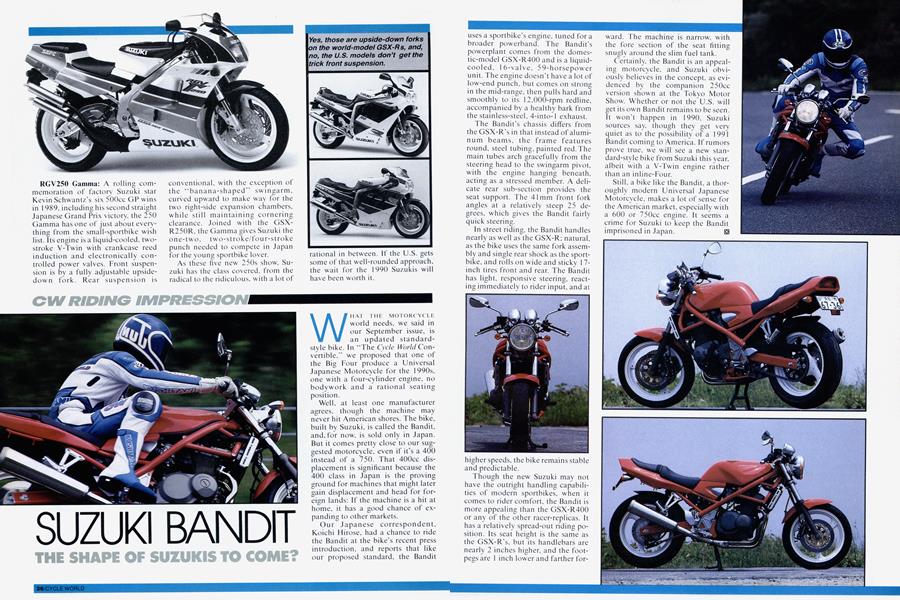
SUZUKI BANDIT
CW RIDING IMPRESSION
THE SHAPE OF SUZUKIS TO COME?
WHAT THE MOTORCYCLE world needs, we said in our September issue, is an updated standard-
style bike. In “The Cycle World Convertible,” we proposed that one of the Big Four produce a Universal Japanese Motorcycle for the 1990s, one with a four-cylinder engine, no bodywork and a rational seating position.
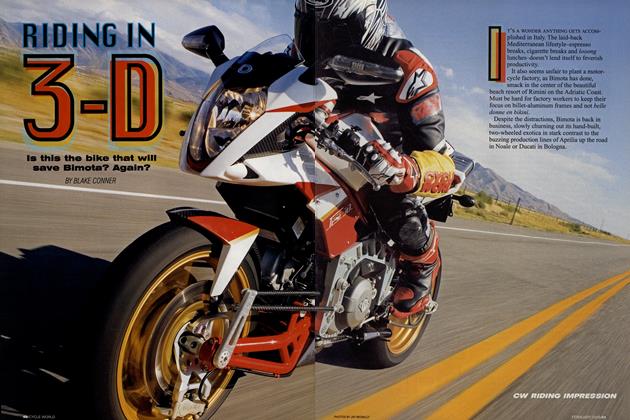
Well, at least one manufacturer agrees, though the machine may never hit American shores. The bike, built by Suzuki, is called the Bandit, and, for now. is sold only in Japan. But it comes pretty close to our suggested motorcycle, even if it’s a 400 instead of a 750. That 400cc displacement is significant because the 400 class in Japan is the proving ground for machines that might later gain displacement and head for foreign lands: If the machine is a hit at home, it has a good chance of expanding to other markets.
Our Japanese correspondent. Koichi Hirose, had a chance to ride the Bandit at the bike’s recent press introduction, and reports that like our proposed standard, the Bandit
uses a sportbike’s engine, tuned for a broader powerband. The Bandit’s powerplant comes from the domestic-model GSX-R400 and is a liquidcooled, 16-valve, 59-horsepower unit. The engine doesn’t have a lot of low-end punch, but comes on strong in the mid-range, then pulls hard and smoothly to its 12,000-rpm redline, accompanied by a healthy bark from the stainless-steel. 4-into-l exhaust.
The Bandit's chassis differs from the GSX-R’s in that instead of aluminum beams, the frame features round, steel tubing, painted red. The main tubes arch gracefully from the steering head to the swingarm pivot, with the engine hanging beneath, acting as a stressed member. A delicate rear sub-section provides the seat support. The 41mm front fork angles at a relatively steep 25 degrees, which gives the Bandit fairly quick steering.
In street riding, the Bandit handles nearly as well as the GSX-R; natural, as the bike uses the same fork assembly and single rear shock as the sportbike, and rolls on wide and sticky 1 7inch tires front and rear. The Bandit has light, responsive steering, reacting immediately to rider input, and at
higher speeds, the bike remains stable and predictable.
Though the new Suzuki may not have the outright handling capabilities of modern sportbikes, when it comes to rider comfort, the Bandit is more appealing than the GSX-R400 or any of the other racer-replicas. It has a relatively spread-out riding position. Its seat height is the same as the GSX-R’s, but its handlebars are nearly 2 inches higher, and the footpegs are 1 inch lower and farther for-
ward. The machine is narrow, with the fore section of the seat fitting snugly around the slim fuel tank.
Certainly, the Bandit is an appealing motorcycle, and Suzuki obviously believes in the concept, as evidenced by the companion 250cc version shown at the Tokyo Motor Show. Whether or not the U.S. will get its own Bandit remains to be seen. It won't happen in 1990, Suzuki sources say, though they get very quiet as to the possibility of a 1991 Bandit coming to America. If rumors prove true, we will see a new standard-style bike from Suzuki this year, albeit with a V-Twin engine rather than an inline-Four.
Still, a bike like the Bandit, a thoroughly modern Universal Japanese Motorcycle, makes a lot of sense for the American market, especially with a 600 or 750cc engine. It seems a crime for Suzuki to keep the Bandit imprisoned in Japan. ®