Kawasaki Kdx125
KAWASAKI KDX125
LONG TERM TEST
A 20-race look at the KDX200's ancestral roots
DO YOU FEEL LUCKY? You'd better if you're buying a new dirt bike. How do you find out about the long-term reliability of a motorcycle that just hit the showrooms, something that'll give you a clue as to how well the machine will hold up and handle its designated tasks?
The answer is rather simple, really: You can’t.
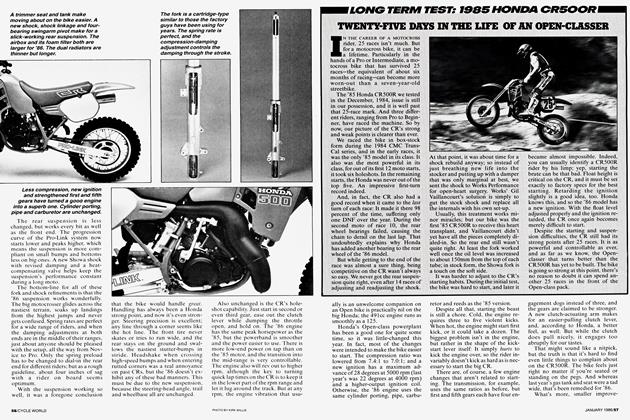
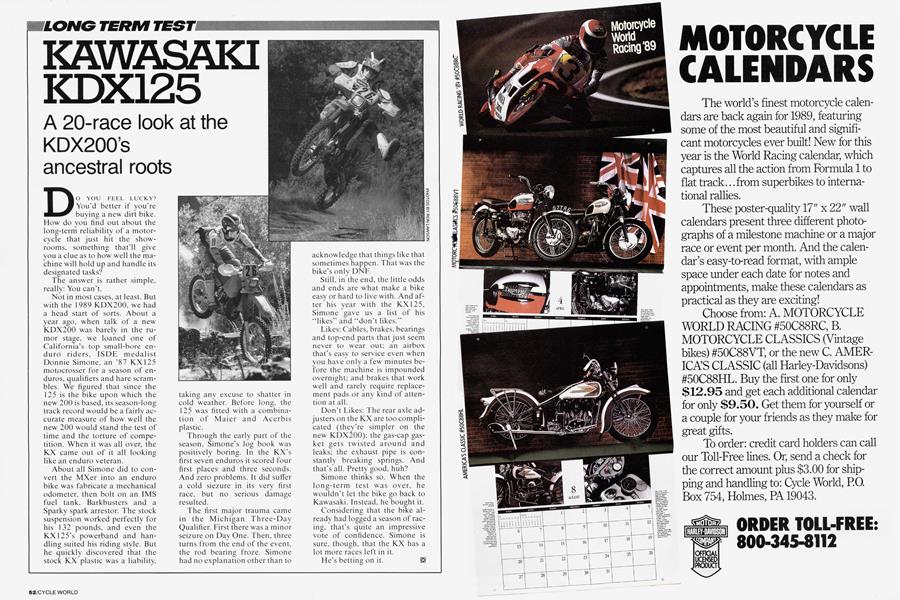
Not in most cases, at least. But with the 1989 KDX200, we had a head start of sorts. About a year ago, when talk of a new KDX200 was barely in the rumor stage, we loaned one of California’s top small-bore enduro riders, ISDE medalist Donnie Simone, an '87 KX125 motocrosser for a season of enduros, qualifiers and hare scrambles. We figured that since the 125 is the bike upon which the new 200 is based, its season-long track record would be a fairly accurate measure of how well the new 200 would stand the test of time and the torture of competition. When it was all over, the KX came out of it all looking like an enduro veteran.
About all Simone did to convert the MXer into an enduro bike was fabricate a mechanical odometer, then bolt on an IMS fuel tank, Barkbusters and a Sparky spark arrestor. The stock suspension worked perfectly for his 132 pounds, and even the KX125’s powerband and handling suited his riding style. But he quickly discovered that the stock KX plastic was a liability,
taking any excuse to shatter in cold weather. Before long, the 125 was fitted with a combination of Maier and Acerbis plastic.
Through the early part of the season, Simone’s log book was positively boring. In the KX’s first seven enduros it scored four first places and three seconds. And zero problems. It did suffer a cold siezure in its very first race, but no serious damage resulted.
The first major trauma came in the Michigan Three-Day Qualifier. First there was a minor seizure on Day One. Then, three turns from the end of the event, the rod bearing froze. Simone had no explanation other than to
acknowledge that things like that sometimes happen. That was the bike’s only DNF.
Still, in the end, the little odds and ends are what make a bike easy or hard to live with. And after his year with the KX125, Simone gave us a list of his “likes” and “don’t likes.”
Fikes: Cables, brakes, bearings and top-end parts that just seem never to wear out; an airbox that’s easy to service even when you have only a few minutes before the machine is impounded overnight; and brakes that work well and rarely require replacement pads or any kind of attention at all.
Don't Fikes: The rear axle adjusters on the KX are too complicated (they’re simpler on the new KDX200); the gas-cap gasket gets twisted around and leaks; the exhaust pipe is constantly breaking springs. And that’s all. Pretty good, huh?
Simone thinks so. When the long-term test was over, he wouldn't let the bike go back to Kawasaki. Instead, he bought it.
Considering that the bike already had logged a season of racing, that’s quite an impressive vote of confidence. Simone is sure, though, that the KX has a lot more races left in it.
He’s betting on it. E3