Doctor's Orders
DOCTOR'S ORDERS
1. ENGINE OIL
Use Mobil 1 synthetic oil. It will give a small power increase at high rpm, with superior lubrication. In four years of racing with Mobil 1, we’ve never had an oil-related failure, and the wear rate has been very low. I drain the oil after every race and practice session, mainly to check for engine parts in the oil, so I don’t have any recommendations for oil-change intervals. Certainly, it doesn’t hurt to change oil as often as every 3000 miles.
2. AIR FILTERS
Use large, foam air filters, which conveniently fit around frame tubes. We use Unifilters, which can be ordered through most shops. They don’t slow our racebike down one mile an hour, and they’ll make your streetbike go faster. You may have to go to onesize-larger main jets.
3. IGNITION
KV Products’ (1060 E. Cypress St., Covina, CA 91724; [818] 967-3786) Dyna 3 or Dyna S ignition systems are simple, dead-reliable and reasonably priced. Both offer an increase in horsepower through stabilization of spark timing. You may also want to fit a KV rev limiter. If you ride fast, you’re going to miss a shift every now and then. A rev limiter is cheaper than replacing a bent valve.
4. EXHAUST SYSTEM
Any four-stroke has a lot of horsepower locked up in its exhaust. European Performance Accessories ( 1302 N. Beverly, Tucson, AZ 85712; [602] 795-8726) sells a stainless-steel, 2into-1 exhaust system for the Le Mans IV. The primary pipes and collectors are exactly like those on our current racebike. The EPA system favors mid-range torque, which is what you need to go fast on a Twin, either on the street or on the track.
5. CARBURETORS
The stock Dell’Ortos work well, but have a heavy throttle pull. Cut a couple of coils from the return springs and fit a Le Mans I throttle, which is actually a Tomaselli part, and a very nice assembly. If you want the best, get Mikuni flat-slide 41.4mm Pro Series carbs from Sudco ( 1824 E. 22nd St., Los Angeles, CA 90058; [213] 747-5173). That’s what the race Guzzi uses. If you go this route, you’ll have to do some rejetting to get the carburetion spot-on.
6. FLYWHEEL
The single most rewarding modification you can perform on a Moto Guzzi is to reduce flywheel inertia. Acceleration improves and clunky gear changes disappear. There are two ways to do this. You can send the stock steel flywheel to Raceco (333 Kent Avenue, Brooklyn, NY 11211; [718] 782-6636) for machining, or you can fit a Swiss-built Transkontinental aluminum flywheel and clutch kit, also available from Raceco. The latter is pricey ($800), but is lighter than the best steel flywheel made. Use brand-new bolts to reinstall the flywheel, no matter which setup you choose.
7. REAR-DRIVE UNIT
Disassemble rear drive and re move the locking tabs that secure the ring-gear bolts. These tabs can crush under heavy loads and cause the ringgear bolts to loosen. Get a set of brand-new bolts and eight new flywheel bolt washers, which are hardened. Reinstall with red or green Loctite and your ring gear will never come loose.
8. CYLINDER HEADS
A good, racing-type valve job will increase the power of any Guzzi by a bunch, and extend valve life, as well. Any race-oriented shop should be able to do the job.
9. PORTING
Do not enlarge the port size of any Le Mans III or IV; if you do, the bike will go slower. Expert reshaping of the ports, however, can increase flow and power by 10 to 15 percent. I recommend Manfred Hecht of Raceco for the work. Manfred and I have collaborated on the cylinder-head preparation for all of our race Guzzis, and he’s gotten it right on every one.
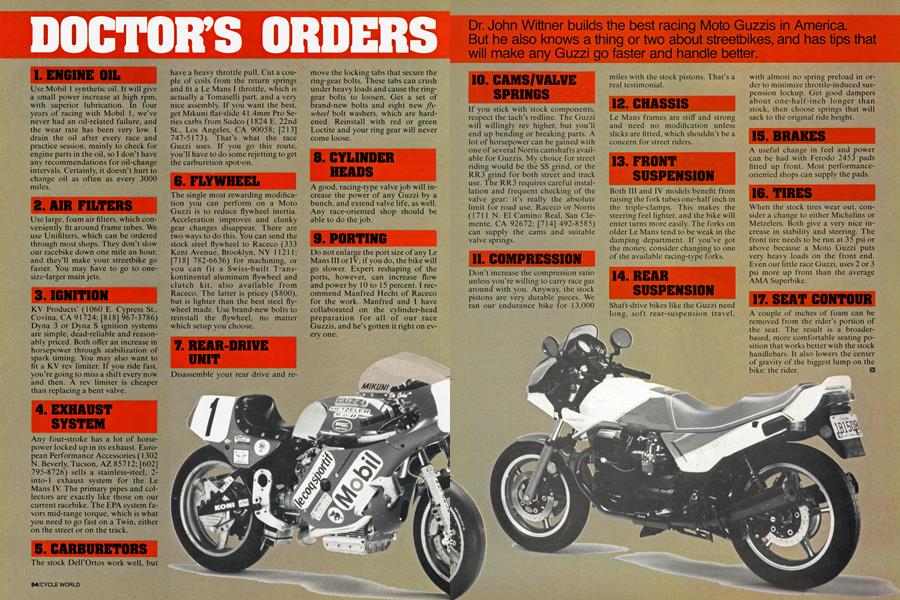
Dr. John Wiftner builds the. best racing Moto Guzzis in America. But he also knows a thing or two about streetbikes, and has tips that will make any Guzzi go faster and handle better.
10. CAMS/VALVE SPRINGS
If you stick with stock components, respect the tach’s redline. The Guzzi will willingly rev higher, but you’ll end up bending or breaking parts. A lot of horsepower can be gained with one of several Norris camshafts available for Guzzis. My choice for street riding would be the SS grind, or the RR3 grind for both street and track use. The RR3 requires careful installation and frequent checking of the valve gear; it’s really the absolute limit for road use. Raceco or Norris (1711 N. El Camino Real, San Clemente, CA 92672; [714] 492-8585) can supply the cams and suitable valve springs.
11. COMPRESSION
Don’t increase the compression ratio unless you’re willing to carry race gas around with you. Anyway, the stock pistons are very durable pieces. We ran our endurance bike for 13,000 miles with the stock pistons. That’s a real testimonial.
12. CHASSIS
Le Mans frames are stiff and strong and need no modification unless slicks are fitted, which shouldn’t be a concern for street riders.
13. FRONT SUSPENSION
Both III and IV models benefit from raising the fork tubes one-half inch in the triple-clamps. This makes the steering feel lighter, and the bike will enter turns more easily. The forks on older Le Mans tend to be weak in the damping department. If you’ve got the money, consider changing to one of the available racing-type forks.
14. REAR SUSPENSION
Shaft-drive bikes like the Guzzi need long, soft rear-suspension travel, with almost no spring preload in order to minimize throttle-induced suspension lockup. Get good dampers about one-half-inch longer than stock, then choose springs that will sack to the original ride height.
15. BRAKES
A useful change in feel and power can be had with Ferodo 2453 pads fitted up front. Most performanceoriented shops can supply the pads.
16. TIRES
When the stock tires wear out, consider a change to either Michelins or Metzelers. Both give a very nice increase in stability and steering. The front tire needs to be run at 35 psi or above because a Moto Guzzi puts very heavy loads on the front end. Even our little race Guzzi, uses 2 or 3 psi more up front than the average AMA Superbike.
17. SEAT CONTOUR
A couple of inches of foam can be removed from the rider’s portion of the seat. The result is a broaderbased, more comfortable seating position that works better with the stock handlebars. It also lowers the center vity of the biggest lump on the ridpr 0