Husqvarna 250 Enduro/ Ktm 250 Enduro
HUSQVARNA 250 ENDURO/ KTM 250 ENDURO
CYCLE WORLD COMPARISON TEST
Battle of the 250 Enduro Survivors
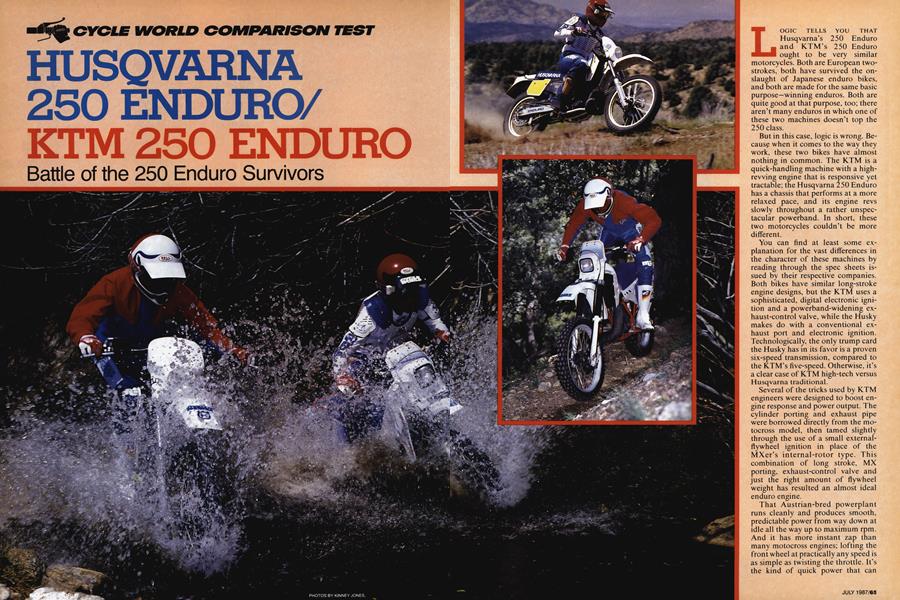
LOGIC TELLS YOU THAT Husqvarna's 250 Enduro and KTM's 250 Enduro ought to be very similar motorcycles. Both are European two-strokes, both have survived the onslaught of Japanese enduro bikes, and both are made for the same basic purpose—winning enduros. Both are quite good at that purpose, too; there aren’t many enduros in which one of these two machines doesn’t top the 250 class.
But in this case, logic is wrong. Because when it comes to the way they work, these two bikes have almost nothing in common. The KTM is a quick-handling machine with a highrevving engine that is responsive yet tractable; the Husqvarna 250 Enduro has a chassis that performs at a more relaxed pace, and its engine revs slowly throughout a rather unspectacular powerband. In short, these two motorcycles couldn’t be more different.
You can find at least some explanation for the vast differences in the character of these machines by reading through the spec sheets issued by their respective companies. Both bikes have similar long-stroke engine designs, but the KTM uses a sophisticated, digital electronic ignition and a powerband-widening exhaust-control valve, while the Husky makes do with a conventional exhaust port and electronic ignition. Technologically, the only trump card the Husky has in its favor is a proven six-speed transmission, compared to the KTM’s five-speed. Otherwise, it’s a clear case of KTM high-tech versus Husqvarna traditional.
Several of the tricks used by KTM engineers were designed to boost engine response and power output. The cylinder porting and exhaust pipe were borrowed directly from the motocross model, then tamed slightly through the use of a small externalflywheel ignition in place of the MXer’s internal-rotor type. This combination of long stroke, MX porting, exhaust-control valve and just the right amount of flywheel weight has resulted an almost ideal enduro engine.
That Austrian-bred powerplant runs cleanly and produces smooth, predictable power from way down at idle all the way up to maximum rpm. And it has more instant zap than many motocross engines; lofting the front wheel at practically any speed is as simple as twisting the throttle. It’s the kind of quick power that can boost the fun on just about any ride.
Usually, however, a quick-revving engine can be a major handicap when riding on slippery hardpack or slimy mud. But these kinds of conditions generally aren’t a problem on the KTM. You just ride the bike a gear higher than normal, which suppresses the engine’s quickness and enhances rear-wheel traction.
And when the going gets tough and tricky, the KTM’s redesigned clutch also adds an extra element of control. Lighter clutch springs make for an easy, two-finger pull, and the clutch action is progressive and grab-free. The 250’s transmission ratios are unchanged for ’87, but the excessive ratio jump from third to fourth that plagued last year’s model is no longer noticeable, thanks to the engine’s wider powerband. And while the jump from fourth to fifth initially seems too great, it isn’t a problem once the engine gets four or five hundred miles on it. The shifting is a tad notchy, however, even though the gearchange mechanism has been redesigned to eliminate missed shifts.
The Husqvarna, on the other hand, shifts smoothly, but its new, long-stroke 250 engine doesn’t offer the flexibility of the KTM motor. The engine climbs meekly off of idle, builds power very gradually as it gets into its mid-range, then briefly delivers a spurt of fairly rapid acceleration in the upper rpm ranges before signing off.
All things considered, it is a rather boring power delivery that lacks any element of excitement. Yes, this kind of slow, progressive power can be a blessing when riding in mud or a wet forest; but under drier conditions, the mild-mannered engine can propel the Husky down the trail at a competitive pace only if the rider keeps it singing in its upper mid-range and constantly shifts to stay near the peak power output.
Thankfully, the Husky’s transmission never balks at such treatment. The clutch, however, is a problem area; it drags and quickly heats up if the bike is stopped in gear, at which point the bike starts creeping forward even with the clutch lever pulled all the way in. And the clutch action is vague and lacks good feel, and the lever must be released a long way before the clutch starts to engage.
What’s more, the Husky’s lazy engine characteristics heavily influence the bike’s general handling. With the engine poking its way along the trail, the Husky chassis feels equally sluggish. Ridden like a madman—the engine buzzing and the transmission changing gears non-stop—the Husky’s handling suddenly seems much quicker. Weaving in and out of the trees becomes easier than a ride at a casual pace would lead you to believe. But even at that, the 250 Enduro handles more like an Openclasser than anything else in the 250 class. Only the feeble power output constantly reminds you that this is no Open bike.
Just the opposite is true of the KTM. It’s cat-quick, to use an overworked metaphor. It leaps over just about any trail challenge with a blip of the wrist. It drives out of corners with a rush. It changes direction instantly and can be pitched around like a 125 motocrosser.
This light, agile feel is no accident; the KTM’s new chrome-moly steel frame features a lowered backbone and subframe, and the main structure is substantially narrower in width at the footpegs compared with last year’s model. The steering head angle is half a degree steeper (27 degrees), the gas tank is placed lower on the frame, and the shock has been moved forward.
Husky’s strong chrome-moly steel frame is much the same as it was last year with the exception of new mounting brackets for the seat, a redesigned gas tank, and revised shocklinkage levers. The 250 frame is shared with the 430 Enduro, which contributes to the big, Open-class feel of the 250. But that isn’t necessarily bad; taller riders usually love the large feel of a Husky.
Suspensions also add their measure of difference to the character of these bikes. The KTM has a White Power fork and shock, which, like past White Power components, work stiffly the first 400 miles or so. After that, they get more compliant with every mile traveled. The rigid, upside-down fork doesn’t flex when diving into sharp gullies or any other off-road nastiness, and it contributes heavily to the KTM’s laser-beam steering precision. Compression and rebound damping rates are close to the mark, and the only complaint voiced by our test riders was a slight front-fork harshness at lower speeds.
Similarly, the KTM’s rear suspension doesn’t start performing up to snuff until well after the initial break-in period. A new leverage ratio, a longer aluminum swingarm and a longer, revalved shock have eliminated the wag and bounce that were evident on the ’86 KTM.
Less break-in time is required for the Husky’s fork and Ohlins shock. The fork is sprung a little softly, but those low-rate springs and new damper rods provide a plush ride over rocks, ruts and other trail obstacles. The Husky fork seldom bottoms, but it does flex somewhat when bashed into sharp bumps, roots or ditches; the Husky also doesn’t have the extra-sharp steering response of the KTM. But these criticisms don’t pose a problem; the Husky goes where it is pointed and does what it is asked.
In the rear, the Husky’s new suspension linkage allows the use of a softer spring and lighter compression valving in the Ohlins shock. These changes result in a smooth, soft ride at low speeds and better control at high speeds. The rear suspension worked well from day one and got better after the shock and linkage seals broke in.
For the first time ever, the KTM has effective, easy-to-operate brakes, thanks to its redesigned disc brakes. There’s a completely new system with a dual-piston caliper at each wheel, with large-diameter, braidedsteel hydraulic brake lines, a front disc with holes instead of massive slots, a rear rotor made of new material, new master cylinders and a redesigned rear brake pedal. All these improvements put the KTM’s brakes on par with those on the best Japanese MX bikes, in both power and ease of use.
Husqvarna’s 6.3-inch drum rear brake, which is part of a lightened hub, stops effectively in the wet or the dry, and provides good feedback. A new fixed front disc rotor and floating caliper greatly increase the stopping power of the Husky so that two fingers will quickly slow the bike from high speeds. Still, the Husky’s front-brake lever requires a slightly harder pull than the KTM’s.
For the most part, these enduro bikes are ready for competition right out of the crate. Both are equipped with enduro lights, and both have a spark arrestor/silencer. A small odometer is standard on the Husky (but a better drive cable is needed; as with every Husky Enduro test bike, ours broke its cable in the first 100 miles), while the KTM odometer is a $76.95 option. Adding the odometer to the KTM boosts its already-steep price to $3666. The Husky goes for almost $400 less at $3275.
Even so, these bikes offer a fairly good value when compared to Japanese machinery; because of the increased value of the yen. European and Japanese motorcycles are closer than ever in price. And there is perceived value in the quality components used on both machines—leading-edge suspensions, good levers and controls, strong frames and wheels, excellent tires and comfortable seats. And just as important, both seem quite durable. A total of six riders recorded over 600 trail miles on each bike during our test, and both machines came away with an excellent reliability record. And that was during a test conducted on terrain that ranged from tight, mountain trails to wide-open desert fastness.
No matter where or how we rode, though, the KTM seemed to generate the most grins. Everyone agreed that it is KTM’s most improved bike in years. So when our riders turned in their ballots, it came as no surprise that all of them voted for the KTM as the best production 250cc enduro bike of 1987. Both bikes give you what you need to excel in enduros; the KTM gives you more of it.
HUSQVARNA 250 ENDURO
KTM 250 ENDURO
$3275
$3666