Harley-Davidson Low Rider Custom Fxlr
HARLEY-DAVIDSON LOW RIDER CUSTOM FXLR
CYCLE WORLD TEST
AN ANNIVERSARY WORTH CELEBRATING
TEN YEARS AGO, AMERICA wasn’t such a different place. Gas cost about a buck a gallon, “Charlie’s Angels” was one of the most popular ways to spend an evening, and AMF Harley-Davidson, the only American motorcycle company, was struggling against stiff Japanese competition. Today, the story hasn’t changed much. Sure, “Charlie’s Angels” has been replaced by “Miami Vice,” and Harley-Davidson is no longer owned by AMF, but the overall picture is about the same.
And it was 10 years ago that Harley-Davidson discovered a new way to compete with the Japanese, a way that’s been working nicely ever since. Harley began to compete by not competing, by offering a product that was distinctly American—the Low Rider. A decade later, the Low Rider is still one of Harley’s best-selling models, and the company is celebrating with a special 10th anniversary edition called the FXLR Low Rider Custom.
Harley calls this Low Rider a custom because the bike is, in essence, the type of motorcycle that many HD owners used to—and still do—build themselves. Never mind that the word “custom” has been continuously abused by being tagged onto all sorts of production motorcycles; the name fits the FXLR to a T. The bike looks like a machine tailored around just one person, even though many of its standard features are things that have appeared on other Harleys in recent times, or that H-D owners have been doing to their bikes for years.
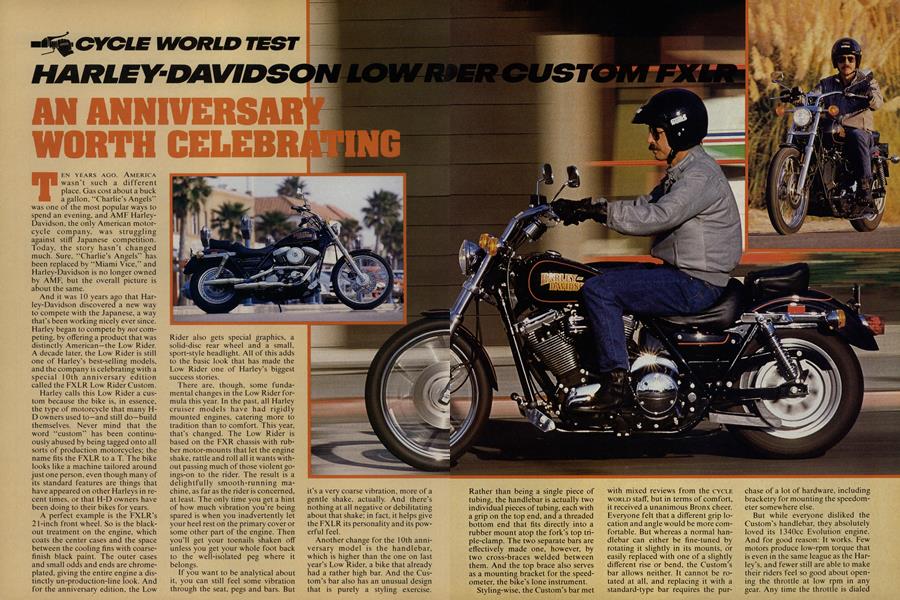
A perfect example is the FXLR’s 21-inch front wheel. So is the blackout treatment on the engine, which coats the center cases and the space between the cooling fins with coarsefinish black paint. The outer cases and small odds and ends are chromeplated, giving the entire engine a distinctly un-production-line look. And for the anniversary edition, the Low Rider also gets special graphics, a solid-disc rear wheel and a small, sport-style headlight. All of this adds to the basic look that has made the Low Rider one of Harley’s biggest success stories.
There are, though, some fundamental changes in the Low Rider formula this year. In the past, all Harley cruiser models have had rigidly mounted engines, catering more to tradition than to comfort. This year, that's changed. The Low Rider is based on the FXR chassis with rubber motor-mounts that let the engine shake, rattle and roll all it wants without passing much of those violent goings-on to the rider. The result is a delightfully smooth-running machine, as far as the rider is concerned, at least. The only time you get a hint of how much vibration you’re being spared is when you inadvertently let your heel rest on the primary cover or some other part of the engine. Then you’ll get your toenails shaken off unless you get your whole foot back to the well-isolated peg where it belongs.
If you want to be analytical about it, you can still feel some vibration through the seat, pegs and bars. But it’s a very coarse vibration, more of a gentle shake, actually. And there’s nothing at all negative or debilitating about that shake; in fact, it helps give the FXLR its personality and its powerful feel.
Another change for the 10th anniversary model is the handlebar, which is higher than the one on last year’s Low Rider, a bike that already had a rather high bar. And the Custom’s bar also has an unusual design that is purely a styling exercise.
Rather than being a single piece of tubing, the handlebar is actually two individual pieces of tubing, each with a grip on the top end, and a threaded bottom end that fits directly into a rubber mount atop the fork’s top triple-clamp. The two separate bars are effectively made one, however, by two cross-braces welded between them. And the top brace also serves as a mounting bracket for the speedometer, the bike’s lone instrument.
Styling-wise, the Custom’s bar met with mixed reviews from the CYCLE WORLD staff, but in terms of comfort, it received a unanimous Bronx cheer. Everyone felt that a different grip location and angle would be more comfortable. But whereas a normal handlebar can either be fine-tuned by rotating it slightly in its mounts, or easily replaced with one of a slightly different rise or bend, the Custom’s bar allows neither. It cannot be rotated at all, and replacing it with a standard-type bar requires the pur-
chase of a lot of hardware, including bracketry for mounting the speedometer somewhere else.
But while everyone disliked the Custom’s handlebar, they absolutely loved its 1340cc Evolution engine. And for good reason: It works. Few motors produce low-rpm torque that is even in the same league as the Harley’s, and fewer still are able to make their riders feel so good about opening the throttle at low rpm in any gear. Any time the throttle is dialed open, the Harley churns forward with booming purposefulness, if not with blinding acceleration. The big VTwin is not an impressive pure performer, especially in the higher rev ranges, which accounts for its so-so quarter-mile numbers. But that doesn't matter. The Harley is one of those bikes content to impress riders with real-world pleasure instead of with performance statistics.
Fact is, the most negative aspect of the Evolution V-Twin is not its performance, but rather its bulk. The engine is one of the widest made, thanks mostly to the massive primary case and its accompanying clutch-bulge. That width results in footpegs that are almost two feet apart-compared to 18 inches on a Yamaha Virago and about 19 inches on a Sportster— which contributes to the bike’s overall feeling of massiveness. And even though the rider’s legs are farther apart than on almost any motorcycle around, a taller rider still will find that his right knee fouls the aircleaner housing.
Thanks to that engine widthalong with the overall lowness of the FXLR’s chassis—you can makt some serious scraping sounds in the turns. On the left side, the kickstand is in danger of going up in sparks any time you get cranked over, and on the right side, the pipes touch first. This scraping rarely comes as a total surprise, though, for you almost have to be trying in order to make something hit the ground.
In fact, you have to be tryingjust to turn the bike at all. The large-diameter front wheel makes for a very stable package, but one that requires some muscle to bull around turns, especially at low speed. It isn’t until you get out on the open road that this liability becomes an asset. Point the bike in the right general direction, adjust the set-screw-style throttle-lock, put your feet on the stock highway pegs and enjoy the trip. The Harley does most of the work.
It does so with surprising comfort, too. The seat is a little thin, perhaps, but the suspension does a decent job of smoothing out the rough stuff. The fork is a Japanese-built, 39mm Showa that works effectively enough to calm the roughest of roads. The rear end doesn't have nearly as much travel, but still gets the job done fairly well. At either end, the suspension quality is a cut above that of many Japanese cruisers.
Take our advice, though. If you’re riding double, don’t mention how comfortable the bike is; you'll have a hard timé convincing your passenger. The Low Rider is designed for visual appeal, and passengers somehow don’t fit into that picture. The passenger seat is thin and practically devoid of any contouring, plus there’s no backrest.
That kind of good-mixed-with-bad engineering is apparent all over the bike, especially in the attention to detail. On one hand, the finish of the engine is excellent, with gleaming, polished-aluminum castings and chromed knick-knacks; on the other hand, seemingly no thought went into the rear-view mirrors, which give a very narrow view of what’s behind you and are rendered practically useless by the aforementioned gentle vibration. On one hand, the bike has the convenience of belt final drive, which is practically maintenancefree; and on the other hand, it has inconvenient turnsignal switches that have to be held on with your thumb. It’s a motorcycle full of contradictions.
But then, nobody ever bought, or didn’t buy, a Harley Low Rider because of its turnsignals. Or because of its rear-view mirrors. When you're dealing with a custom motorcycle, whether it was customized by a factory or by an individual, turnsignals and mirrors aren’t what make or break the bike. Rather, its worth is measured in terms such as simplicity, styling and, perhaps most of all, pride of ownership. These factors have made the Low Rider a success story that is starting into its second decade. And as long as the bike stays on the same track, chances are it will be a success for at least another 10 years.
HARLEY-DAVIDSON LOW RIDER CUSTOM
$9099