Editorial
EDITORIAL
In the beginning...
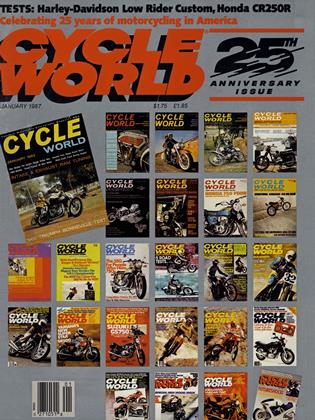
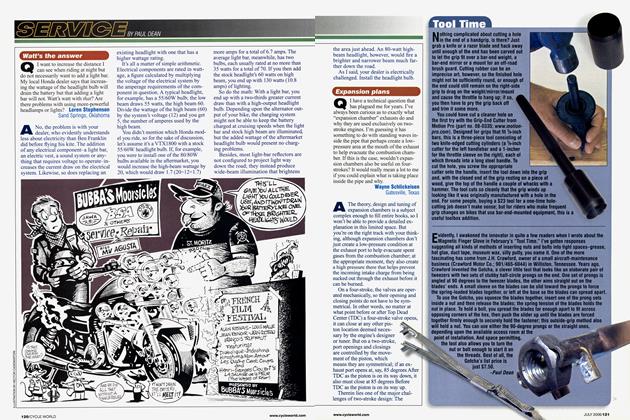
THE CALENDARS HAVE TO BE WRONG; CYCLE WORLD can’t possibly be celebrating its 25th anniversary this month. Surely, 1962 was not a quarter of a century ago.
Time has been good to CYCLE WORLD, though, for it consistently has been motorcycling’s most successful magazine during those 25 years. But Joe Parkhurst, the man who made it all happen, would be the first to admit that, for all of the success it has enjoyed, this book did not have the most auspicious beginning.
It was at a party one hot summer night in 1960 that the seed of the idea for CYCLE WORLD was planted in Parkhurst’s mind. In his private life, he had been a card-carrying bike loony since turning 16; professionally, he was a graphics designer who learned about publishing while serving as art director at ROAD -AMP;AMP; TRACK magazine until 1959. That night, during one of those typical, alcoholfueled party discussions about the meaning of life, the host—himself a car and motorcycle buff—asked a question for which Parkhurst had no answer: Why isn’t there a motorcycle magazine like ROAD -AMP;AMP; TRACK?
To get the full impact of that question, you have to understand that: 1) There were only two motorcycle magazines of any consequence in 1960—Floyd Clymer’s CYCLE, and Bill Bagnall’sMOTORCYCLisT-both of which were little more than deadly dull, bike-industry newsletters that weren’t sold on newsstands; and 2) ROAD -AMP;AMP; TRACK had broken fresh ground a few years earlier by bringing real journalism and entertainment to automobile publishing, becoming immensely successful as a result.
Parkhurst mulled over that question for a moment. But, owning little in the way of wealth and even less in the ways of entrepreneurship, he simply filed it away for future reference, figuring that someone might someday publish such a magazine, but that it wasn’t likely to be him.
As he would learn one year later, while working as art director of KARTING WORLD, he had figured wrong.
Thanks to the inexplicable boom that go-karting was enjoying at that time, KARTING WORLD had become quite profitable, so much so that its publisher, Jack Pelzer, wanted to expand by either buying some existing magazine titles or starting up new ones. And when asked for ideas on the matter, Parkhurst, thinking back to the question asked of him a year earlier, suggested a motorcycle publication, maybe a newsstand book done just like ROAD -AMP;AMP; TRACK, with bike tests, technical stories, news from around the world, race reports from Europe, personality profiles and a touch of humor. Two-wheel entertainment, in other words.
Pelzer embraced the idea, and gave Parkhurst the responsibility for putting the package together. A few months later, in December of 1961, the inaugural issue of CYCLE WORLD hit the newsstands.
In the mind of Joe Parkhurst, the magazine was an instant success. But in the mind of Jack Pelzer it was not, because neither the early newsstand sales figures nor the volume of advertising in the first issue were up to his expectations. So before the second issue was even completed, Pelzer announced that he immediately was going to “kill” the magazine.
Parkhurst pleaded and argued, but to no avail. Pelzer did, however, agree to sell Parkhurst the rights to the CYCLE WORLD name; so in short order, Parkhurst sold his car and his boat, took out a mortgage on his house, and talked a couple of fellow journalists, Henry Manney and Dean Batchelor, into loaning him some money. In a matter of just a few days, Parkhurst became the book’s publisher, editor, art director and chiefcook-and-bottle-washer.
That second issue got published, obviously, along with 298 others since then. It wasn’t easy, particularly in the beginning, and the magazine underwent its share of changes as it “grew up”; but all along, Parkhurst held firm to his belief that the format he had lifted directly—and unashamedly—from ROAD -AMP;AMP; TRACK was The Formula for success.
Apparently, lot of people agreed, because by the early Seventies, the world of motorcycling entertainment was no longer Joe Parkhurst’s private preserve, CYCLE and MOTORCYCLIST had been bought by big-time publishing houses and turned into real magazines; CYCLE GUIDE had been created to try to blow CYCLE WORLD off the newsstands. And in one way or another, they all had adopted the basic concept Parkhurst had introduced in 1962.
By that time, Parkhurst had already concluded that he didn’t have the journalistic skills needed to keep pace in this ever-more-competitive arena, and in 1966 had installed Ivan Wagar as Editor-In-Chief—a position Wagar held until 1973. His replacement, Bob Atkinson, held the reins until the end of 1976.
That year signaled the close of an era for CYCLE WORLD. Not only did it mark the exit of Atkinson—who had literally grown up under Parkhurst’s tutelage, starting as an errand boy back in 1962 and, in a classic example of The American Dream, working his way up to the top editorial spot— but the departure of Parkhurst, as well. The magazine had been bought by CBS in 1972, and though Parkhurst had been retained as publisher, he and his supervisors at CBS didn’t see eye to eye. In mid-1976, he resigned.
Both Wagar and Atkinson had furthered the CYCLE WORLD tradition of leadership in motorcycle publishing, each in his own different way. But when Allan Girdler took over the editor’s chair in 1977, he felt that the magazine had somehow gotten too technical and dirt-bike-oriented. So he worked diligently to get the magazine headed back toward Parkhurst’s original goal: reader entertainment.
I couldn’t agree more, a fact I made known when I took over as editor in 1984. And although I don’t expect that I’ll be reporting the results of the next 25 years, I fully expect that someone will, that this magazine will persevere. Because just as Joe Parkhurst did in 1962, we believe in you; that’s still the best way to keep you believing in us.
Paul Dean