Suzuki Gsx-R750/1100
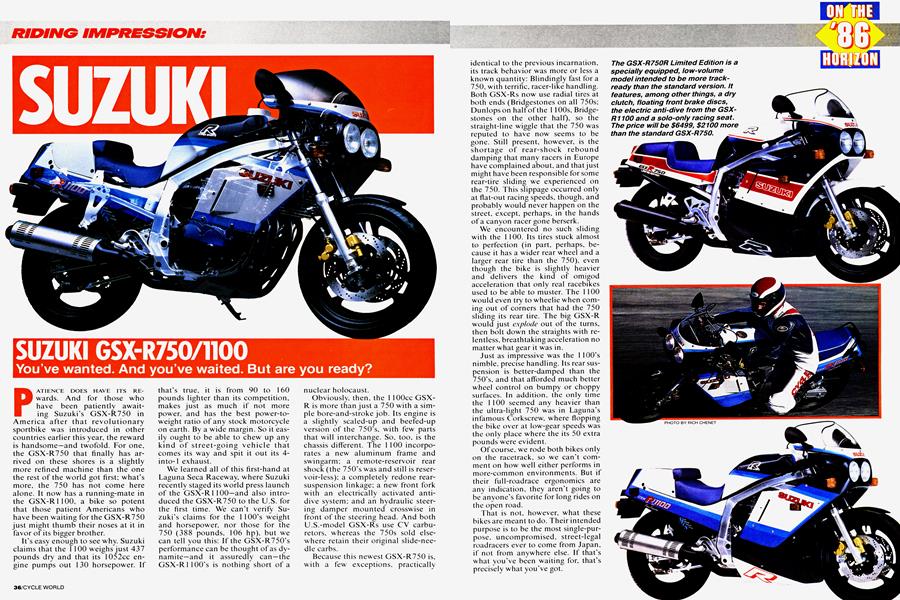
SUZUKI GSX-R750/1100
RIDING IMPRESSION:
You’ve wanted. And you’ve waited. But are you ready?
PATIENCE DOES HAVE ITS REwards. And for those who have been patiently awaiting Suzuki’s GSX-R750 in America after that revolutionary sportbike was introduced in other countries earlier this year, the reward is handsome—and twofold. For one, the GSX-R750 that finally has arrived on these shores is a slightly more refined machine than the one the rest of the world got first; what’s more, the 750 has not come here alone. It now has a running-mate in the GSX-R1100, a bike so potent that those patient Americans who have been waiting for the GSX-R750 just might thumb their noses at it in favor of its bigger brother.
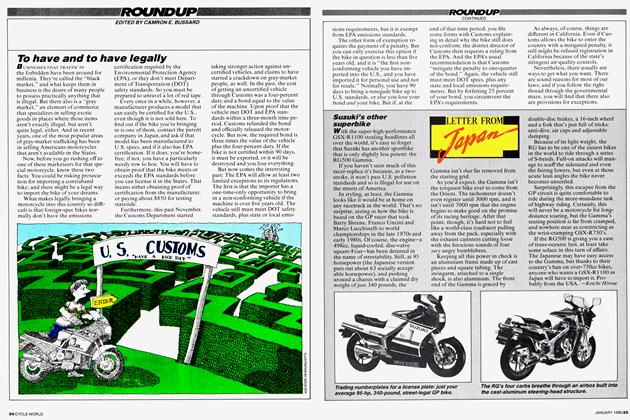
It’s easy enough to see why. Suzuki claims that the 1 100 weighs just 437 pounds dry and that its 1052cc engine pumps out 130 horsepower. If that’s true, it is from 90 to 160 pounds lighter than its competition, makes just as much if not more power, and has the best power-toweight ratio of any stock motorcycle on earth. By a wide margin. So it easily ought to be able to chew up any kind of street-going vehicle that comes its way and spit it out its 4into-1 exhaust.
We learned all of this first-hand at Laguna Seca Raceway, where Suzuki recently staged its world press launch of the GSX-R1 100—and also introduced the GSX-R750 to the U.S. for the first time. We can't verify Suzuki's claims for the 1 100’s weight and horsepower, nor those for the 750 (388 pounds, 106 hp), but we can tell you this: If the GSX-R750’s performance can be thought of as dynamite—and it assuredly can—the GSX-R 1 100’s is nothing short of a nuclear holocaust.
Obviously, then, the 1 lOOcc GSXR is more than just a 750 with a simple bore-and-stroke job. Its engine is a slightly scaled-up and beefed-up version of the 750's, with few parts that will interchange. So, too, is the chassis different. The 1 100 incorporates a new aluminum frame and swingarm; a remote-reservoir rear shock (the 750's was and still is reservoir-less); a completely redone rearsuspension linkage; a new front fork with an electrically activated antidive system; and an hydraulic steering damper mounted crosswise in front of the steering head. And both U.S.-model GSX-Rs use CV carburetors, whereas the 750s sold elsewhere retain their original slide-needle carbs.
Because this newest GSX-R750 is, with a few exceptions, practically identical to the previous incarnation, its track behavior was more or less a known quantity: Blindingly fast for a 750, with terrific, racer-like handling. Both GSX-Rs now use radial tires at both ends (Bridgestones on all 750s; Dunlops on half of the 1 100s, Bridgestones on the other half), so the straight-line wiggle that the 750 was reputed to have now seems to be gone. Still present, however, is the shortage of rear-shock rebound damping that many racers in Europe have complained about, and that just might have been responsible for some rear-tire sliding we experienced on the 750. This slippage occurred only at flat-out racing speeds, though, and probably would never happen on the street, except, perhaps, in the hands of a canyon racer gone berserk.
ON THE '86 HORIZON
We encountered no such sliding with the 1 100. Its tires stuck almost to perfection (in part, perhaps, because it has a wider rear wheel and a larger rear tire than the 750), even though the bike is slightly heavier and delivers the kind of omigod acceleration that only real racebikes used to be able to muster. The 1100 would even try to wheelie when coming out of corners that had the 750 sliding its rear tire. The big GSX-R would just explode out of the turns, then bolt down the straights with relentless, breathtaking acceleration no matter what gear it was in.
Just as impressive was the 1 100’s nimble, precise handling. Its rear suspension is better-damped than the 750’s, and that afforded much better wheel control on bumpy or choppy surfaces. In addition, the only time the 1 100 seemed any heavier than the ultra-light 750 was in Laguna’s infamous Corkscrew, where flopping the bike over at low-gear speeds was the only place where the its 50 extra pounds were evident.
Of course, we rode both bikes only on the racetrack, so we can't comment on how well either performs in more-common environments. But if their full-roadrace ergonomics are any indication, they aren't going to be anyone’s favorite for long rides on the open road.
That is not, however, what these bikes are meant to do. Their intended purpose is to be the most single-purpose, uncompromised, street-legal roadracers ever to come from Japan, if not from anywhere else. If that’s what you’ve been waiting for, that’s precisely what you’ve got.