1985 Honda Cr500r
1985 HONDA CR500R
LONG TERM TEST:
TWENTY-FIVE DAYS IN THE LIFE OF AN OPEN-CLASSER
IN THE CAREER OF A MOTOCROSS rider, 25 races isn’t much. But for a motocross bike, it can be a lifetime. Particularly in the hands of a Pro or Intermediate, a motocross bike that has survived 25 races—the equivalent of about six months of racing—can become more worn-out than a seven-year-old streetbike.
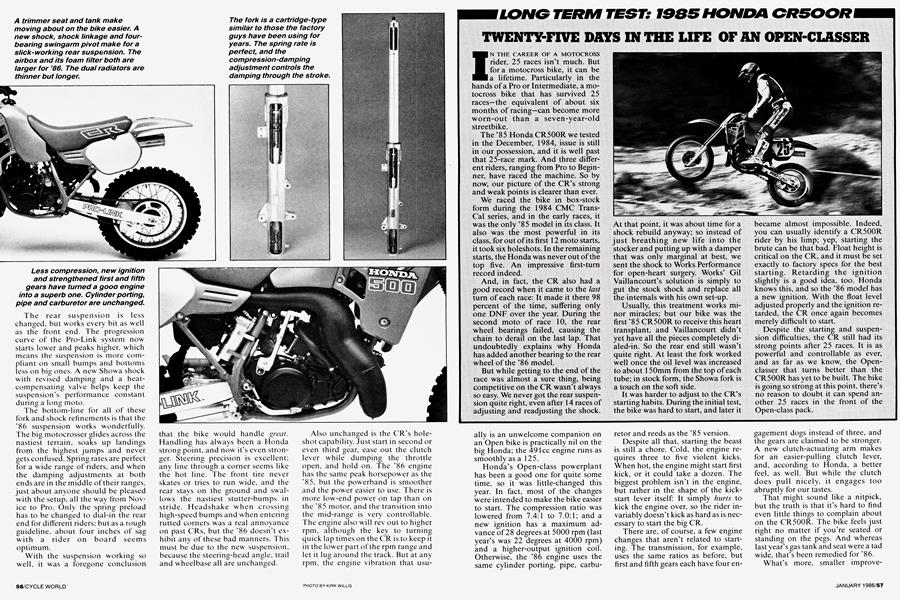
The ’85 Honda CR500R we tested in the December, 1984, issue is still in our possession, and it is well past that 25-race mark. And three different riders, ranging from Pro to Beginner, have raced the machine. So by now, our picture of the CR’s strong and weak points is clearer than ever.
We raced the bike in box-stock form during the 1984 CMC TransCal series, and in the early races, it was the only ’85 model in its class. It also was the most powerful in its class, for out of its first 12 moto starts, it took six holeshots. In the remaining starts, the Honda was never out of the top five. An impressive first-turn record indeed.
And, in fact, the CR also had a good record when it came to the last turn of each race: It made it there 98 percent of the time, suffering only one DNF over the year. During the second moto of race 10, the rear wheel bearings failed, causing the chain to derail on the last lap. That undoubtedly explains why Honda has added another bearing to the rear wheel of the ’86 model.
But while getting to the end of the race was almost a sure thing, being competitive on the CR wasn’t always so easy. We never got the rear suspension quite right, even after 14 races of adjusting and readjusting the shock.
At that point, it was about time for a shock rebuild anyway; so instead of just breathing new life into the stocker and putting up with a damper that was only marginal at best, we sent the shock to Works Performance for open-heart surgery. Works’ Gil Vaillancourt’s solution is simply to gut the stock shock and replace all the internals with his own set-up.
Usually, this treatment works minor miracles; but our bike was the first ’85 CR500R to receive this heart transplant, and Vaillancourt didn’t yet have all the pieces completely dialed-in. So the rear end still wasn’t quite right. At least the fork worked well once the oil level was increased to about 150mm from the top of each tube; in stock form, the Showa fork is a touch on the soft side.
It was harder to adjust to the CR’s starting habits. During the initial test, the bike was hard to start, and later it became almost impossible. Indeed, you can usually identify a CR500R rider by his limp; yep, starting the brute can be that bad. Float height is critical on the CR, and it must be set exactly to factory specs for the best starting. Retarding the ignition slightly is a good idea, too. Honda knows this, and so the ’86 model has a new ignition. With the float level adjusted properly and the ignition retarded, the CR once again becomes merely difficult to start.
Despite the starting and suspension difficulties, the CR still had its strong points after 25 races. It is as powerful and controllable as ever, and as far as we know, the Openclasser that turns better than the CR500R has yet to be built. The bike is going so strong at this point, there’s no reason to doubt it can spend another 25 races in the front of the Open-class pack.