Motocross Blast Off
MOTOCROSS BLAST OFF
CYCLE WORLD COMPARISON TEST:
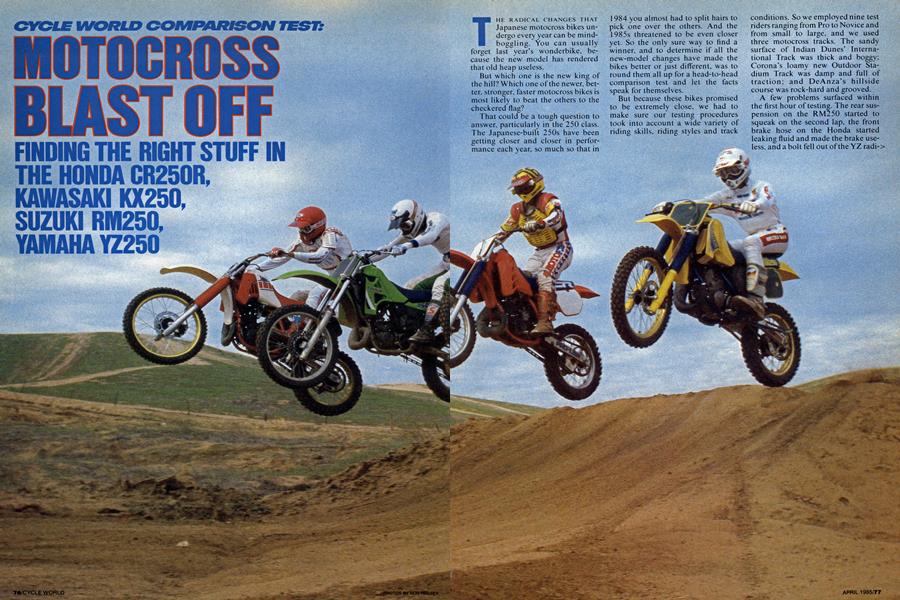
FINDING THE RIGHT STUFF IN THE HONDA CR250R, KAWASAKI KX250, SUZUKI RM250, YAMAHA YZ250
THE RADICAL CHANGES THAT Japanese motocross bikes undergo every year can be mindboggling. You can usually forget last year’s wonderbike, because the new model has rendered that old heap useless.
But which one is the new king of the hill? Which one of the newer, better, stronger, faster motocross bikes is most likely to beat the others to the checkered flag?
That could be a tough question to answer, particularly in the 250 class. The Japanese-built 250s have been getting closer and closer in performance each year, so much so that in 1984 you almost had to split hairs to pick one over the others. And the 1985s threatened to be even closer yet. So the only sure way to find a winner, and to determine if all the new-model changes have made the bikes better or just different, was to round them all up for a head-to-head comparison test and let the facts speak for themselves.
But because these bikes promised to be extremely close, we had to make sure our testing procedures took into account a wide variety of riding skills, riding styles and track conditions. So we employed nine test riders ranging from Pro to Novice and from small to large, and we used three motocross tracks. The sandy surface of Indian Dunes’ International Track was thick and boggy; Corona’s loamy new Outdoor Stadium Track was damp and full of traction; and DeAnza’s hillside course was rock-hard and grooved.
A few problems surfaced within the first hour of testing. The rear suspension on the RM250 started to squeak on the second lap, the front brake hose on the Honda started leaking fluid and made the brake useless, and a bolt fell out of the YZ radi-> ator airscoop. A bit of tightening and bleeding right at the track made the Honda as good as new, but the other problems weren’t solved until we got back to our shop. We did. however, get the suspensions pretty much dialed-in during the second hour of testing, not an easy job considering our large group of testers. The vital statistics of the riders and the particulars of suspension set-up are listed in the charts below.
These settings worked best for us (with minor variations for different tracks) but should make good starting points for other riders and racetracks. The Yamaha’s shock never worked well, and got progressively worse as the test wore on. We had to use the No. 1, or stiffest, rebound-damping position by the time the last day of testing rolled around. The CR’s rear end wasn’t so great, either; it constantly kicked, especially when entering bumpy turns and accelerating on rough straights, leading most of us to conclude that the CR’s rear end was confused. We finally settled on 12 clicks out on the compression knob and 16 clicks out on the rebound. Those settings resulted in some bottoming over large jumps and some kick entering turns, but it was the best compromise we could find.
The rear of the Suzuki kicked and squealed its way though the first day. The rear suspension was disassembled and greased before the second test day, and it worked much better afterward. Greasing the Full Floater rear end was a nightmare, though, consuming five hours before all of the linkage, shock ends and numerous loose spacers and seals were greased and reassembled. Grease nipples would turn the job into a two-minute affair. And greasing the bearings during assembly at the factory level would help, too; every joint was lacking any visible sign of lubrication.
The Kawasaki has grease fittings, and it also has two knobs for adjusting the shock’s compression damping-one for high-speed compression, one for low-speed compression. We set the adjustments on our KX250 once and never needed to change > them throughout the test. The rear of the KX always worked exceptionally well for all of the riders at every track. The rear wheel followed the bumps well under power and while braking, and landings from jumps and dropoffs were always smooth.
TECHNICAL BRIEFING HONDA CR250R
HONDA, makes MORE major THAN changes ANY to OTHER its motocross MANUFACTURER, bikes on a yearly basis. And ’85 is no different. The new CR250R is, once again, quite a bit changed.
After having what many racers considered the perfect 250cc motocross powerband, Flonda changed the porting, the CR’s ATAC power-valve design, the pipe and the carburetor. Gone is the high-winding engine with the mile-wide powerband, and in its place is an engine tuned for lowand mid-range operation. Riders who race on short, twisty tracks will like the strong mid-range power and the instant throttle response of the ’85 engine, but those who regularly race on fast courses won’t think the engine so great. Everyone will enjoy increased piston life, however, thanks to a bridged exhaust port and revised cooling-system passages in the cylinder.
And, for what seems like the hundredth time, the CR has a new rear shock and Pro-Link linkage. The Showa shock is longer and larger in diameter, and the linkage arms are a different length to flatten the progression curve once again. Needle bearings have been added to the suspension rocker arm and strut for a reduction in friction and wear. Disassembly is still required when time comes to grease the bearings, however, because they do not have grease fittings.
Also changed yearly is the CR’s frame geometry. Honda has moved the steering head back and forth and up and down numerous times in recent years, and for ’85, the distance between the steering head and swingarm pivot has been lengthened slightly. Honda claims the change makes the CR250R feel more neutral when turning. The steering head angle and trail remain unchanged at 27.5 degrees and 4.4 inches.
Lots of smaller parts have been changed or modified to fine-tune the CR. The rear wheel spokes and nippies are stronger, a new throttle design eases maintenance, the air filter fits better, louvered radiator grilles improve cooling efficiency and keep rocks away from the radiator, there’s a molded, one-piece radiator-to-engine hose, and the transmission’s engagement dogs and shift forks are an improved design for more positive shifts. There’s an improved gasket between the silencer and pipe to prevent drool, and the front part of the silencer body fits into a nifty frame loop for added support.
Less apparent changes are a smaller, 1.9-gallon fuel tank, a seat that’s wider at the front, and a return to soft-terrain Bridgestone M22 and M23 tires.
Setting up the fork on each bike was easier. All were run with zero air pressure, and we fiddled with the compression-damping adjusters until most of the riders were happy. The fork springs on the YZ were too soft
for the Pros but about right for the slower riders. The slower riders complained about fork harshness on the YZ, a problem that was eliminated by backing off on the compression damping, but then that made the bike unacceptable for the Pros. Still, most riders rated the YZ front suspension as either good or very good.
TECHNICAL BRIEFING KAWASAKI KX250
FOR has 1985, a new KAWASAKI frame, IS suspension GETTING TOUGH. and engine THE headKX250 ing a rather long list of changes.
Adjustable suspension is nothing new to motocross bikes, but Kawasaki has one-upped the competition with the most adjustable suspension yet offered on a production bike. A KYB fork with 43mm stanchion tubes offers air-assist, plus eight-position compession damping, three-position spring preload, and reversible, offset handlebar pedestals. The rear suspension is even more adjustable, for its aluminum-bodied KYB shock features the usual spring preload, and independently adjustable highand low-speed compression damping. There are four settings for high-speed compression and 14 for low-speed compression, and the rebound damping has a 22-position adjustment. Additionally, the aluminum strut between the swingarm and suspension rocker can be adjusted for length to alter the steering geometry, although Kawasaki claims the purpose of the adjustment is only to allow the same strut to be used on all the KXs.
The 250’s new, silver-painted frame is constructed of large-diameter tubing and is heavily gusseted. Rake and trail are in the middle range of these four motocross bikes at 28 degrees and 4.7 inches. The airbox has a large foam filter and an inlet under the fuel tank.
Two-stroke exhaust-control devices are the current rage in motocross, and the KX250 now has one. Called Kawasaki Integrated Powervalve System (KIPS), the system alters the volume of the exhaust headpipe according to engine rpm. Each of two auxiliary exhaust ports that flank the main port is fitted with a small, cylindrical valve that is held wide-open at high rpm, which increases the overall exhaust-port area for optimum top-end performance. At low revs, the right valve rotates to close off its port altogether, but the left valve turns to redirect exhaust gases into a chamber built into the front of the cylinder. The added volume of the chamber effectively changes the headpipe tuning to aid low-rpm power. Both valves are actuated by a linkage that is connected to a crankshaft-driven ball-ramp device.
A big, 40mm Mikuni carb with a flat-bottom, Rtype slide feeds fuel through an eight-petal reed cage fitted with quick-reacting fiber reeds. The transmission gears and ratios are unchanged for ’85 but there is a new clutch hub and primary kickstart gear. The gear floats instead of being solidly attached to the clutch hub, and that helps eliminate chatter when slipping the clutch at high revs.
Initially, most riders thought the KX’s fork springs were a little soft, too, but turning the preload adjuster on the top of each fork leg one click cured the complaints. Rider ratings for the KX fork were in the excellent and very good category. The CR fork, unchanged from last year, drew mixed reactions ranging from fair to very good. Almost all complained about harshness that might have been caused by the constant rear-end kicking, which tends to put excessive demands on the front suspension. A rear end that was better-behaved would undoubtedly make the front end seem better. Ratings of the RM250's fork were mostly favorable, with the exception of two Pros who thought it was too soft and only deserving of a fair rating.
Reliability problems also started showing up toward the end of the first day of testing. After two tanks of gas> were consumed per bike, the Suzuki suddenly locked up without warning. A teardown revealed a slight piston seizure from a too-lean fuel mixture. Our RM had been rejetted by Suzuki before delivery (the only bike of the group with non-stock jetting), and was much leaner than stock. The pilot jet was a No. 45 (50 is stock), the slide cut was a No. 5 (replacing the richer, stock No.4), an R-2 needle jet replaced the stock R-4, and the mainjet size had been dropped from a 320 to a 290.
TECHNICAL BRIEFING SUZUKI RM250
VISUALLY. SUZUKLS 1985 RM250 ISN’T GOING TO
wow anyone; it looks just like the '84. But don’t let the sameness fool you. because the ’85 incorporates several mechanical changes. There’s new steering geometry, a hydraulic disc front brake, a new shock and front fork, and a revised engine.
Externally, the engine appears unchanged except for the gray paint, but internally, many parts are changed. The connecting rod is 8mm longer, which alters the rod-to-crank geometry in a way that results in a slight power increase. The longer rod requires a taller cylinder, and that cylinder has revised porting intended to provide a wide, usable powerband. The RM250 still employs Suzuki’s novel case-reed intake system that feeds fuel both through a conventional piston-port into the cylinder and through a large reed valve directly into the crankcase. A 38mm flat-slide Mikuni carburetor replaces the 36mm used last year.
Frame changes were aimed at improving straightline stability. Last year, the steeper steering-head angles on the competition's motocross bikes forced Suzuki to steepen the steering rake on the '84 RM from 29.5 to 28 degrees. And that change did quicken the RM's steering and eliminate front tire washout, but it also resulted in head-shake on bumpy straights. So for 1985, Suzuki has attempted to reduce or eliminate that head-shake by leaving the head angle at 28 degrees but increasing the RM’s trail through the use of triple clamps with 5mm less offset.
A new KYB shock and fork offer more adjustability for ’85. Fork compression damping adjustments are now 17 compared to only 8 last year. The rear shock has 17 compression choices and 21 rebound, up from four each in ’84. The added settings have broadened the adjustment range and allow better fine-tuning for track conditions and suspension wear. But the leverage ratios on the Full Floater remain unchanged.
A new spool-type front hub with straight-pull spokes holds a large, 9.5-inch disc rotor. The lever has an adjustment screw for lever free-play.
A new piston, ring and top-end bearing were installed in the honed cylinder, and the carburetor needle raised one notch to the No. 4 position. We also changed the NGK B8EV sparkplug to a colder B9ES.
Day two found our test crew at Corona Raceway’s new loamy outdoor stadium-style track. This course is full of little peaked jumps, big bermed turns and very few straights. And as a bonus, the ground was damp from a recent rain; perfect conditions for bikes with strong midand low-end powerbands. And so the Honda and Yamaha engines were right at home. Both are strong midrange engines that require short-shifting for best performance. The YZ revs a little higher than the CR. though, before flattening out; the CR's engine makes a lot of mid-range power then suddenly signs off if overrevved.
TECHNICAL BRIEFING YAMAHA YZ250
AFTER production-based A VERY SUCCESSFUL motocrossers 1984 SEASON at the OF national RACING level, Yamaha has built a 1985 YZ250 that is, suprisingly, significantly different.
Perhaps the most interesting change is a rear suspension called BASS, which stands for Brake Actuated Suspension System. BASS looks like any other single-shock rear end except for a small cable running between the rear brake pedal and the shock reservoir. When the rear brake is pushed, the cable pulls open a valve in the reservoir that significantly reduces the compression damping, the theory being that a reduction in compression damping when braking into a choppy corner will eliminate rear-wheel hop. Also, the shock’s adjustment range has been extended to 25 clicks for rebound damping and 28 for compression damping.
Changes in the KYB front fork are less radical. The compression damping is 10 percent higher throughout the 16-click adjustment range, and there’s more clearance between the stanchion tubes and sliders. Increasing the compression damping and adding adjustments positions makes the fork easier to fine-tune; reducing the tolerance between the tubes and sliders reduces drag so the fork can react faster.
Some change has been made to the frame, too. The steel tubes are thinner-walled to reduce weight, and extra gusseting has been added where last year’s frame tended to crack. The brackets above the cylinder head are designed for double head stays, a needed modification on last year’s YZ when raced at the pro level. Rake and trail are unchanged.
In the engine department, new cylinder porting and an external-flywheel ignition with a different advance curve both boost top-end performance. New center cases employ an added bearing surface for the clutch arm pivot, which is supposed to lighten the clutch lever pull, but it still has a stiffer action than the other apanese motocrossers do.
Broken spokes were a problem with the ’84 YZs, pecially in the rear wheel. For ’85, the spokes are .5mm larger in diameter, and solid-bead Takasago rims replace the hollow-bead DIDs. Steel spoke nipples finalize the wheel updates and promise better durability. A new front hub, complete with Yamaha’s exclusive Z-spokes, mounts a 9.4-inch disc rotor, replacing last year’s dual-leading-shoe drum brake.
A new seat that’s 15mm thicker positions the rider higher on the bike. Thicker plastic side numberplates and a more durable air-filter foam both are claimed to be longer-
The KX250 engine doesn't make as much power oft' idle as either the CR or YZ. but its powerband is verv progressive, with great mid-range power and good top end. Not surprisingly, the KX engine soon became our favorite. A rider could simply wind the engine a little bit more in the short straights and eliminate some shifting. The RM. on the other hand, has the only engine in the group that doesn't have some kind of exhaust-control device, and, not coincidentally, it has the least low-end power. But the RM is very strong in the mid-range, although it fades badly on the top end.
We had more trouble with the RM engine, though, this time early in the second day. It developed an odd rattling noise that got progressively louder until the engine quit running altogether. A faulty wrist-pin bearing was the culprit. It had been replaced during the top-end rebuild with a new -bearing that looked, well, like a new bearing, but the cage for the needle rollers had broken and dropped the hardened rollers into the engine. That broke the piston, ruined the cylinder and deposited pieces of the piston skirt into the lower end. Complete engine disassembly was required, along with another piston, a cylinder, and new main bearings.
On day three our wrecking crew went to DeAnza, known for its hardpacked. medium-length, suspension-torturing, hillside track. Two days of racing on wet ground prior to our arrival had turned the course into a rutted, demanding, hard-as-nails obstacle course. Perfect for testing. >
Some front-tire skate was noticed on the KX at DeAnza, and the YZ and RM didn’t want to turn. The RM also tended to climb up out of berms. Raising the fork stanchions 3/s-inch on the KX transformed it into the second-best-turning bike of the group. An identical adjustment helped the YZ too, but not to the extent it did on the KX. Much of the YZ’s cornering problem can be blamed on the rear shock’s poor performance: It’s hard to pick a line going into a turn when the rear wheel is bouncing into the air. Excellent lowend power is the only thing that saves the YZ and makes it fairly controllable in turns.
Raising the fork tubes even slightly on the RM caused tire contact with the front fender—a dangerous move. The RM’s fork stanchions were moved back to the stock position. But the Honda’s steering geometry was right at home on DeAnza's hardpack; it was the easiest, quickest and most precise-turning bike of the lots. The CR’s rear end also kicks slightly going into tight, choppy turns, but it remains controllable anyway.
Straight-line stability was rated as good to excellent on the YZ and CR, although a couple of the riders complained of head-shake on the Honda. The KX received the most excellent ratings for stability, with a smattering of goods. Most of the faster riders didn’t like the RM in the straights; it wanders around some and doesn't make directional changes as easily as the other bikes do. The slower riders thought the RM was good to very good in straight-line stability.
All of the bikes have disc front brakes, but they differ greatly in function. The CR brake requires the
lightest pull and provides the best feel. The KX brake is a close second but pulls a little harder than the Honda’s. The YZ brake requires a heftier pull and doesn’t have the stopping power or feel you get with the CR and KX. And the RM brake is terrible; the lever free-play constantly changes and braking power is poor. Adjusting the RM's lever freeplay (to avoid lever contact with the rider's knuckles) results in a too-tight brake after a few hot laps. Lever feel is vague and the lever travel inconsistent. Brake pads that swell when hot and a flimsy hydraulic hose seem to be the problem.
Control exiting a motocross start gate varies greatly from bike to bike. The YZ is the easiest to launch thanks to its great low-end power, its excellent clutch, and the fact that it puts most of its power to the ground. The CR isn't far behind the YZ but doesn’t hook up quite as well. A little less low-end torque and a lighter flywheeled, quicker-revving engine make the KX a bit difficult to get off the starting line cleanly. The RM ended up fourth in the category of start-line efficiency, hampered by a lack of low-end power and a clutch that tends to heat up and drag.
But while the YZ almost always got the jump on the other bikes coming out of the gate, it would drop back after reaching third. Truthfully, these bikes are all so close on starts that any one of them might be first into the first turn starting straight is short. But when racing to the end of a long starting straight, the KX simply outruns the others.
Clutch action, clutch fade, gear shifting and gear ratios can make or break a motocross bike, and the Honda wins that competition handsdown. The CR shifts smoothly, even under full-throttle situations, (the only one in the group to do so), clutch action is smooth and positive, the clutch lever is easy to pull, and the gear ratios are nearly perfect. The YZ and KX are good in this area, too, but they don’t quite equal the CR. The KX has an annoying ratio gap between second and third that's sometimes noticed in tight corners, where third gear is too high and second gear too low.
Much the same complaint applies to the YZ, which runs out of second gear quickly. The KX has extremely notchy shifting when new but smoothes out after a couple of days. Clutch action on the KX is good, with an easy but rather mushy lever pull. The YZ shifts more stiffly than the others all the time, and the clutch lever pull is extreme, a combination that makes the bike tiring to ride.
The RM changes gears fairly well so long as full-throttle shifts are avoided, but the clutch is fragile and overmatched. Two starts from the gate has it smoking and dragging, and toward the end of the last day of testing, it starting slipping if clutched out of turns. The gear ratios on the RM are spaced a little to widely to work well with the engine’s lack of of lowend; some riders complained of engine-bogging after shifting if the engine wasn't kept wailing like a 125. >
HONDA CR250R
$2498
KAWASAKI KX250
$2499
SUZUKI RM250
$2479
YAMAHA YZ250
$2499
How well a bike fits you is a serious consideration when you’re buying a new racer. And that’s no easy job for a manufacturer, who has to make one machine fit riders of widely varying sizes and riding styles. But once again, the KX won the most excellents, followed by the CR. The YZ slid into third, followed by a lot of poor votes for the RM. Almost every rider thought the RM felt cramped and small.
At the end of the last day of testing, all of our riders were given questionnaires asking which bike they would buy. Their answers pretty much tell you everything you need to know about these four machines. The chart clearly shows that the RM250 is the least desirable, while the YZ250 gets the third-place trophy. The CR250R, the best 250 motocrosser the past two years, slipped to second, with most testers feeling that the ’84 CR250R was better than the ’85. And so Kawasaki’s KX250 wins by a landslide.
It’s not hard to see why, considering that the Kawasaki came up a winner in practically every individual category. The conclusion was perhaps summed up best by one rider’s spontaneous remarks as he filled out the question form: “The KX has it all.” S