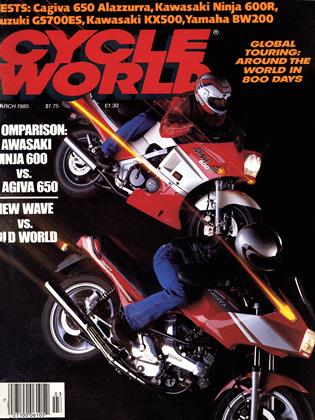
Cagiva Alazzurra 650 Vs. Kawasaki Ninja 600r
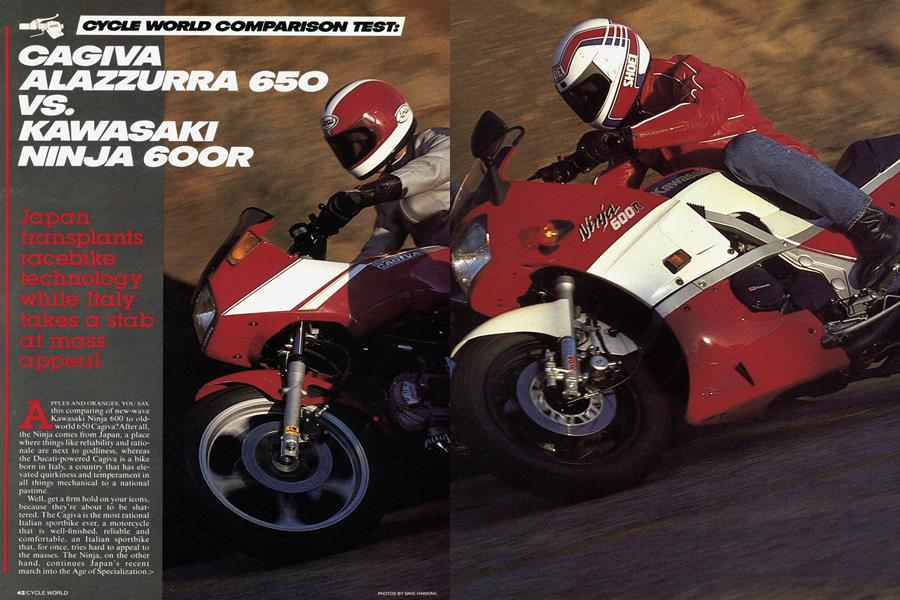
CAGIVA ALAZZURRA 650 VS. KAWASAKI NINJA 600R
CYCLE WORLD COMPARISON TEST
Japan transplants racebike technology while Italy takes a stab at mass appeal
APPLES AND ORANGES, YOU SAY, this comparing of new-wave Kawasaki Ninja 600 to old-world 650 Cagiva? After all, the Ninja comes from Japan, a place where things like reliability and rationale are next to godliness, whereas the Ducati-powered Cagiva is a bike born in Italy, a country that has elevated quirkiness and temperament in all things mechanical to a national pastime.
Well, get a firm hold on your icons, because they're about to be shattered. The Cagiva is the most rational Italian sportbike ever, a motorcycle that is well-finished, reliable and comfortable, an Italian sportbike that, for once, tries hard to appeal to the masses. The Ninja, on the other hand, continues Japan's recent march into the Age of Specializations It is of such narrow focus and drips with so much exotic hardware that it has entered the realm of the so-called “flashbike,” an area which, ironically enough, was once the private domain of the Italians.
A quick walk-around of each bike provides visual evidence. The 650 Cagiva’s flat handlebar, bench-type seat and mildly rearset footpegs are a thousand backaches away from the clip-on, mono posto misery we’ve come to expect from most Italian sporting machines. The bike’s paint job is well-done, with none of the dust specks and overspray that have marred more than a few Italian finishes. The 650 has a frame-mount fairing that is almost Oriental in appearance, what with its Interceptorlike, brushed-aluminum dash plate, band of warning lights, accurate clock and flush-mount turnsignals. Even the rear indicator lights look planned for, rather than a quick addon just to get past the safety inspectors. This is a civilized motorcycle.
Conversely, the Ninja 600 could easily pass for a racebike on its way to the starting grid. And that’s no idle threat. For this Kawasaki not only has the looks and the hardware to make many factory racebikes of a couple of years ago green with envy, but it has the performance, too.
Providing that propulsion is a 592cc. inline-Four engine that is liq uid-cooled and breathes through a dohc, 16-valve top end. Chunky Dunlop tires designed specifically for the 600 Ninja ride on 16-inch wheels front and rear. A single shock, adjust able for air preload and rebound damping. is hidden behind the engine. The front fork has an automatically variable damping system and adjustable anti-dive mechanism. A scoop-laden full fairing helps the 600 pierce the wind efficiently. The aluminum swingarm rides in needle bearings. The handlebars might as well be called clip-ons, and the footpegs are hiked up and back. And the whole affair is held together by a high-tech, perimeter-style frame that wraps box-section tubes around the engine a la the Yamaha FJ 1 100 or certain Bimota models.
When you get right down to it, the Ninja is so exotic that if you were to peel off its decals, construct the frame of aluminum rather than of silverpainted steel, and clean up its globby welds, the bike could just as easily have been hand-built at the Italian Bimota workshop instead of on the assembly line at Akashi.
There can be no mistaking where the Alazzurra (Blue Wing) comes from, though. Whatever school of design all Italians are forced to attend has come through again, because the Cagiva 650 possesses that lithe, simplistic blending of plastic, steel and aluminum that seems to characterize all Italian mechanical devices. It’s the kind of motorcycle that always prompts a second look—and a smile— every time^you walk away from it.
Still, beautiful or not, the Cagiva comes up short on the technical side of things when it’s pitted against the 600 Ninja. The Cagiva led a former life that began in 1980 as Ducati’s Pantah 500 (see “The Duke Lives On,” pg. 46 ); and although the Alazzurra’s bodywork is all-new and its 90-degree V-Twin engine has been bored and stroked to 650cc, the frame and running gear remain essentially the same as on that fiveyear-old Ducati.
All of which makes the chassis a little dated, but no less novel than it was then. There is no main backbone to the frame, but instead the engine hangs from a multi-tube, “laddertype” sub-assembly. More interesting, perhaps, is the fact that the swingarm pivot runs through the rear of the engine’s crankcase and is even lubricated by engine oil. Besides providing for long swingarm-bushing life, the setup saves space, a major consideration in a 90-degree V that has one cylinder protruding toward the front wheel.
Other than those features, the rest of the Cagiva’s chassis is pretty unremarkable. Twin Marzocchi piggyback-reservoir shocks bolt to a roundsteel swingarm, providing a meager 3. 5 inches of travel. A five-position spring-preload collar is the only rearsuspension adjustment provided. And the Marzocchi front fork has to make do with 6.3 inches of travel and no adjustments whatsoever. Wheels front and rear are 18-inchers mated to excellent Pirelli Phantom tires.
As interesting as it is to compare their specs, these two motorcycles weren’t made to be technically dissected; they were meant to be ridden, hard, fast and long, down a coiled back-country road. And because backroads can’t read specification pages, they don’t know that a new-astomorrow Japanese repliracer is supposed to be able to carve rings around a slightly dated Italian roadster. So that’s not what happens, at least not most of the time. Put skilled riders on the Ninja and Cagiva and let them loose on a genuinely twisty road, one where the Ninja can’t flex its superior acceleration and top speed, and the two bikes will stay nose-to-tail for as long as the riders care to play tag.
It also is on these roads where the Cagiva shows one of its greatest improvements over past Italian sportbikes; in the suspension. The wheel rates have been recalibrated so that the rider isn't pummeled into submission after a few miles on rough roads. Make no mistake, though, the 650’s suspension is nowhere near as plush or as versatile as the Ninja’s. The fork doesn't know the meaning of the word “supple,” and the shocks still are harsh by Japanese standards; but compared to the 600 Pantah that Cycle World tested back in 1982, the Alazzurra is a cream puff.
As nice as the softened suspension is, we were were all set to blame it for the ease with which the Cagiva’s centerstand slammed against the asphalt during aggressive cornering. In one afternoon, the stand’s tang was ground to half its diameter and its feet were starting to look pretty tattered as well. Then we noticed that the stand has a height-adjustment bolt, of all things, presumably so the owner can snuggle the stand up to various aftermarket exhaust pipes. As soon as we moved the stand up about two inches, our spark-throwing rides were over. Really fast riders will still be able touch the stand down, however. And after that, the exhaust system’s heat shields get nicked, which is a signal that the Pirellis are about to run out of tread, anyway.
Though the new suspension was cleared of the stand-dragging charge, it may still be guilty of causing a slight wallow in some above-80-mph sweepers. That’s a surprise, because our test Pantah was as rock-steady as the U.S.S. Forrestal in high-speed corners. In all other types of corners, though, the Cagiva displayed the steady-tracking traits that Italians have been building into their bikes for years. All in all, the Cagiva’s suspension tradeoffs have transformed the bike into something that is viable as everyday transportation, even if the upper-echelon cornering has been somewhat compromised.
While the Cagiva is good at cutting a path through corners, the Kawasaki positively etches its way through a bend. At first, the Ninja feels a little twitchy, especially for someone who has just jumped off of a relatively slow-steering bike like the Cagiva. A few miles of acclimation, though, is all it takes to realize that the Ninja needs only subtle inputs at the controls, and is one of the world’s easiest bikes to go fast on. The Ninja rider is free to take virtually any line through a corner, or even change lines in midstream, without having to worry about using up all the ground clearance or running out of tire. And while the Cagiva might be able to stay with the Kawasaki on the right road at a fast street-riding pace, once the speeds approach race-level and some top-gear sweepers and long straights are thrown in, the Ninja simply motors off into the distance.
Still, there aren’t many bikes of any sort, including the big-brother Ninja 900, that can stay with the 600 at near-race speeds on properly sinuous roads. Last year we nominated Honda’s 500 Interceptor as the bike to have when the going got twisty; but the new Ninja is on equal footing with the Honda, with the 500 perhaps having an advantage only in the really tight stuff by virtue of the Ninja’s extra 25 pounds. In fact, the Ninja’s 452-pound dry weight—28 pounds up on the Cagiva—is one of the few disappointing aspects of the motorcycle, especially when you consider that the 600 is almost 20 pounds heavier than the GPz550, the bike it supplants in Kawasaki’s ’85 lineup. The 550 is still available this year, but it’s no longer Kawasaki’s King Killer Middleweight.
It probably comes as no surprise, then, that the Ninja is better than the Cagiva at full-tilt backroad charging. But the results of the in-town and highway portion of our test may shock you. The Alazzurra excels in that environment, because in riding position it is the antithesis of the Universal Italian Sportbikes, machines that forced their riders to endure hunched backs, aching backsides and wilting wrists while in transit to the backroads. The Ninja, close in seating position to those UIS bodybreakers, comes in second for the same reasons that made those bikes so miserable. In-town trolling puts excess weight on the wrists, and highway touring is cramped thanks to a one-postion saddle, cranked-up footpegs and an intruding fuel tank. Still, the Ninja’s ergonomics are not punishing enough to make weekend highway tours out of the question, claim that most pre-Cagiva Italian sportbikes couldn’t have made.
At least engine vibration won’t be much of a concern to any highwaymoored Ninja riders. The engine is rubber-mounted at the front, but the rear mounts are solid to maintain the proper alignment of the countershaft sprocket and the final-drive chain; still, very little buzzing gets through to the rider at normal cruising speeds, although the seat and fuel tank tingle slightly as the revs increase.
The Cagiva is also little-bothered by buzzing and tingling, and the credit here must go to the engine’s 90-degree V-spread that allows perfect primary balance. Like the Ninja, however, the Cagiva is not vibrationfree. As engine speed increases so do the vibes, which in the 650’s case manifest themselves in footpegs that can become uncomfortably tingly on ultra-high-speed runs, especially there are no turns along the way to break the monotony.
It is also on those high-speed jaunts where the Cagiva shows its greatest disparity with Ninja. Even with its rider trying to crawl under the paint, the Alazzurra tops out at 107 mph. The Ninja simply blasts by, on its way to a 122-mph top speed.
The dragstrip is a little kinder to the Italian V-Twin. Aided by an hydraulic clutch that engages smoothly, an engine with strong mid-range power, and 36mm Dell’Orto carbs that, unlike the ones on our 1982 Pantah, are stumble-free, the Cagiva tripped the lights in 12.91 seconds at exactly 100 mph. Those numbers are even more impressive when you consider that in our 1983 test of the Harley-Davidson XR1000, a race-shopinspired V-Twin having almost one-third more displacement than the Alazzurra, the bike mustered only a 12.88-second run at 101 mph. In other words, the Cagiva 650 is a very quick V-Twin.
But even that distinction doesn't make it the equal of the Ninja, which scorched the quarter-mile in 12.45 seconds and 107 mph. That puts the Kawasaki on an even keel with the 1984 drag champ of the 500-600 class, Yamaha's less-nimble FJ600, and ahead of the Interceptor 500.
To get that kind of performance from a mere middleweight, Kawasaki started with its GPz550, a bike with a stout heart that was starting to show its age. The GPz's plain-bearing bottom-end was borrowed and, with only slight alterations, installed in new cases that are narrower and not as long front-to-back as the 550’s. The rest of the development was concentrated on hot-rodding the topend, with the cylinders getting 2mmlarger bores and water jackets, followed, of course, by the requisite radiator, cooling fan and thermostat.
Each cylinder also got two additional valves in a system very much like the 900 Ninja’s—except that the 600's lighter cam chain runs through a centrally located cavity instead of being outboard of the left cylinder as on the 900. Like the bigger Ninja, the 600 has screw-type valve adjusters, which is an easier setup to deal with than the 550’s labor-intensive, shimand-bucket system.
When compared bolt-to-bolt to the Ninja's Four, the Cagiva’s Ducatibuilt Twin seems a little behind the times. But in truth, it’s about as upto-date as things get in Europe. When it was introduced, the Pantah engine was the first really new streetbike powerplant Europe had produced in years. And even today, only BMW’s K100 flat-Four is newer than the Cagiva V-Twin.
Back in 1980, the 500 Pantah engine came into being largely because Ducati wanted a motor that was less costly to produce than its 750/860/ 900 V-Twins. Those engines used a roller-bearing crank that was expensive to produce and install, noisy, and not all that reliable, especially at racing revs. Ducati’s trademark, the desmodromic valve gear in those engines, was actuated by gear-andtower camshaft drives that ran up the cylinder heads; again, noisy and expensive. But the Pantah engine broke new ground with a plain-bearing crank, a move that necessitated a beefed-up oiling system. And gone were the camshaft-drive towers, replaced by—and this is pretty innovative, even today—jackshaft-driven, toothed rubber belts on the right side of the cylinders. While they were at it, Ducati’s engineers gave the Pantah a spin-on oil filter and sight-glass windows for both the oil level and the ignition timing.
What the designers kept was the desmodromic valve train, a move that probably had a lot more to do with tradition than with performance. Desmo valve systems date back to the Fifties and beyond, a time when conventional valve springs often were unable to prevent high-rpm valve float, especially in engines with high-lift, quick-opening camshafts. But in a desmodromic system there are no valve springs, for each valve is closed mechanically, actually pulled shut by a rocker arm activated by a separate lobe on the camshaft. Not a bad system, really, as valve float is completely eliminated, but adjusting the desmo hardware is a time-consuming business that can sometimes include hand-grinding the individual adjustment shims to get the perfect clearance. Cagiva recommends that the clearances at least are checked every 3000 miles.
Previously, worrying about setting desmo valve systems was left to the truly hardcore Italian sportbike fanatic, because, quite honestly, that’s about the only person those sorts of bikes appealed to. And the entry fee for climbing aboard one of those Italobikes was so high that most motorcyclists opted to buy a more-mainstream Japanese machine—and use the change for a vacation in, say, Acapulco. But due to Cagiva’s increased production and strong will to make a go of it in the U.S. market, the Alazzurra will have an almost-bargain-basement price of $3750. Now, that’s a hefty $451 more than the Ninja 600, already mid-displacement pricy at $3299, but that price is $ 1200 cheaper than the 1982 Pantah.
Good price, you say, but what about the lamentable reliabilty record of Italian motorcycles? Well, we can’t speak for every Cagiva that hits U.S. shores, but our 650 was about as reliable as any bike we’ve tested. Unless you count an idle that would occasionally hang up at 2000 rpm and a burned-out bulb in the twin-bulb taillight, nothing went wrong. Only time and miles will tell for sure, but the Alazzurra looks like one of the few Italian motorcycles that will be able to boast Japanesebike levels of reliability.
That matter is still open to debate, though, because the Cagiva we tested was a European model, not yet U.S.certified; and sometimes, motorcycles have a way of losing something in the process of getting certified.
If the Cagiva displayed Japaneselike reliability, then the Ninja had its share of Italian quirkiness: Our test Kawasaki was one of the few bikes in recent years that has failed to finish its testing regimen mechanically unscathed. The first problem we encountered was a leaky left fork seal that left a small puddle every time we parked the bike. Next to come under the reliabilty hex were the carburetor float bowls, which, apparently contaminated by filings in the gas tank, took turns overflowing. The most debilitating problem of all, though, was a stripped bolt on the cam cover, evidenced by an oil leak that misted the whole right side of the bike—and whoever happened to be riding it. We got another Ninja from Kawasaki to complete our performance tests, but that bike, too, had some problems, namely, a clutch that would slip during full-power upshifts.
We should point out that the Ninjas we tested were not production units, but pilot-run models—that is, the first bikes off the assembly line, which are used to check manufacturing procedures. Too, the bikes previously had been used at a press introduction that involved much time on a roadrace track and a dragstrip. Those two facts may account for the Ninja's poor reliability: certainly, Kawasaki sportbikes in the past have proven all but bulletproof.
What we’ve got here, then, is the Cagiva, a rational Italian sportbike that is, in terms of comfort and ridabilty, certainly a milestone in the evolution of that country’s motorcycle offerings. Then there is the Kawasaki, state-of-the-art in almost every way, just a set of slicks and numberplates away from an out-andout racebike. It, too, is a milestone, because it points the way that the other Japanese manufacturers must go if they are to compete for America’s sportbike dollars.
Ah, but what about your dollars? Which of these two middleweights should you consider for that special spot out in your garage?
Well, if you’re looking to find a winner in this particular comparison, you first must figure out what is important to you. If having a real racebike is important, if having the bike that generates the best numbers is important, if having the biggest/ fastest/quickest/newest of anything is important, then the choice is obvious: The Kawasaki wins going away. But if your requirements list runs to the slightly esoteric, if the ever-increasing trend toward more-sophisticated and more-complicated motorcycles leaves you cold, if you’ve always wanted a real Italian sportbike but were never willing to pay the price (both in terms of dollars and reliability), then the Cagiva could be the answer to your prayers.
Two bikes. Two winners.
CAGIVA
ALAZZURRA 650
List price $3750
KAWASAKI
NINJA 600R
List price $3299