Ktm 250mx
KTM 250MX
CYCLE WORLD TEST
A very Japanese-style motor; a very European-style motorcycle
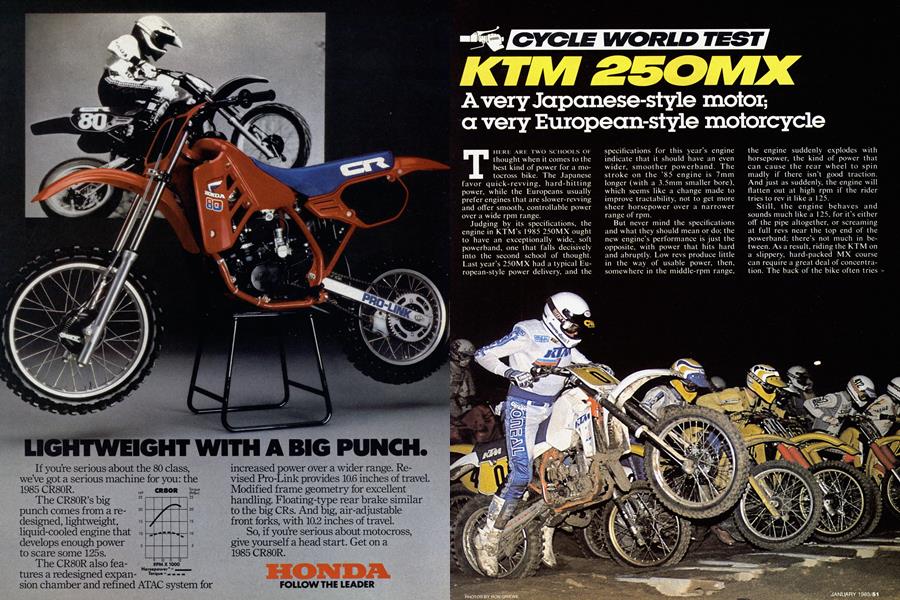
THERE ARE TWO SCHOOLS OF thought when it comes to the best kind of power for a motocross bike. The Japanese favor quick-revving, hard-hitting power, while the Europeans usually prefer engines that are slower-revving and offer smooth, controllable power over a wide rpm range.
Judging by its specifications, the engine in KTM’s 1985 250MX ought to have an exceptionally wide, soft powerband, one that falls decisively into the second school of thought. Last year’s 250MX had a typical European-style power delivery, and the specifications for this year’s engine indicate that it should have an even wider, smoother powerband. The stroke on the ’85 engine is 7mm longer (with a 3.5mm smaller bore), which seems like a change made to improve tractability, not to get more sheer horsepower over a narrower range of rpm.
But never mind the specifications and what they should mean or do; the new engine’s performance is just the opposite, with power that hits hard and abruptly. Low revs produce little in the way of usable power, then, somewhere in the middle-rpm range, the engine suddenly explodes with horsepower, the kind of power that can cause the rear wheel to spin madly if there isn’t good traction. And just as suddenly, the engine will flatten out at high rpm if the rider tries to rev it like a 1 25.
Still, the engine behaves and sounds much like a 125, for it’s either off the pipe altogether, or screaming at full revs near the top end of the powerband; there's not much in between. As a result, riding the KTM on a slippery, hard-packed MX course can require a great deal of concentration. The back of the bike often tries to pass the front if the rider grabs a handful of throttle while exiting any turns that are slick, choppy or don't offer excellent traction for any reason.
It’s fair to say, then, that the KTM’s power delivery is more Japanese in nature than European. Which is not to say that it’s necessarily a bad power delivery; but anyone accustomed to European motocross bikes— and KTMs in particular—will be caught a little off-guard the first time he swings a leg over a new 250MX. Those familiar with Japanese bikes, though, will feel more at home, although the KTM is even a little more abrupt, power-wise, than the average Oriental 250. But the 250MX is competitively fast around the track, abruptness or not.
Don’t think, however, that the lengthened stroke is responsible for the Japanese-type powerband. There are many other changes to the ’85 250MX engine, and most of them have affected the power delivery more than the stroke increase itself. For one thing, the longer stroke allows the ports to be taller (and thus larger in overall area) without changing the actual port timing. The exhaust pipe and silencer have different tuning for ’85, and the cylinder-bore surface is no longer cast-iron; instead, the bore in the aluminum cylinder assembly receives a Nikasil treatment (an extremely hard nickel-silicon-carbide coating electrochemically applied to the aluminum), resulting in better port alignment, improved heat-dissipation and a lighter cylinder. The new engine uses the same connecting rod as before, with the crankpin simply moved 3.5mm farther from the center of the crankshaft.
Other changes to the ’85 250cc engine benefit longevity. The area around the main bearings has been strengthened, the kickstarter gears are stronger, the water-pump cover material has been changed from plastic to aluminum, and the transmission has a larger-diameter breather vent.
The 250MX also received significant chassis refinements, including several in the White Power-built rear shock and front fork. The fork is the latest No. 4054 upside-down unit that was used last year only on the 495. It’s standard on all KTMs for '85, but with new spring and damping rates (see “White Power Fork,” pg. 54 ). in the rear, a piggyback-reservoir single shock with externally adjustable compression and rebound damping sits 1.5 inches lower in the frame and attaches to new lever arms that provide a flatter progression curve. The linkage pivots and the swingarm all work on needle bearings, and maintenance is simplified by grease fittings that are easily reached.
One of KTM’s top priorities for 1985 was to deliver the bikes with suspension rates geared for American > tracks; so for the first time ever, the prototyping was conducted in this country, not in Europe. Our ’84 250MXC test bike, for example, had suspension that worked well across rolling terrain but was brutal when landing from big, stadium-style jumps. But this time around, KTM has gotten the damping and springing rates a lot closer. Dialing-in the suspension required a lot of experimenting on numerous MX tracks, along with a couple of home remedies, but we eventually got things working.
Novice through Intermediate riders got the best results from the rear suspension with the compression and rebound adjusters both set on No. 3, and with 4 inches of rear-end sack (the difference between the distance from the rear axle to the seat with the bike on a stand, rear wheel fully extended, and the distance between the same two points with the rider on the bike, all riding gear on and both feet on the pegs). The front fork worked best when the oil level was raised 0.4inch from its stock measurement.
With a Pro motocrosser aboard (or a fast Intermediate), those suspension settings were a little too soft, allowing both ends to bottom. We cured the problem in the front by putting a lAinch-thick shim below each fork spring. In the rear, we replaced the stock 325-pound shock spring with a 365-pound spring (available from White Bros.), and turned both of the shock’s damping adjusters to their No. 4 positions.
Once the rear suspension is properly set-up, landings from stadiumtype jumps are smooth and controllable, smaller bumps and ripples are absorbed effectively, and the rear tire follows bumps nicely entering whooped turns. The front fork provides equal or better performance. Nothing flexes or wiggles, and the fork bottoms only if the rider lands too flat or slaps the front end down harshly after a rear-wheel landing.
Some other traits of the ’85 250MX aren’t as endearing. Although the bike has a 58.5-inch wheelbase, it feels much shorter. The rear wheel will kick to the side over jumps unless the rider takes care to hit the launch completely straight. The bike tends to be nose-heavy in the air, making front-wheel landings a common occurrence. And despite a steeper, 26.5-degree steering head angle (the ’84 250 had a 27-degree angle), the bike sometimes tries to climb up out of hard-packed berms. Sliding the fork tubes farther up into the triple-clamps—which is the normal way to improve that sort of steering behavior—simply made the problem worse. It was lowering the tubes 3/s-inch that proved the best solution. The front tire stopped climbing the berms and the bike even stayed straighter when leaving jumps.
KTM spokesmen claim that the upside-down fork is the same length, from steering head to axle, as the conventional Marzocchi fork used last year, so the change in steering geome-
try could be the cause of the ’85 250MX’s berm-climbing tendencies. A similar handling quirk is noticed when entering almost any bermed turn: Most modern MX bikes require only a momentary push on the handlebar to be pitched into the berm, but the KTM has to be deliberately steered through the turn.
There are no such quirks or surprises associated with the KTM’s brakes, however, thanks to a few improvements in the system. The front brake uses a roadrace-type floating disc, a dual-piston Brembo caliper mounted behind the fork leg, and a braided steel hose routed neatly to a Magura master cylinder. The lever requires a slightly harder pull than the disc brakes used on Japanese MX bikes; but the non-adjustable lever is easy to reach, and two fingers are all that are needed in most instances. The dual-leading-shoe rear brake itself is unchanged from '84, but even it works a little better this year due to a redesigned brake pedal. Still, rearbrake feel is not up to par with that of the Japanese motocross bikes, although it’s not quite as vague as it was on last year’s 250.
Another weak link carried over from the ’84 250MX is the chromeplated brass spoke nipples. The nipples are quite soft, making spoketightening a difficult (they round-off too easily) and never-ending (they stretch continuously) proposition. Replacing them with stainless-steel nipples solves the problem entirely.>
We also made a few modifications to our test bike in an attempt to smooth out the power delivery. Close inspection of the pipe revealed that the rear cone was nosed down quite a bit smaller than the l'/s-inch stinger that it leads into. A little work with a hacksaw blade and a screwdriver opened the end cone and aided the low-end power ever so slightly. A little filing on the cutaway of the carburetor slide leaned the part-throttle jetting a bit, and that, along with a change to dual-stage Boyesen reeds.
helped smooth the transition into the pow'erband.
Individually, none of these modifications make giant changes to the KTM's abrupt power; but combined, they lower the point where the power first hits, and smooth out the transition. That makes the 250MX easier to ride on slippery ground. For sandy or loamy tracks, though, the power that the bike makes right out of the shipping crate might be best.
Nonetheless, not many KTM owners will be taking their new 250MXs
straight out of the crate and winning races. Despite its Japanese-style powerband, the KTM still has some distinctively European traits: That is to say, it requires that its rider experiment, tinker and change things until it conforms to his personal ideals of what a motocrosser should be. The difference is that unlike its European counterparts of years past, the 1985 250MX has the potential of being not only the best non-Japanese 250, but among the best 250cc motocross bikes made on any continent. E9
KTM
250MX
$2997
SPECIFICATIONS